





It is the legal responsibility of employers to make the workplace safe for their employees. However, mishaps can occur even at a safe location and when every safest measure has been taken care of. For instance, a few months ago, an operator of a tower crane lost his life and three workers got injured when the crane broke down, and its heavy parts fell at a construction site in Hinjewadi, Pune.
Key Takeaways
-
The “No-Fault” Exchange: This policy is a bargain; workers get guaranteed compensation for time lost and medical care without proving employer negligence, and in return, they generally give up the right to sue the business.
-
Statutory Depth: A valid policy doesn’t just cover the 1923 Act; it also protects the employer against liabilities arising under the Indian Fatal Accidents Act, 1855 and Common Law.
-
The Course of Employment: For a claim to be valid, the accident must happen “out of and in the course of employment.” This means there must be a clear link between the work being done and the injury sustained.
-
Harsher Penalties: Following the 2016 Amendment, the penalty for contravening the Act has jumped from a mere ₹5,000 to a range of ₹50,000 to ₹1 lakh, making compliance more critical than ever.
-
Higher Appeal Thresholds: The amount required to appeal a compensation dispute in High Court has been raised from ₹300 to ₹10,000, filtering out minor disputes and focusing on significant cases.
-
Rehabilitation Focus: Beyond immediate payouts, the policy is designed to support rehabilitation services, helping injured workers recover and potentially return to the workforce.
Read More: Who Should Buy Workers Compensation Policy?
In the case of accidents, employers are legally responsible for paying the compensation, which in certain cases could be a hefty amount.
Therefore, to safeguard employers from lawsuits resulting from workplace accidents and to give complete medical care and compensation for lost income to employees, it is necessary to buy a workmen compensation insurance policy.
Purpose of a Worker’s Compensation Insurance Policy.
Offering legal liability coverage to employees, a worker’s compensation insurance plan covers both work-related accidents and illnesses. This ‘no fault’ insurance policy rewards injured workers and their families. Even, safeguards policyholders from potentially big suits, filed by the injured employee or their family in case of any mishap. The compensation is payable as per the scheme detailed in the Workmen’s Compensation Act of India. Monitored by the Ministry of Labour. Its name has been changed to the Employees’ Compensation Act, 1923.
A workmen’s compensation insurance plan is useful as it gives payments to injured workers. Without regard to whose fault was it, for time lost from work and various medical and rehabilitation services. Insurance is useful as it also gives various benefits to surviving spouses and dependents.
Relevant Statutes and Laws which fall under the Workmen’s Compensation Act of India
This insurance policy covers the legal liability of any employer as per the following –
- Workmen’s Compensation Act, 1923 and subsequent amendments to the Act before the date of the policy issuance
- Indian Fatal Accidents Act, 1855 and subsequent amendments to the action prior to the date of the policy issuance
- Common-Law
Usually, having this insurance cover means that employees give up their rights to sue your business for negligence. In return, they also get complete peace of mind knowing that they will get the necessary compensation amount without going through the intricacies of the law.
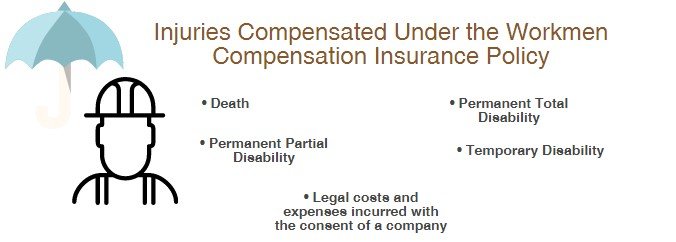
While a workers’ compensation policy offers the basic cover, you can extend it with the following coverages:
- Actual medical, surgical, and hospital expenditures incurred along with the cost of transporting to the hospital for treating the accidental work injuries
- Occupational ailments, mentioned in Part ‘C’ of Schedule III of the Workmen’s Compensation Act, 1923
Note, an employee is liable to get compensation only if the accident happened out of or in the course of employment. It means, the accident should occur when the employee is in employment and linked to employment.
Summary Table: Legal Framework and Policy Purpose
| Feature | Description | Business Impact |
| Legal Basis | EC Act 1923, Fatal Accidents Act 1855, and Common Law. | Compliance: Meets all statutory requirements for worker safety. |
| “No-Fault” Principle | Compensation is paid regardless of who caused the accident. | Speed: Provides immediate relief without lengthy fault-finding. |
| Liability Shield | Employees typically waive the right to sue for negligence. | Legal Protection: Safeguards the business from expensive civil suits. |
| Medical Extensions | Covers surgery, hospital bills, and ambulance transport. | Comprehensive Care: Reduces out-of-pocket costs for emergencies. |
| 2016 Amendment | Increased appeal limits (₹10k) and penalties (up to ₹1L). | Regulated: Higher stakes for non-compliance with the Act. |
| Occupational Illness | Covers diseases listed in Schedule III, Part C. | Health Shield: Protects against claims for long-term work-related ailments. |
See: What is covered under Workmen Compensation Insurance Policy?
In 2016, the Lok Sabha passed the Employee’s Compensation (Amendment) Bill. Which increased the cap on the compensation amount the high courts take. Section 30 of the Employees’ Compensation Act, 1923, allows an appeal in high courts. Whenever the disputed amount of compensation increases to Rs 300. Now, the bill has increased this limit to Rs 10,000. Further, the bill has also made the provision of an increase in the penalty for contravention of the Act from Rs 5,000 to Rs 50,000. Which may raise to Rs 1 lakh.
So, reiterating what we said above, “Yes, you need a workmen compensation insurance policy. In order, to save you and your business from hefty claims that may arise in the case of injury caused by your worker”.
Frequently Asked Questions (FAQs)
1. What does “No-Fault” insurance mean in a workplace context?
A) It means that an injured worker is entitled to compensation even if their own mistake caused the accident. As long as the injury happened during work and wasn’t due to specific exclusions (like intoxication), the insurance pays out without the need to prove the employer was “negligent.”
2. Can an employee still sue my company if I have this insurance?
A) Generally, by accepting the guaranteed benefits of a Workmen’s Compensation policy, employees waive their right to sue the employer for negligence. This provides “peace of mind” for the business owner against unpredictable and massive court awards.
3. Does the policy cover the cost of the ambulance that took the worker to the hospital?
A) Yes, but often as an extension. While the basic policy covers the statutory compensation, you can add a cover for “Actual medical, surgical, and hospital expenditures,” which specifically includes the cost of transporting the injured worker to a medical facility.
4. What is the “1923 Act” versus the “Employees’ Compensation Act”?
A) They are the same. The original “Workmen’s Compensation Act, 1923” was renamed the “Employees’ Compensation Act” to reflect a more modern and inclusive definition of the workforce, though the core legal principles remain the same.
5. What happens if I am found to be in “contravention” of the Act?
A) Following the 2016 Amendment, the penalties have increased significantly. If you fail to follow the rules laid out in the Act (such as failing to report an accident or pay compensation), you could face fines between ₹50,000 and ₹1,00,000.
About The Author
Rahul Kumar
MBA Finance
With a wealth of experience in the insurance industry, Rahul is a seasoned writer specializing in articles related to workmen compensation policies (WC policies) for SecureNow. With 12 years of experience in the field, he has acquired in-depth knowledge and expertise in workmen compensation insurance, understanding its complexities and nuances. Their insightful articles provide valuable insights into the importance of WC policies for businesses and employees alike, offering practical advice and guidance on navigating the intricacies of insurance coverage. Trust him to deliver informative and engaging content, backed by years of experience and a passion for educating readers about insurance-related topics.