

Introduction
Group Personal Accident (GPA) insurance is an employer-arranged policy that pays specified benefits if a covered employee suffers accidental death or disability. For employers, GPA Insurance supports employee welfare, retention, and a stronger benefits package, and replaces ad hoc payouts with a planned benefit. For employees, it can provide financial support to them or their families after a covered accident. What it actually pays depends on the policy wording, benefit schedule, sum insured, and exclusions, so both sides should understand the terms.
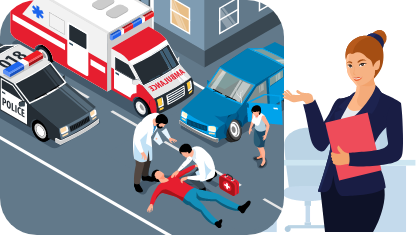
A fractured leg can keep an employee at home for weeks. Similarly, a serious road accident can end someone’s ability to work in their trade. Either way, the household faces the same questions: who pays the bills while the person recovers, and what happens to the family if the worst occurs?
Group Personal Accident insurance is one way employers help answer those questions. It is an accident insurance benefit arranged for a group of employees, paying specified amounts after covered accidental death or disability, subject to the policy terms.
This guide explains the benefits for employers and employees, which workforces gain the most, how GPA differs from health, life and employees’ compensation cover, and what to check before buying.
What Is Group Personal Accident Insurance?
Group Personal Accident insurance is a single policy that an employer or other eligible organisation arranges for a defined group of people, paying specified benefits if an insured member suffers covered accidental death or disability. You will also see it called GPA, group accident insurance, or group personal accident insurance.
The organisation is the policyholder and usually pays the premium. Meanwhile, employees who meet the eligibility rules are the insured persons. In addition, benefits usually depend on a sum insured for each member, which may be a flat amount or linked to salary, depending on the policy.
GPA is not health insurance and not life insurance. For example, Group Health Insurance pays for hospital treatment for illness as well as accidents. Similarly, Group Term Life pays on death from almost any cause. In contrast, GPA responds only to accidents, and only to the outcomes its policy covers.
Benefits, eligible members, insured events, geographical scope, exclusions and limits all depend on the particular policy. For a full explanation, see what is Group Personal Accident Insurance.
| Feature | Group Personal Accident Insurance | Individual Personal Accident Insurance |
|---|---|---|
| Typical policy arrangement | One policy covering a defined group | One policy for a person and, where offered, their family |
| Who arranges the policy | The employer or sponsoring organisation | The individual |
| Who can be covered | Eligible members of the group, as the policy defines | The individual and family members the policy allows |
| Benefit structure | Set by the organisation, often by grade or salary | Chosen by the individual, subject to underwriting |
| Important considerations | Cover usually ends when the person leaves the group | Continues while premiums are paid; the individual bears the cost |
Why Is Group Personal Accident Insurance Important?
Accidents can stop people earning and add costs at the same time. A badly injured employee may lose income for weeks or permanently, while the family still has rent, loans, and school fees to pay. If the employee dies, the family may lose its main source of income.
The importance of group personal accident plan cover lies in what it can do in those moments. Where a covered accident causes death or a disability the policy recognises, GPA can pay a defined amount that helps the family manage. However, it does not cover every accident or every cost, and the payment depends on the benefit schedule.
For employers, the importance is practical too. Without a policy, companies often face pressure to help injured staff from their own funds, case by case and unbudgeted. In contrast, a GPA policy turns that into a planned benefit with a known cost.
Benefits of Group Personal Accident Insurance for Employers
1. Demonstrates Duty of Care and Employee Welfare
Above all, offering accident protection shows employees that the organisation thinks about their welfare beyond salary. It fits naturally into a wider welfare approach that includes safety practices, health cover and support after incidents.
GPA is a voluntary benefit. It does not by itself meet an employer’s legal obligations, such as liability for employment injury under the Code on Social Security, 2020, or any contractual commitments. Those need a separate assessment.
2. Supports Employee Retention and Engagement
In general, employees tend to value benefits that protect their families. In particular, a clearly communicated GPA policy can help people feel the organisation has their back, which may support engagement and retention.
This is a potential benefit, not a guaranteed result. After all, retention depends on many factors, and insurance is only one part of the picture.
3. Provides a Financial Protection Benefit for the Workforce
When a covered accident happens, the policy, not the employer’s cash, provides the specified benefit to the employee or their beneficiary. In other words, it replaces ad hoc, discretionary payouts with a planned arrangement.
This is a benefit arranged for the workforce. It does not protect the employer against its own legal liabilities, which other policies, such as workmen compensation insurance, address.
4. Supports Recruitment and Employee Value Proposition
Notably, candidates compare benefits as well as pay. Accident cover can strengthen the overall package, particularly for roles involving travel, field work or physical tasks, where candidates may see the risk more clearly.
5. Helps Create a More Comprehensive Employee Benefits Package
GPA complements other group covers rather than duplicating them. Group Health Insurance pays for treatment, while Group Term Life Insurance pays on death. GPA adds disability benefits that neither typically provides, and an additional benefit when death is accidental.
6. Can Be Structured for Eligible Groups
Employers can often design cover around their workforce – for example, different sums insured by grade, or a salary-multiple structure – subject to insurer underwriting, eligibility rules and policy terms. Additionally, employers can usually add and remove members during the year as people join and leave. However, not every insurer offers the same flexibility, and employees need not all receive identical benefits.
7. Supports Employee Confidence in the Organisation’s Welfare Approach
A benefit only helps if people know about it. Employers that explain what the policy covers, share the policy summary, and tell employees how to claim help make sure employees use the cover when they need it – the lesson of the Mr. Verma scenario later in this guide.
| Employer benefit | Practical value | Important qualification |
|---|---|---|
| Employee welfare | Shows care for employees and their families | Voluntary; does not meet statutory obligations by itself |
| Retention and engagement | May help employees feel valued | Not a guaranteed effect |
| Workforce financial protection | Planned benefit replaces ad hoc payouts | Benefits depend on the policy; not cover for employer liability |
| Recruitment support | Strengthens the benefits package | Value depends on how it is communicated |
| Complementary employee benefits | Fills gaps left by health and life cover | Does not replace either |
| Workforce-specific planning | Cover can vary by grade or salary | Subject to insurer underwriting and terms |
Benefits of Group Personal Accident Insurance for Employees
For many staff, this is personal accident insurance employees receive through work without having to arrange it themselves. The Group Personal Accident benefits below are common, but each one applies only if the policy includes it and the claim meets its conditions.
1. Financial Support Following a Covered Accidental Death
If an insured employee dies as a result of a covered accident, the policy may pay a defined benefit, often the sum insured, to the nominee or other eligible recipient. However, the death must meet the policy’s definition, and exclusions apply. In contrast, deaths from illness are generally outside GPA’s scope.
2. Benefits for Permanent Total Disability
Permanent total disability generally means a permanent disability that meets the policy’s definition of total disability – for example, a specified loss of limbs or sight. The definition, any assessment period, and the benefit amount are set out in the policy and benefit schedule.
3. Benefits for Permanent Partial Disability
A covered permanent partial disability, such as the permanent loss of a finger, may lead to a benefit calculated as a percentage of the sum insured. Specifically, the percentage comes from the policy’s disability table, which varies between insurers.
4. Benefits for Temporary Total Disability
Some policies offer a temporary total disability benefit, usually a weekly payment while an accident keeps the employee from working, for up to a maximum period. However, not every GPA policy includes it, and waiting periods and limits vary.
SecureNow explains each disability class in more detail in types of disabilities covered under a GPA plan.
5. Potential Support During Recovery
Where the policy includes the relevant benefit, GPA payments can reduce financial pressure while an employee recovers. Some policies also include accident medical expenses or other add-ons, usually within limits; see the limit of coverage for medical expenses under GPA plans. However, GPA is not a substitute for health insurance and does not automatically pay hospital bills or lost income.
6. Potential Protection for Employees’ Families
For single-earner households in particular, a death or disability benefit can help the family meet commitments while it adjusts. Some policies add family-focused benefits, such as education allowances for children, as add-ons; see additional benefits available in GPA insurance.
7. Access to Employer-Arranged Coverage
Employees who meet the eligibility rules get cover without having to find, buy, or manage a policy themselves, and often without medical tests. They should still check their eligibility, the sum insured, exclusions, how to claim, and whether cover continues if they leave.
| Employee situation | Potential benefit | What to check in the policy |
|---|---|---|
| Covered accidental death | Lump sum to the nominee or eligible recipient | Definition, sum insured, exclusions, nominee details |
| Permanent total disability | Lump sum, a percentage of the sum insured | Definition, assessment period, benefit percentage |
| Permanent partial disability | Percentage of the sum insured from the disability table | The disability table |
| Temporary total disability | Weekly benefit, where included | Whether included; waiting period, amount, maximum weeks |
| Recovery following an accident | Add-on medical expenses, where included | Whether included; limits |
| Change or end of employment | Cover usually ends on leaving | When cover stops; individual alternatives |
Which Workforces Gain the Most from Group Personal Accident Insurance?
Of course, every workforce faces some accident risk, including on the daily commute. But some roles carry more exposure, and insurers usually classify group accident employees by occupation risk when pricing cover. However, whether the policy covers accidents outside work hours depends on its wording.
| Workforce category | Why accident protection may matter | Coverage considerations |
|---|---|---|
| Field sales and travelling staff | Extensive road travel | Territory, travel and hours of cover |
| Delivery and logistics | Time on the road, often on two-wheelers | Occupation class; any vehicle-related exclusions |
| Manufacturing and factory staff | Machinery and physical tasks | Occupation class; interaction with employee’s compensation cover |
| Construction and infrastructure | Heights, heavy equipment, site hazards | Insurer acceptance; hazardous-occupation terms |
| Warehouse and maintenance staff | Lifting, equipment and repair work | Occupation class; TTD benefit |
| Office employees | Commuting and everyday accidents | Whether cover applies outside work hours |
| SMEs and startups | Building a benefits package on a budget | Minimum group size; benefit design |
Ultimately, the right cover depends on the nature of the work, actual exposure, eligibility, insurer underwriting and the policy wording. Also, the policy does not automatically cover every workplace accident.
Group Personal Accident Insurance vs Other Employee Insurance Benefits
These cover different risks. However, GPA does not replace any of them.
| Feature | Group Personal Accident Insurance | Group Health Insurance | Group Term Life Insurance | Workers’ Compensation |
|---|---|---|---|---|
| Primary purpose | Specified benefits for accidental death or disability | Medical and hospitalisation costs | Life cover | Cover for the employer’s legal liability for employment injury |
| Main event or need addressed | Covered accidents | Illness or injury needing treatment | Death during the policy period | Injury or specified disease arising out of and in the course of employment |
| Typical benefit structure | Fixed benefit or percentage of sum insured | Reimbursement or cashless treatment, up to the sum insured | Sum assured | Compensation as determined under the law |
| Main beneficiaries | Employee or nominee | Employee and covered dependants | Nominee | Employee or dependants, through the employer’s liability |
| Important limitations | Accidents only; definitions and exclusions apply | Sublimits, waiting periods, exclusions | Exclusions apply | Limited to legal liability for employment injury |
In India, employee’s compensation is now governed by Chapter VII of the Code on Social Security, 2020, which replaced the Employee’s Compensation Act, 1923 and came largely into force on 21 November 2025. Meanwhile, establishments covered by ESI generally handle employment injury through ESI. GPA is a separate benefit and does not automatically meet these obligations, so employers should assess them separately.
Worked Scenario: Lessons from the “Mr. Verma” Article
SecureNow’s article, Don’t be like Mr. Verma tells a short story about an employee who had GPA cover and didn’t know what it offered.
Who he is. Suresh Verma, 35, an IT professional who had worked at a multinational company in Delhi for six years. He knew part of his salary went towards group personal accident insurance each month, but he had never found out what the policy covered.
What happened. On his way to the office one morning, his motorcycle collided with a truck coming from the opposite direction. As a result, he fractured his right hand and spent nearly two months at home recovering. Then he used all his savings to pay his medical and household expenses.
Why the Benefit Went Unused
The issue. When he returned to work, a colleague asked why he hadn’t used the company’s group personal accident cover. He had held cover all along but had never understood the benefit. However, the original article does not say whether he filed a claim, which benefits his policy included, or what it would have paid.
How better understanding could have helped. Had Mr. Verma known his policy, he could have checked straight away whether it included benefits relevant to his situation – for example, temporary total disability or accident medical expenses, if his policy offered them – and asked HR to help him notify the insurer in time. This paragraph is explanatory; it does not describe what his actual policy covered.
What employers can learn. After all, a benefit employees don’t understand delivers little value. For example, employers can share a plain-language summary at joining and renewal, explain how to claim, and make policy documents easy to find.
Key lesson: Buying GPA is only half the job. Employees need to know what their policy covers and how to claim – otherwise, like Mr. Verma, they may pay costs themselves that their cover could have helped with.
Video: Why Do You Need Group Personal Accident Insurance?
In this short SecureNow video, our team uses a real-life case to explain why a group accident policy matters and what it can offer employers and employees.
What Does Group Personal Accident Insurance Cover-and What Should Employers Check?
The core benefits are accidental death, permanent total disability, permanent partial disability, and, where included, temporary total disability. Many policies add optional benefits. For a full list, see what is covered under Group Personal Accident Insurance.
Before buying, check:
- Definition of a covered accident – what counts and what doesn’t
- Benefit schedule and sum insured – amounts and percentages for each benefit
- Disability assessment requirements – how and when disability is certified as permanent
- Exclusions and limitations – these vary by insurer and product; see what is not covered under GPA insurance
- Eligibility – which employee categories are covered
- Territorial scope – India only or worldwide; on-duty or 24 hours
- Optional benefits – medical expenses, education allowance and others
- Nomination details – kept current for every member
- Claims process – notification, documents and timelines; see how a GPA claim is processed
- Leaving the organisation – when cover ends
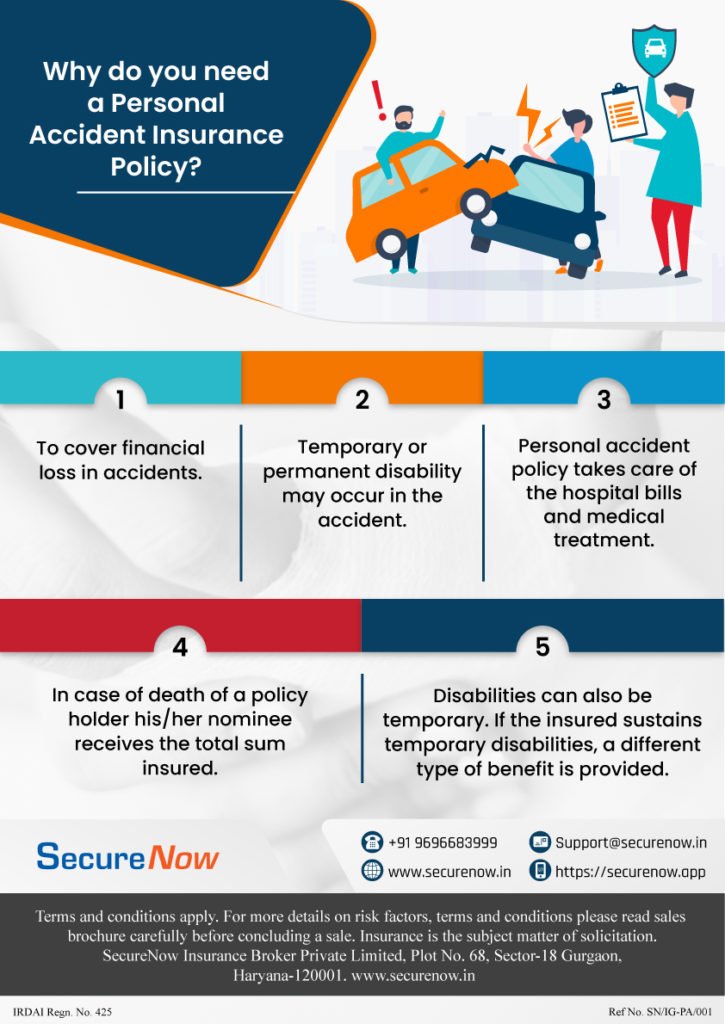
Infographic: Importance of a Personal Accident Policy
How Employers Can Choose Suitable Group Personal Accident Insurance
- Count and categorise employees to be insured.
- Assess the nature of duties and accident exposure.
- Decide the sum insured and structure – flat or salary-linked.
- Choose the disability benefits – PTD, PPD and whether to include TTD.
- Select relevant optional benefits – medical expenses, education allowance and others.
- Read the definitions, exclusions, waiting periods and limitations, where applicable.
- Check affordability and the insurer’s underwriting requirements.
- Understand the claims process and required documents.
- Plan employee communication and access to policy documents.
- Review the policy periodically as the workforce changes.
However, the lowest premium is not necessarily the best option. Instead, compare coverage, exclusions, benefit schedules, service and claim requirements, not just price.
Conclusion
Group Personal Accident insurance gives employers a planned, affordable way to support employees after serious accidents, and gives employees and their families financial support they might not otherwise have. Ultimately, its value depends on the details: the benefits included, the sum insured, the exclusions and how well employees understand the cover.
Use GPA alongside health, life and employees’ compensation cover rather than instead of them, and make sure your people know what they have.
Looking to provide accident protection to your workforce? Explore Group Personal Accident Insurance options with SecureNow and compare suitable cover based on your employees’ needs, benefit requirements, and budget.
This article is general information. Coverage depends on the specific policy wording. Insurance is the subject matter of solicitation.
Frequently Asked Questions
Q) What is Group Personal Accident Insurance?
A) Group Personal Accident Insurance is a policy an employer arranges for eligible employees that pays specified benefits after covered accidental death or disability. Benefits, eligibility and exclusions depend on the policy wording.
Q) What are the main benefits of Group Personal Accident Insurance for employers?
A) It supports employee welfare, may help retention and recruitment, rounds out the benefits package, and replaces ad hoc payouts to injured staff with a planned benefit. However, it does not cover the employer’s own legal liabilities.
Q) How does GPA Insurance benefit employees?
A) It may pay a lump sum to the family after covered accidental death, and benefits for permanent or temporary disability, depending on the policy. In short, employees get this cover through work without arranging it themselves.
Q) Why do employees need a personal accident policy if they have health insurance?
A) Health insurance pays for treatment, but it does not usually pay a lump sum for accidental death or disability. Employees need a personal accident policy, whether group or individual, to address that income and family-security gap.
Q) Should you offer Personal Accident cover to your Employees?
A) Many employers do, especially where staff travel, work on the road or do physical work. Whether to offer it depends on your workforce, budget and existing benefits; it is generally a voluntary benefit.
Q) Does Group Personal Accident Insurance cover accidents outside the workplace?
A) Many GPA policies cover accidents 24 hours a day, including outside work, but some limit cover to working hours or specific locations. Check the policy’s territorial and time scope.
Q) Does GPA Insurance cover medical expenses?
A) Not automatically. Some policies include accident medical expenses as a benefit or add-on, usually within a limit. However, GPA is not a substitute for health insurance.
Q) Is Group Personal Accident Insurance mandatory for employers in India?
A) GPA is generally a voluntary employee benefit, though a client contract or tender may require it. However, employers do have separate legal liability for employment injury under the Code on Social Security, 2020, which GPA does not automatically meet.
Q) What happens to coverage when an employee leaves the organisation?
A) Cover under your Group Personal Accident policy usually ends when the employee leaves the group, subject to the policy terms. Therefore, employees who want continued protection may consider individual personal accident insurance.
Q) How is the sum insured decided under a group accident policy?
A) The employer chooses it, subject to the insurer’s acceptance. For example, it is commonly a flat amount for everyone or each grade, or a multiple of each employee’s salary.
Q) What documents may be needed to make a claim?
A) Requirements vary, but commonly include a claim form, medical records and certificates, and for some claims a police report (FIR) and post-mortem report. Finally, the policy lists the documents for each claim type.
Q) How can an employer obtain a quote for Group Personal Accident Insurance?
A) Share your headcount, employee categories, occupations and preferred benefits with an insurer or broker. Then you can request and compare GPA quotes through SecureNow’s Group Personal Accident Insurance page.