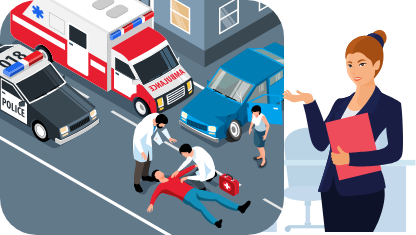


There are different types of disabilities that are covered under a Group personal accident insurance. The disabilities caused by accidents are classified under the following three sections for determining compensation:
- Permanent Total Disablement (PTD)
- Permanent Partial Disablement (PPD)
- Temporary Total Disablement (TTD)
Key Takeaways
-
The 365-Day Threshold: For a severe disability to be legally classified as permanent under corporate accident insurance, the functional impairment must persist continuously for more than 365 days without medical recourse.
-
Capital Protection via PTD: Permanent Total Disablement triggers a full lump-sum payout, designed to serve as an alternate wealth corpus to clear outstanding debts, manage routine household expenses, and settle major EMIs when an employee can never work again.
-
Proportional PPD Adjustments: Permanent Partial Disablement handles localized, irreversible structural losses. Insurers assess the exact percentage of the sum insured relative to the specific body part lost, facilitating a transition to alternative employment.
-
TTD Cash Flow Continuity: Temporary Total Disablement relies on weekly compensation installments rather than a lump sum. This mechanism acts as a direct substitute for a regular salary, keeping the household running while the employee undergoes rehabilitative treatment.
-
Salary-Linked Underwriting: Across all disability categories, insurers require an official salary certificate or recent salary slips to calculate the maximum permissible weekly or lump-sum compensation thresholds, preventing over-insurance.
-
Dual Financial Cushioning: Comprehensive group personal accident plans simultaneously cover immediate emergency hospitalization/medical expenses while independently executing the contractual disability payout.
Permanent total disablement refers to permanent loss of functionality. For example, if there is loss of both the legs and the arms or there is blindness in both eyes. A disability becomes permanent only when it lasts for more than 365 days. A disability may include loss of arms or feet, loss of eyesight, or hearing without recourse.
Permanent Partial Disablement refers to the partial loss of functionality without the chance of recovery or treatment. For example, if one leg or eye is damaged and cannot be repaired within 1 year. In this case, the insurer pays a weekly benefit instead of a one-time lump-sum amount.
Read More: What is group personal accident insurance?
The insurer may apply a limit on the maximum period for which the insurer will receive the benefit. This limit depends on the percentage of the sum insured (S.I.) payable with each installment. The insurer will pay only up to the maximum S.I. under the plan. The examples below illustrate different types of disabilities covered under a Group Personal Accident Plan.
Group Personal Accident Plan: Case 1
As a senior accountant, Radha Sharma was working at K.J. Jewellers for the last ten years. When her retirement was a few years away, destiny played its game.
One day, when she was coming back from the office, her car collided with a truck coming from the other side. The impact of the collision was so severe that the truck driver died on the spot and Radha suffered grave injuries. Some passersby took her to a hospital where doctors operated on her immediately. To save her life, the doctors amputated her right hand and both legs.
The group personal accident insurance policy offered by K.J. Jewellers covered all her medical expenses. As she became permanently totally disabled, the insurer along with covering the medical expenses paid a lump-sum amount (on the basis of her salary). This helped her to deal with the loss of income. As she also lost her earning ability, the lump sum amount helped in dealing with costs such as expenses and EMI’s.
Case 2
It was the fateful day December in 2015 when Ram Sharan’s hand gloves were caught in the machine while working in the clothing mill in Gujarat. His co-workers took him to a hospital, where the doctors had to cut a portion of his right thumb. It was severely damaged in the accident.
Doctors kept him under observation and discharged him after a week.
Ram Saran’s employer had covered him in a group personal accident insurance policy. Considering the case as a permanent partial disability, the insurer agreed to cover medical expenses and also paid a lump sum amount to Ram as per his salary. His partial disability was permanent which affected his earning capacity, and he had to find a new job as per his current state.
The insurer’s lump sum amount provided much-needed relief to the family.
Case 3
Vijay Saran was traveling to Pune on an official trip when his car brakes failed and hit a stationary mini truck. As Vijay’s car had airbags, they opened as soon as the car hit the truck. Thankfully, these airbags saved his life, however, he sustained some injuries. The passersby took him to a nearby hospital.
Read More: How the claim is processed under group personal accident insurance?
Though doctors declared him out of danger, he was in shock and lost sensation in both his hands and feet. As per the doctors attending him, “Due to the accident, Vijay is in shock because of which, some of his body parts are not moving fully. His condition will improve with time and eventually he will start working normally as he would have before the accident.”
Summary Table: Disability Classifications & Compensation Mechanics
| Disability Category | Medical Status & Criteria | Payout Mechanism | Impact on Earning Capacity | Case Example |
| Permanent Total Disablement (PTD) | Irreversible total loss of function (e.g., loss of multiple limbs, total blindness) lasting more than 365 days. | One-time Lump-Sum payment based on salary and sum insured. | Complete and permanent destruction of earning ability. | Amputation of right hand and both legs following a severe collision. |
| Permanent Partial Disablement (PPD) | Irreversible localized loss of function (e.g., loss of a single thumb, toe, or eye) with no chance of recovery. | Lump-Sum or Scaled Benefit based on the specific percentage of impairment. | Partial reduction in earning capacity necessitates job adaptation. | Traumatic amputation of a portion of the right thumb in factory machinery. |
| Temporary Total Disablement (TTD) | Complete temporary immobility or loss of function (e.g., severe shock, fractures) with full recovery expected. | Continuous Weekly Cash Benefits for a fixed duration (e.g., 6 months). | Temporary suspension of earning ability during medical recovery. | Temporary paralysis/loss of sensation in limbs due to accident shock. |
In this case, Vijay’s employer was covering him under a group personal accident insurance policy. In this case, Vijay’s employer was covering him under a group personal accident insurance policy. Since his disability was temporary, the insurer paid weekly benefits instead of a lump-sum amount. The weekly benefit was on the basis of the sum insured for six months. The insurer asked for his salary certificate to decide the amount to be paid to Vijay as weekly compensation.
Frequently Asked Questions (FAQs)
1. What is permanent total disablement in group personal accident insurance?
A) Permanent total disablement (PTD) is a classification used when an accidental injury causes a complete and irreversible loss of an employee’s physical functionality or earning capacity that lasts for more than 365 days. Standard medical examples include the loss of both legs, both arms, or total blindness in both eyes. PTD claims are settled through a comprehensive, one-time lump-sum payout.
2. How is permanent partial disablement calculated under a group accident policy?
A) Permanent partial disablement (PPD) applies when an accident results in a lifelong, partial loss of a specific body part or faculty, such as losing a thumb, a finger, or the hearing in one ear. The insurance company assesses the disability percentage according to a standard medical schedule and pays a proportional lump-sum or structured benefit linked to the employee’s salary and total sum insured.
3. What is the temporary total disablement weekly benefit compensation?
A) Temporary total disablement (TTD) occurs when an accidental injury renders an employee completely unable to perform their job duties for a limited timeframe, but a full recovery is medically expected. Instead of a lump sum, the insurer provides a weekly cash benefit based on a percentage of the sum insured or salary to maintain household cash flow during the recovery period.
4. What documents are required to claim temporary total disablement benefits?
A) To secure weekly TTD compensation, the insured must submit a completed claim form, an official medical certificate confirming the temporary loss of mobility or function, a comprehensive treatment plan from the attending medical officer, recent salary slips, and an employer-issued salary certificate to validate the weekly payout limit.
5. Can an employee claim disability benefits if they return to work with minor injuries?
A) No, if an employee is capable of performing their regular corporate duties, a Temporary Total Disablement (TTD) claim cannot be triggered, as the policy requires a total temporary suspension of working ability. However, if the injury resulted in an irreversible, localized impairment (like losing the tip of a finger), they may still qualify for a Permanent Partial Disablement (PPD) payout even while remaining fully employed.
6. Does group personal accident insurance pay for medical expenses during disability recovery?
A) Yes, provided the employer’s master policy features a specific medical expenses extension rider. While the primary purpose of a personal accident policy is to provide structured disability compensation or death benefits, the medical extension ensures that hospital surgery bills, doctor consultations, and operating costs are reimbursed during the crisis.
Written By-
Gunjan Saxena
MBA Insurance Management
With a robust background in the insurance industry, Gunjan is a seasoned professional who brings 10 years of expertise to group personal accident insurance. Throughout her career, she has demonstrated a deep understanding of the intricacies and nuances of insurance products, particularly in personal accident coverage. Having worked closely with both individuals and businesses, she has gained valuable insights into the diverse needs and challenges faced by clients seeking insurance protection. Her experience encompasses designing tailored insurance solutions, providing expert advice, and guiding clients through the insurance process with confidence and clarity.
Through her articles, Gunjan aims to educate and inform readers about the importance of group personal accident insurance and the benefits it offers in safeguarding against unforeseen events.