

Introduction
Group Personal Accident (GPA) insurance is an employer-arranged policy that pays specified benefits when an insured employee suffers a covered accident. The core covers are usually accidental death, Permanent Total Disability (PTD) and Permanent Partial Disability (PPD), and many policies also include Temporary Total Disability (TTD) and other benefits. The actual payout depends on the policy’s definitions, sum insured, benefit schedule, exclusions, and optional extensions. Employers should also check whether cover applies 24 hours a day or only while employees are on duty.
Two GPA policies can share the same name and still pay very differently. One may cover employees around the clock, worldwide, with weekly disability payments and accident medical expenses. By contrast, another may cover only working hours, with death and permanent disability benefits alone.
That is why the coverage question matters more than the product label. This guide explains what GPA insurance covers, what each benefit means, how the AD&D terminology used by global HR teams relates to it, what “liabilities” a GPA scheme does and doesn’t address, and what employers should check before buying.
What Is Group Personal Accident Insurance?
Group Personal Accident insurance is a single policy an employer arranges for a defined group of eligible employees, paying specified benefits if an insured person suffers accidental death or disability covered by the policy. The employer is the master policyholder and usually pays the premium; eligible employees are the insured persons.
GPA pays defined benefits – often a percentage of each person’s sum insured – when a covered outcome occurs. It does not aim to reimburse every medical bill or every financial loss after an accident. Some policies add medical expense cover as an extension; however, many don’t include it by default.
GPA also differs from other group covers:
- Group Health Insurance pays for hospital treatment for illness as well as injury.
- Group Term Life Insurance pays on death from almost any cause during the policy period.
- GPA responds only to accidents, and only to the outcomes its wording covers – including disability, which the other two generally don’t address.
Benefits, eligibility rules and terms differ by insurer and product. For an overview of the product, see what is Group Personal Accident Insurance.
The Important Features of Group Personal Accident Insurance
The important features of Group Personal Accident insurance fall into three groups: the core benefits, the way the cover is structured, and the conditions that limit it. However, not every policy includes every feature listed here.
- Accidental death benefit – a specified amount after covered accidental death
- Permanent Total Disability (PTD) – a benefit for qualifying permanent total disability
- Permanent Partial Disability (PPD) – a percentage of the sum insured, by disability schedule
- Temporary Total Disability (TTD) – a periodic benefit, where included
- Sum insured and benefit schedule – the base amount and how the insurer calculates each benefit
- Eligibility – which employee categories the policy covers
- Optional benefits – extensions such as medical expenses, available for extra premium in some policies
- Exclusions and limitations – events and activities not covered
- Claim requirements – notification time limits and documents
- Coverage scope – 24 hours or on duty only; worldwide or limited territory
Feature Summary Table
| Policy feature | What it generally means | What employers should verify |
|---|---|---|
| Accidental death | Specified benefit if a covered accident causes death | Definition, sum insured, nominee details |
| Permanent Total Disability (PTD) | Benefit for permanent disability meeting the total-disability definition | Definition, assessment requirements, percentage |
| Permanent Partial Disability (PPD) | Percentage of sum insured for qualifying partial loss | The disability schedule and percentages |
| Temporary Total Disability (TTD) | Periodic benefit while temporarily unable to work | Whether included; amount, waiting period, maximum duration |
| Sum insured | Base amount for calculating benefits | Flat or salary-linked; any caps |
| Optional benefits | Extensions beyond core cover | What the policy includes vs what costs extra |
| Coverage scope | When and where the policy covers accidents | 24×7 or on duty; territory |
| Exclusions and limitations | Events and activities outside cover | Exclusion list, definitions, conditions |
Core Covers Under Group Personal Accident Insurance
1. Accidental Death Benefit
If an insured employee dies as a result of a covered accident, the policy may pay a specified benefit to the nominee, beneficiary or other eligible recipient. Insurers usually set the benefit as a percentage of the person’s sum insured – often the full amount – according to the policy terms.
Its purpose is to give the family a lump sum to manage financially after losing an earner. To be payable, the death must meet the policy’s definition – including any time limit between the accident and death – and the claim must meet the notification and documentation rules. However, deaths from illness are generally outside GPA’s scope.
Keep nomination details current for every employee. Otherwise, missing or outdated nominations can delay payment.
2. Permanent Total Disability (PTD)
PTD generally means a permanent disability, caused by a covered accident, that meets the policy’s definition of total disability. Policies typically define it through a list of qualifying losses – for example, loss of sight in both eyes or loss of two limbs – and sometimes through permanent inability to engage in any occupation.
The benefit is usually a percentage of the sum insured, often paid as a lump sum. Many policies require medical evidence, and some require the disability to continue for a set period before the insurer treats it as permanent. Therefore, check the definition, the assessment requirements and the percentage in the benefit schedule; insurers do not all use identical criteria.
3. Permanent Partial Disability (PPD)
PPD generally means a permanent disability that is partial rather than total, as the policy defines it – for example, the permanent loss of a finger, a toe or the sight of one eye.
Insurers usually calculate the benefit as a percentage of the sum insured using the policy’s disability schedule, which assigns a percentage to each type of loss. Because schedules differ, the same injury can produce different payments under different policies. Insurers also normally require medical documentation and an assessment.
4. Temporary Total Disability (TTD)
TTD generally means a temporary disability, caused by a covered accident, that stops the insured person from working for a period. For example, a fracture that keeps an employee at home for several weeks is a typical case.
Where included, policies commonly pay TTD as a weekly benefit until the person can return to work, up to a maximum period. One insurer’s published wording, for instance, pays weekly for up to 104 weeks; other policies set different limits, and some don’t include TTD at all. Check the weekly amount, any waiting period, the maximum duration and the documents required.
TTD is an income-support benefit. In other words, it is not the same as reimbursement of medical expenses, which requires a separate benefit or extension.
Core benefit comparison
| Benefit | Type of event | Potential benefit structure | Key policy conditions |
|---|---|---|---|
| Accidental Death | Death caused by a covered accident | Lump sum, often the full sum insured | Death definition and time limit; nominee; exclusions |
| Permanent Total Disability | Permanent disability meeting the total-disability definition | Lump sum, a percentage of the sum insured | Qualifying losses; assessment period; medical evidence |
| Permanent Partial Disability | Permanent partial loss of a body part or function | Percentage of the sum insured from the disability schedule | The schedule; medical assessment |
| Temporary Total Disability | Temporary inability to work | Weekly benefit up to a maximum period, where included | Whether included; amount, waiting period, maximum weeks |
The policy wording and selected benefit structure determine the actual cover. For more detail on each disability class, see types of disabilities covered under a GPA plan.
What Is Accidental Death and Dismemberment (AD&D) Insurance?
Accidental Death and Dismemberment insurance is the term used in many international benefits programmes for cover that pays a benefit after accidental death or after the loss, or loss of use, of a limb, sight, speech or hearing. “Dismemberment” refers to those qualifying losses.
AD&D terminology is common in global benefits programmes, especially those designed in the United States. In some markets it is a standalone group product; in others, insurers attach it to a life or health policy. It typically pays according to a schedule – a full benefit for death or certain multiple losses, and a stated percentage for single losses.
How AD&D Compares With GPA in India
For MNC HR teams in India, the closest local product is usually Group Personal Accident insurance. The two overlap: both pay scheduled benefits for accidental death and serious physical losses. But a global benefits label is not proof that a local policy provides the same cover. Indian GPA policies often include benefits that a basic AD&D plan may not, such as temporary total disability, while definitions, schedules and exclusions can differ in either direction.
When aligning a global AD&D standard with an Indian GPA policy, compare:
- The definitions of accident, covered loss and disability
- The disability schedule and percentages
- Whether the policy includes temporary disability benefits
- Exclusions, including hazardous activities and territory
- The sum insured basis – for example, salary multiples – and any caps
- Whether cover runs 24×7 or only during working hours
| Comparison point | AD&D terminology | Group Personal Accident Insurance |
|---|---|---|
| General meaning | International term for accidental death and loss benefits | Indian group product for accidental death and disability |
| Accidental death benefit | Usually a core benefit | Usually a core benefit |
| Qualifying dismemberment or loss benefits | Core; paid by schedule | Covered within PTD and PPD, by schedule |
| Disability benefits | Usually limited to scheduled losses; temporary disability often not included | PTD and PPD usually; TTD in many policies |
| Benefit calculation | Percentage of the principal sum by loss | Percentage of the sum insured by benefit schedule |
| Important limitations | Wording, schedule and exclusions vary by plan and market | Wording, schedule and exclusions vary by insurer and product |
What Liabilities Does a Group Personal Accident Scheme Cover?
“Liabilities” can mean different things here, so it helps to separate them. A Group Personal Accident scheme deals mainly with the first two below.
Three Types of Liability
- Policy benefits after a covered accident. The insurer’s obligation under the policy is to pay specified benefits – for accidental death, permanent disability and, where included, temporary disability – according to the benefit schedule. This is what the scheme pays.
- The financial impact on the employee or family. An accident can reduce someone’s ability to earn and put pressure on household finances. A policy benefit may help with that, but it is a defined amount, not full compensation for every loss.
- The employer’s legal liability. This is separate. An employer may be legally liable to compensate an employee for injury arising out of and in the course of employment – in India, now under Chapter VII of the Code on Social Security, 2020, which replaced the Employee’s Compensation Act, 1923 and came largely into force on 21 November 2025. GPA is not employer liability insurance and does not automatically meet that obligation. Workmen compensation insurance exists for that purpose.
GPA is also not third-party liability insurance. Likewise, it does not cover claims by the public or by other businesses.
GPA and Liabilities at a Glance
| Situation or exposure | What GPA may provide | What to verify |
|---|---|---|
| Covered accidental death | Specified death benefit to the nominee | Definition, sum insured, nominee details |
| Qualifying permanent disability | PTD or PPD benefit by schedule | Definitions, schedule, medical assessment |
| Qualifying temporary disability | Weekly TTD benefit, where included | Whether included; amount and maximum period |
| Employee or family financial impact | Defined benefits that may help | Benefit levels against employees’ needs |
| Employer’s legal liability | Not covered automatically – GPA is a benefit policy, not liability insurance | Employer’s obligations under the Code on Social Security, 2020; separate WC or ESI arrangements |
On-Duty vs 24×7 Coverage: What Should Employers Check?
Whether GPA covers accidents outside working hours depends on the policy. Many GPA policies cover accidents 24 hours a day, but some restrict cover to accidents while employees are on duty.
As an example from actual wording, one insurer’s published GPA policy covers accidents “for 24 hours or as mentioned in Part 1 of the policy and on a worldwide basis”. It also offers an optional “On Duty Cover” that limits protection to official hours – in the office, or on official visits, training or seminars. In other words, insurers can set up the same product either way, and the policy schedule decides. (Source: ICICI Lombard Group Personal Accident policy wording.)
Questions to Ask Before Buying
Therefore, don’t assume either scope. Before buying or renewing, ask:
- Does the policy cover accidents only during work, or also outside working hours?
- Does the policy cover commuting and business travel?
- Are there geographical or territorial restrictions?
- Does the policy cover all employee categories on the same terms?
- Does the policy exclude or restrict any occupational activities?
- What definitions of accident, disability and covered loss apply?
- Are there exclusions or conditions that affect off-duty events?
- What are the claim notification and documentation requirements?
| Question | On-duty-restricted arrangement | 24×7 arrangement |
|---|---|---|
| General scope | Accidents during working hours or work activities, as defined | Accidents at any time, subject to the wording |
| Non-working-hour accidents | Generally not covered | Covered, subject to exclusions |
| Commuting or business travel | Depends on how the policy defines “on duty” | Usually covered, subject to the wording |
| What HR should verify | The exact definition of duty and official activity | Territory, exclusions and any activity restrictions |
These are conceptual distinctions. Above all, the actual policy wording and schedule take precedence.
Video: Important Features of Group Personal Accident Insurance
In this short SecureNow video, our team uses a case study to explain the key features of a GPA policy and why employers should compare policies against their employees’ needs.
Optional Benefits and Add-ons
Core benefits are the covers built into the base policy; optional benefits are extensions you may add, usually for extra premium. However, the fact that an insurer offers an add-on doesn’t mean your policy includes it.
Depending on the insurer, extensions may include accident medical expenses, children’s education grants, ambulance charges or the transport of mortal remains. Availability, limits and costs also differ.
Before choosing, identify what your workforce actually needs – for example, a workforce with many young families may value an education benefit – then compare each add-on’s limit, eligibility, exclusions, and extra cost. See additional benefits available in GPA insurance.
Medical Expenses: Are They Covered Under GPA Insurance?
Not automatically. The core purpose of GPA is to pay specified benefits for accidental death and disability. Consequently, cover for hospital or treatment costs depends on whether the policy includes a medical expenses benefit or extension.
In the insurer wording referred to above, for example, medical expenses are an extension that applies only if the employer pays additional premium. On the other hand, other policies may include a limited medical benefit as standard. Either way:
- Employers should not treat GPA as hospitalisation insurance.
- Having death or disability cover does not mean the policy covers medical costs.
- Check any medical expense benefit for its limit, documentation and exclusions.
- Group Health Insurance serves a different purpose and can complement GPA.
For more, see the limit of coverage for medical expenses under GPA plans.
Disability Benefits: Definitions and Claim Considerations
The policy’s definitions and schedule entirely govern disability benefits:
- Permanent total – a qualifying permanent disability meeting the total-disability definition
- Permanent partial – a qualifying permanent loss below that threshold, paid by schedule
- Temporary total – a temporary inability to work, where the policy includes TTD
Because definitions and schedules differ between insurers, the same injury may not produce the same benefit under every policy. Claims typically need medical records, disability certification from a qualified doctor and the insurer’s assessment. For this reason, base any benefit estimate on the actual contract, not on general figures.
Policy Exclusions and Limitations
Check the exclusions before assuming an accident is covered. Exclusions vary by insurer and product. Commonly reviewed areas include:
- The definition of an accident and covered loss
- Express exclusions – for example, many wordings exclude self-inflicted injury, intoxication, war and certain hazardous activities
- Occupational or activity restrictions, where applicable
- Territorial limits
- Eligibility – who counts as an insured person
- Benefit limits, sublimits and the disability schedule
- Claim conditions – notification deadlines and documentation
These examples are policy-dependent; not every policy excludes each of them. See what is not covered under GPA insurance.
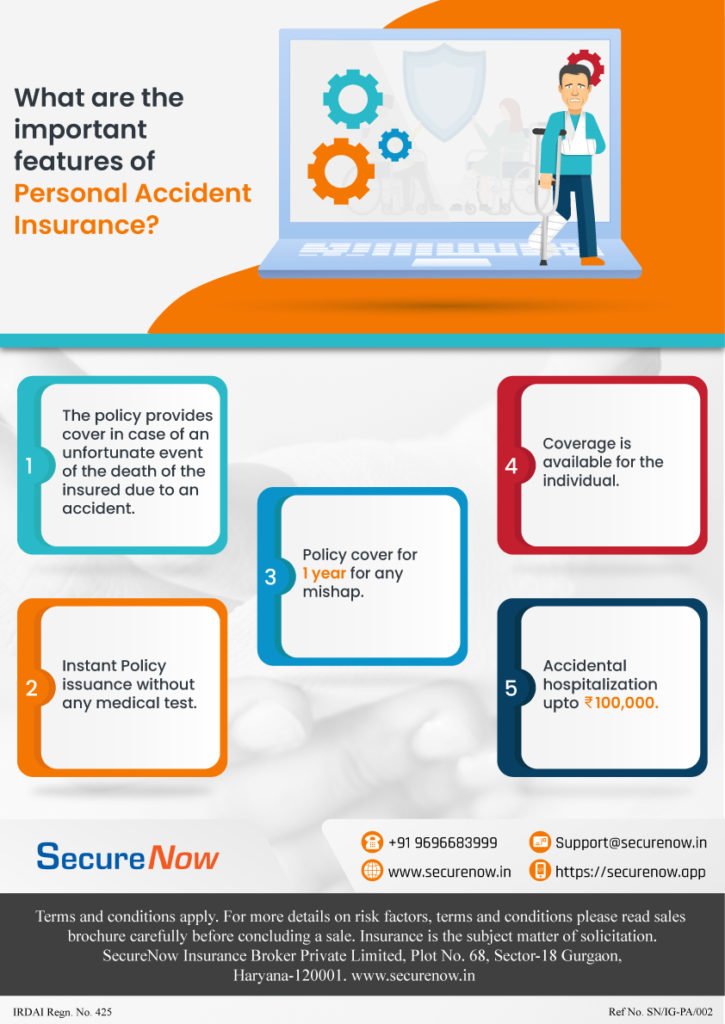
Infographic: Features of Personal Accident Insurance
This SecureNow infographic summarises the main features of a group personal accident policy. Use it as a quick reference alongside the sections above.
How Employers Can Evaluate GPA Coverage
- Confirm the eligible employee population.
- Identify occupational risks and workforce categories.
- Decide which core benefits are required.
- Review the sum insured and benefit schedule.
- Confirm whether TTD and any optional benefits are included.
- Verify on-duty or 24×7 scope, and territory.
- Compare exclusions and coverage conditions.
- Understand the claims process and documents.
- Review any medical expense benefit.
- Compare wording, service and premium before buying.
- Explain benefits and limitations clearly to employees.
- Review the policy when the workforce or business changes.
The cheapest premium isn’t necessarily the most suitable. Instead, compare actual cover and exclusions alongside price.
Conclusion
GPA insurance can provide valuable benefits after accidental death and disability, but the name alone tells you little. Instead, the core benefits, the disability schedule, TTD terms, on-duty or 24×7 scope, optional extensions, and exclusions all decide what employees actually receive. For global HR teams, AD&D terminology is a useful reference point but not a substitute for reading the Indian policy wording.
To compare suitable cover for your workforce, explore Group Personal Accident Insurance options with SecureNow.
This article is general information. Coverage depends on the specific policy wording. Insurance is the subject matter of solicitation.
Frequently Asked Questions
Q) What does Group Personal Accident Insurance cover?
A) GPA usually covers accidental death, permanent total disability and permanent partial disability, and many policies add temporary total disability. However, other benefits, such as medical expenses, may be optional. The policy wording and benefit schedule decide the actual cover.
Q) What are the key features of Group Personal Accident insurance?
A) Key features of Group Personal Accident insurance include the core death and disability benefits, the sum insured and benefit schedule, eligibility rules, optional extensions, exclusions, claim requirements and the coverage scope – 24×7 or on duty.
Q) What is the difference between accidental death and disability benefits?
A) The policy pays the accidental death benefit to the nominee if a covered accident causes death. In contrast, it pays disability benefits to the insured employee if a covered accident causes qualifying permanent or temporary disability.
Q) What is the difference between PTD and PPD?
A) PTD covers permanent disability that meets the policy’s total-disability definition, such as loss of sight in both eyes. PPD covers permanent partial losses, such as loss of a finger, paid as a percentage of the sum insured from the policy’s schedule.
Q) Does every GPA policy include temporary total disability?
A) No. Many GPA policies include TTD, but some don’t, and those that do set different weekly amounts, waiting periods and maximum periods. Therefore, check the benefit schedule.
Q) What does AD&D insurance mean?
A) Accidental Death and Dismemberment (AD&D) insurance is an international term for cover that pays after accidental death or the loss of a limb, sight, speech or hearing, usually according to a schedule.
Q) Is AD&D the same as Group Personal Accident Insurance?
A) Not necessarily. The two overlap, and GPA is the usual Indian equivalent, but definitions, schedules, exclusions and extra benefits such as TTD differ. For this reason, compare the actual wording rather than relying on the label.
Q) Does GPA Insurance cover accidents outside working hours?
A) Many GPA policies cover accidents 24 hours a day, but some restrict cover to on-duty accidents, sometimes as an option the employer selects. Check the policy schedule for the scope that applies.
Q) What does a personal accident Insurance cover include for medical expenses?
A) GPA policies do not automatically include medical expenses. However, some policies offer them as an extension for extra premium or include a limited benefit. GPA is not a substitute for health insurance.
Q) Does GPA cover an employer’s legal liability?
A) No. GPA pays specified benefits to employees or nominees; it is not employer liability insurance. The Code on Social Security, 2020, governs employers’ liability for employment injury, and employers usually address it through workmen’s compensation insurance or ESI.
Q) What should employers check in a GPA policy’s exclusions?
A) Check the accident definition, express exclusions such as self-injury or intoxication, activity and occupation restrictions, territorial limits, eligibility and claim conditions. In addition, exclusions vary by insurer.
Q) How can an employer compare Group Personal Accident Insurance policies?
A) Align the sum insured and benefits first, then compare the disability schedule, TTD terms, scope, exclusions, optional extensions, claims process and premium. Finally, compare the full wording, not just the quotation.