


Introduction
Group Personal Accident Insurance pays benefits when an employee dies or is disabled because of an accident. Some policies also reimburse accident-related medical bills. However, the cover only helps if you make the claim correctly – and claims often go wrong over simple things, such as late notice or a missing police report.
This guide is for employers, HR teams, employees, and nominees. Specifically, it explains the claim steps, when to notify the insurer, which documents to collect for each type of claim, who does what, and how to follow up. For the scope of cover itself, see what a GPA policy covers.
What Is the Claims Process Under Group Personal Accident Insurance?
The claims process under Group Personal Accident Insurance is the sequence from reporting an accident to the insurer’s decision and payment. Because GPA is a group policy, the employer is usually the policyholder, so HR often plays a central role. However, the person who receives the benefit is the injured employee or, after a death, the nominee or legal heir.
Overall, the process has five broad stages:
- Intimation – telling the insurer that an accident has happened and a claim may follow.
- Documentation – collecting the claim form and supporting records.
- Submission – sending everything through the insurer’s claim channel.
- Assessment – the insurer checks the claim against the policy and may then ask questions.
- Decision and settlement – the insurer approves and pays the claim, or explains why it won’t pay.
Finally, the claim must arise from a covered accident – a sudden, external event, not an illness. SecureNow explains what counts as an accidental injury separately.
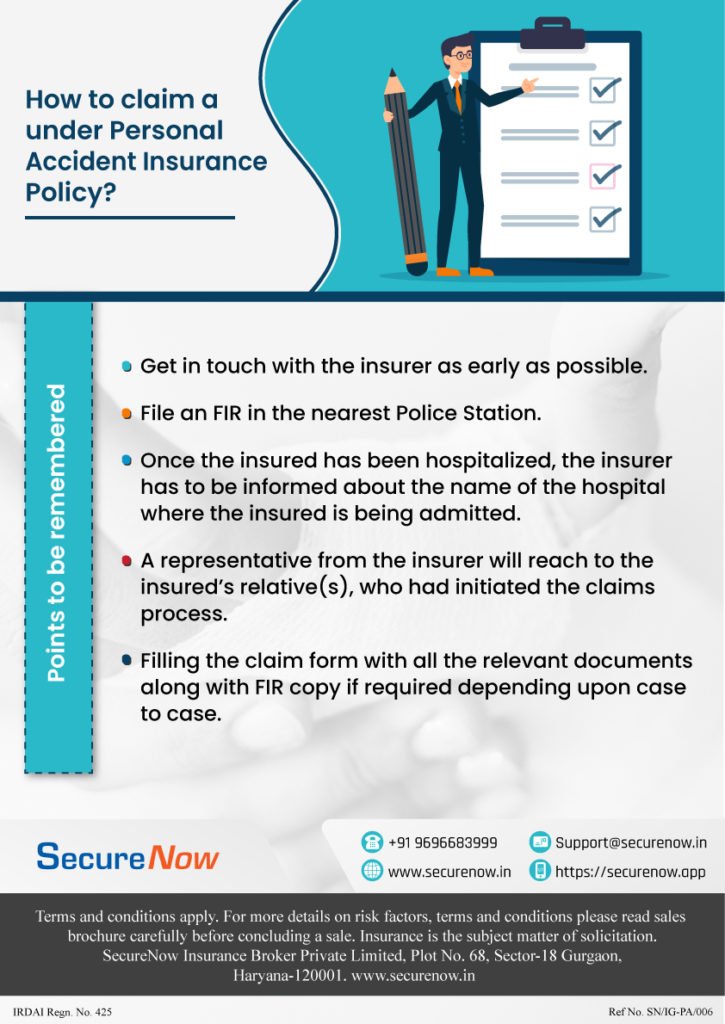
Step-by-Step Guide to Filing a GPA Insurance Claim
The steps below reflect common practice. However, your insurer’s procedure and your policy wording take priority.
Step 1: Get medical help and report to the authorities
Above all, treatment comes first. For road accidents, assaults, falls at a site, or any death without a clear explanation, you may also need to inform the police and register an FIR (First Information Report).
- Who: the employee, family, colleagues, or the employer, depending on the situation.
- Keep: a copy of the FIR, any medico-legal certificate (MLC) from the hospital, and the hospital admission papers.
- Possible delay: not keeping copies. SecureNow’s earlier claim guide describes a death claim that was turned down because the family had not kept copies of the FIR and death certificate.
Step 2: Inform the employer, HR, or insurance coordinator
This matters because HR usually holds the policy details and the insurer’s contact information.
- Who: the employee or, if they can’t, a family member or colleague.
- Share: the employee’s name and ID, date, time, place, and a short description of the accident, the hospital’s name, and the nature of the injury.
- Keep: the email or message you sent.
Step 3: Notify the insurer or claims administrator
This is formal claim intimation. So it should happen within the period your policy states.
- Who: usually HR or the policyholder’s broker for a group policy, but this depends on the policy and the insurer’s process.
- Keep: the claim reference number and the acknowledgement.
- Possible delay: the deadline passing while waiting for documents. Intimation and document submission are separate steps, so notify first.
Step 4: Get the right claim form
Insurers have their own claim forms, and some also have separate forms or sections for death, disability, and medical-expense claims.
- Who: HR, the broker, or the insurer provides the form.
- Possible delay: using an outdated or wrong form.
Step 5: Gather the documents for your claim type
The documents depend on whether the claim is for death, permanent disability, temporary disability, or medical expenses, so use the checklists below.
- Who: the claimant gathers medical and personal documents; meanwhile, HR provides employment records.
- Keep: a full set of copies, and also a note of any originals you hand over.
Step 6: Submit the claim form and documents
Then submit through the channel the insurer specifies – a portal, email, post, or HR or the broker.
- Who: commonly HR or the broker for group claims, but sometimes the claimant directly.
- Keep: proof of submission and also a list of what you sent.
Step 7: Respond to queries promptly
The insurer may then ask for more records, clarification of facts, or a medical examination.
- Who: whoever holds the information – the claimant for medical details, HR for employment records.
- Possible delay: a slow or partial response, or replies sent to the wrong contact.
Step 8: Let the insurer assess the claim
The insurer checks that the policy covers the accident and the person, that the documents are consistent, and that no exclusion applies. For disability claims, it also assesses the nature and degree of disability under the policy’s terms.
Step 9: Receive the decision and settlement
If the insurer admits the claim, it then pays the benefit by bank transfer. However, if it rejects all or part of the claim, it should explain why in writing.
- Keep: the settlement letter or the rejection letter.
Step 10: Follow up, or escalate if needed
If the claim stalls or the decision seems wrong, follow up with a written reference to your claim number. If that still doesn’t resolve it, use the insurer’s grievance process (see the settlement timelines section).
Claim steps at a glance
| Step | What to do | Usually responsible | What to keep |
|---|---|---|---|
| 1. Medical help and authorities | Treatment; FIR where relevant | Employee, family, employer | FIR, MLC, admission papers |
| 2. Inform employer | Report details to HR | Employee or family | Email or message |
| 3. Notify insurer | Formal intimation within the policy period | Usually HR or broker | Claim reference number |
| 4. Claim form | Get the insurer’s current form | HR, broker or insurer | Blank and completed form |
| 5. Documents | Collect per claim type | Claimant and HR | Copies of everything |
| 6. Submit | Through the specified channel | HR, broker or claimant | Proof of submission |
| 7. Queries | Respond fully and quickly | Claimant and HR | Replies and dates |
| 8. Assessment | Insurer reviews | Insurer | – |
| 9. Decision | Payment or reasoned rejection | Insurer | Settlement or rejection letter |
| 10. Follow-up | Written follow-up; escalate if needed | Claimant and HR | All correspondence |
When Should You Intimate a GPA Claim?
Intimate the claim as soon as reasonably possible, and always within the period your policy specifies. Claim intimation means formally telling the insurer that an accident has happened and a claim may follow. However, it is separate from submitting the full set of documents.
Why prompt notice matters. The insurer can verify the facts while they are fresh, and early notice avoids a dispute about late reporting. Therefore, SecureNow’s existing guides advise notifying the insurer “immediately”.
The deadline is in your policy. There is no single deadline that applies to every GPA policy. Instead, check the claims condition in the policy wording, or ask HR or your broker. Don’t rely on a figure from a general article, because policies differ.
What to include in the initial intimation:
- Policy number and the employer’s name
- Employee’s name, employee ID, and contact details
- Date, time, and place of the accident, and how it happened
- Nature of the injury, or the fact of death
- Hospital name, if admitted
- Whether a police report was filed
Keep proof. For example, save the email, the portal acknowledgement, or the claim reference number.
If documents aren’t ready yet. Notify anyway, and say that documents will follow later. In fact, waiting for a full file before notifying is a common mistake.
If notice was late. Notify as soon as you can, explain the reason for the delay in writing, and also keep any evidence that supports it (such as a hospital stay). Acceptance of a late claim depends on the policy terms and the insurer’s assessment; so do not take it for granted.
| Stage | Recommended action | Responsible person | Timeline or deadline | Important note |
|---|---|---|---|---|
| Immediately after the accident | Get treatment; inform police where relevant | Employee, family, employer | As soon as possible | Keep copies of the FIR and MLC |
| Inform the employer | Tell HR or the insurance coordinator | Employee or family | As soon as possible | HR holds the policy details |
| Intimate the insurer | Formal notice with basic details | Usually HR or broker | Within the period in the policy wording | Get a claim reference number |
| Submit documents | Claim form and supporting records | Claimant and HR | Within the period in the policy or insurer instructions | Can follow later, after intimation |
| Late intimation | Notify and explain the delay in writing | Claimant and HR | As soon as the delay is identified | Acceptance is not certain |
Documents Required for a Group Personal Accident Insurance Claim
The documents depend on the type of claim, and the insurer’s own checklist always takes priority. So the lists below are only general guides drawn from SecureNow’s existing claim articles. Not every document applies to every claim, and the insurer may also ask for others. Still, having every document does not guarantee approval.
Generally, claims need some common items: the completed claim form, photo ID, a letter from HR confirming employment and insured status, and bank details (often a cancelled cheque). Some insurers also ask for salary slips, particularly when the policy links benefits to salary.
Accidental Death Claim
The nominee or legal heir usually files this claim, often with HR’s help.
- Completed claim form
- Death certificate
- Post-mortem report, if doctors carried one out
- FIR and the final police report, where applicable
- Hospital records or death summary, if the person received treatment before death
- Photo ID of the deceased and of the nominee or claimant
- Proof of nominee status or relationship, and succession documents if there is no valid nomination
- HR letter confirming employment and insured status; salary slip if requested
- Bank details of the claimant
The post-mortem report and FIR are often critical in accident deaths, because they establish the cause.
Permanent Total Disability (PTD)
PTD means a permanent disability that prevents the person from working at all, as defined in the policy. Policies usually list the injuries that count as PTD, such as the loss of both eyes or both limbs, and pay a set percentage of the sum insured. Also, see SecureNow’s guide to the types of disability covered.
- Completed claim form
- Disability certificate from a competent medical authority, or an insurer-approved doctor if required, confirming that the disability is total and permanent
- Medical records and treatment history
- Investigation reports and X-rays, including post-operative films where relevant
- FIR or other incident record, where applicable
- Photo ID, HR letter and bank details
Permanent Partial Disability (PPD)
PPD means the permanent loss, or loss of use, of part of the body – a finger or an eye, for example. Insurers usually pay it as a percentage of the sum insured according to the policy’s schedule of benefits.
- Completed claim form
- Disability certificate stating the body part affected and the percentage of disability
- Medical records, specialist reports and X-rays
- FIR or other incident record, where applicable
- Photo ID, HR letter and bank details
For both PTD and PPD, the disability definitions, the assessment method and the benefit payable vary by policy. Also, doctors often can’t certify a permanent disability until treatment has finished, so insurers may wait for the final assessment.
Temporary Total Disability (TTD)
TTD means the employee temporarily can’t work at all because of the injury. Policies that include it usually pay a weekly benefit for a limited period.
- Completed claim form
- Medical certificate stating the period the employee was unfit to work
- Medical records and investigation reports
- Fitness certificate from the treating doctor when the employee is able to return to work
- Leave records from the employer, signed and sealed if requested
- Photo ID, HR letter and bank details
Overall, eligibility and the benefit amount depend on the policy and the documented period of disability.
Medical-Expense Claim
Payable only if the policy includes a medical-expense extension. For the limits and options, see SecureNow’s guide to medical expenses under GPA.
- Completed claim form
- Discharge summary, if the person stayed in hospital
- Original itemised hospital bills and payment receipts
- Prescriptions and bills for medicines bought outside the hospital
- Diagnostic and investigation reports
- Attending doctor’s statement, where requested
- FIR or MLC, where applicable
- Photo ID, HR letter and bank details
Document checklist summary
This table is a general checklist. However, it does not replace the insurer’s claim-specific document list.
| Claim type | Core documents | Additional where applicable | Who usually coordinates | Common reason for follow-up |
|---|---|---|---|---|
| Accidental death | Claim form, death certificate, IDs, HR letter, bank details | Post-mortem, FIR, final police report, succession documents | Nominee or legal heir with HR | Missing post-mortem or police report |
| PTD | Claim form, disability certificate confirming total and permanent disability, medical records | X-rays, specialist reports, FIR | Employee or family with HR | Disability not yet certified as permanent |
| PPD | Claim form, disability certificate with percentage, medical records | X-rays, specialist reports, FIR | Employee with HR | Percentage of disability unclear |
| TTD | Claim form, unfit-to-work certificate, medical records | Leave records, fitness certificate | Employee with HR | Period of disability not documented |
| Medical expenses | Claim form, original bills, receipts, discharge summary | Prescriptions, diagnostic reports, MLC | Employee with HR | Bills not itemised; originals missing |
Employer vs Nominee: Who Is Responsible for Filing the Claim?
It depends on the claim. HR typically coordinates group claims, while the employee or the nominee provides most of the personal and medical documents. However, the policy terms and the insurer’s process decide who may formally submit, and in death claims, the law on nomination and succession decides who is entitled to receive payment.
Employer, HR, or insurance coordinator. Usually:
- Confirms employment and insured status
- Coordinates intimation through the agreed channel
- Provides employer declarations, salary and leave records
- Helps the claimant find the right form and claim channel
- Tracks outstanding documents and keeps the claimant updated
- Also keeps claim information confidential
Employee or insured person. Usually:
- Tells the employer as soon as possible
- Gives accurate information about the accident
- Attends medical examinations when the insurer requests them
- Provides medical records and other documents
- Responds to queries until the insurer decides
Nominee, family member or legal representative. In a death claim, usually:
- Informs the employer as soon as possible about the death
- Completes the death claim form and provides the documents
- Provides identity, nominee, relationship, or succession documents
- Shares correct bank details so the insurer can pay
- Responds to queries until the insurer decides
Insurer or claims administrator. Reviews the claim, may then ask for more information, decides on admissibility, and communicates the decision and payment.
Who Does What: Responsibilities at a Glance
| Activity | Employer / HR | Employee / insured person | Nominee/representative | Insurer |
|---|---|---|---|---|
| Reporting the accident | Normally coordinates | Informs HR where possible | Informs HR (death claims) | Receives intimation |
| Claim form | Provides or directs to it | Completes (injury claims) | Completes (death claims) | Issues the form |
| Employment and insured status | Confirms | – | – | Verifies |
| Medical documents | Helps collect | Provides | Provides (death claims) | Reviews |
| Police documents | May help obtain | Provides where applicable | Provides where applicable | Reviews |
| Bank details | – | Provides | Provides | Pays |
| Queries | Coordinates | Responds | Responds | Raises queries |
| Decision | Communicates to the claimant | – | – | Decides and explains |
How Long Does a GPA Insurance Claim Take to Settle?
There is no single settlement period for every GPA claim. Instead, the time depends on the type of claim, how complete the documents are, and whether the insurer needs further checks. A straightforward claim with complete documents usually moves faster than one needing a disability assessment or police investigation.
Keep the stages separate in your mind: intimation, document submission, assessment, decision, and payment. Each has its own pace, so a deadline for one is not a deadline for the others.
What can slow things down:
- Missing or illegible documents
- Pending police or post-mortem reports
- Disability that doctors can’t yet assess because treatment is continuing
- Differences between the claim form, hospital records, and police reports
- Questions about whether the policy insured the person or covers the accident
Tracking and follow-up. Quote the claim reference number in every message. Then say what you submitted and when, ask what is pending, and keep a dated log of calls and emails.
If the claim stays unresolved. In that case, write to the insurer’s grievance officer through its official grievance channel. IRDAI’s Master Circular on Protection of Policyholders’ Interests, 2024 expects insurers to resolve complaints within 14 days. If you are still dissatisfied, you can register the complaint on IRDAI’s Bima Bharosa portal, or approach the Insurance Ombudsman, subject to its eligibility rules.
| Claim stage | What happens | What may affect timing | What the claimant should do |
|---|---|---|---|
| Intimation | Insurer registers the claim | Delayed reporting | Notify early; then save the reference number |
| Document submission | Claimant completes the claim file | Missing police or medical records | Submit a complete set; also list what’s pending |
| Assessment | Insurer checks cover and documents | Disability assessment, investigation, discrepancies | Answer queries fully and quickly |
| Decision | Approval or reasoned rejection | Outstanding queries | Read the decision; then ask for reasons if unclear |
| Payment | Transfer to the claimant’s account | Incorrect bank details | Double-check bank details |
| Escalation | Grievance review | Complexity of the dispute | Use the insurer’s grievance channel, then Bima Bharosa or the Ombudsman |
What Can Delay or Affect a GPA Insurance Claim?
Most delays come from incomplete or inconsistent information rather than from the claim itself. Specifically, common causes include:
- Missing documents – especially the FIR, post-mortem report, or disability certificate.
- Inconsistent details – for example, a different accident date or place on two documents.
- Late notice – the insurer may then need to investigate the reason.
- Pending assessments – doctors often can’t certify permanent disability until treatment ends.
- Coverage questions – whether an exclusion applies, or whether the person was on the insured list.
- Missing extension – a claim for bills when the policy has no medical-expense extension.
The amount payable also depends on the policy: the sum insured, the benefit type, the degree of disability, and any limits. Also, see SecureNow’s guide to GPA exclusions.
Common Mistakes to Avoid When Filing a GPA Claim
- Waiting for all the documents before notifying. Notify first; documents can follow later.
- Not keeping copies. Keep a full set, including the FIR and death certificate, before handing over originals.
- Skipping the police report. If the police attended, the FIR and final report are often essential.
- Assuming hospital bills are covered. Instead, check whether the policy has a medical-expense extension.
- Wrong bank or nominee details. These delay payment even after approval.
- Not updating the employee list. HR should keep the insured list current, so that the insurer cannot dispute cover.
- Ignoring queries. An unanswered query can leave the claim on hold until you reply.
For more, see SecureNow’s guide to common reasons for GPA claim rejection.
Conclusion
A smooth GPA claim comes down to four things: notify early, collect the right documents for the claim type, keep HR, the claimant and the insurer in step, and track the claim until a decision is made. In fact, most delays are avoidable with good records and prompt replies.
Employers can also make this easier by knowing their policy’s claim conditions before an accident happens. To review your cover and its claim requirements, explore Group Personal Accident Insurance with SecureNow.
This article is general information. Claim procedures, deadlines, and documents depend on the specific policy wording and the insurer. Insurance is the subject matter of solicitation.
Frequently Asked Questions
Q) How do I file a claim under Group Personal Accident Insurance?
A) To begin with, inform your employer’s HR team, make sure someone notifies the insurer within the policy’s time limit, complete the insurer’s claim form, and submit the documents for your claim type. Then respond to queries and track the claim until the insurer decides.
Q) How soon should I report a GPA insurance claim?
A) As soon as reasonably possible. However, the exact time limit is in your policy wording, and it differs between policies. If you’re late, notify anyway and explain the delay in writing; acceptance depends on the policy and the insurer.
Q) What documents are required for a GPA death claim?
A) Typically the claim form, death certificate, post-mortem report and FIR where applicable, IDs of the deceased and the claimant, nominee or relationship proof, an HR letter and bank details. However, the insurer’s checklist decides the final list.
Q) What documents are required for a PTD, PPD or TTD claim?
A) Disability claims usually need the claim form, medical records and a disability certificate stating the type and degree of disability. TTD claims also need a certificate showing the period off work and, often, a fitness certificate and leave records.
Q) What documents are needed for a GPA medical-expense claim?
A) Usually the claim form, original itemised bills, payment receipts, the discharge summary, prescriptions and diagnostic reports. However, the claim is payable only if the policy includes a medical-expense extension, and only up to its limits.
Q) Who is responsible for submitting a GPA insurance claim?
A) It depends on the policy and the insurer. HR often coordinates group claims, the employee provides injury documents, while the nominee or legal heir provides documents for a death claim.
Q) How long does a Group Personal Accident Insurance claim take to settle?
A) There is no fixed period for every claim. Instead, the time depends on the claim type, how complete the documents are and whether further assessment is needed. Overall, complete, consistent documents help avoid delays.
Q) What should I do if the insurer asks for more documents or the claim is delayed?
A) Send the requested documents promptly and also quote your claim number. If the claim is still unresolved, use the insurer’s grievance channel, then IRDAI’s Bima Bharosa portal or the Insurance Ombudsman if needed.