


Introduction
To buy Group Personal Accident (GPA) insurance:
- First, identify which employees need cover and why.
- Next, choose a benefit structure and sum insured.
- Before you request quotes, prepare accurate employee data.
- Then get quotations from insurers or a broker, and compare cover, limits, exclusions and price on the same basis.
- When you have chosen an insurer, complete its proposal and underwriting.
- Finally, check the policy schedule and effective date before paying, and keep the documents.
However, each insurer’s process differs.
Buying accident cover for a workforce is more than picking the lowest premium. HR also has to decide who gets cover and how much, supply accurate employee data, read the terms, and make sure every eligible employee is actually on the policy. If any of those goes wrong, the gap usually appears only when someone makes a claim.
This guide takes HR teams through the full journey: deciding whether GPA fits the organisation, choosing the sum insured, preparing data and documents, choosing a buying channel, comparing quotations, and completing the purchase. It also covers how to buy Personal Accident Insurance online for a group, and where an online process ends.
What Is Group Personal Accident Insurance?
Group Personal Accident insurance is a policy an employer buys to pay defined benefits to employees, or their families, if an accident causes death or disability. Depending on the policy, benefits may cover:
- Accidental death
- Permanent total disability (PTD) – disability that stops the person working at all
- Permanent partial disability (PPD) – the permanent loss of part of the body or its use
- Temporary total disability (TTD) – a temporary inability to work
You can also add optional extensions, such as accident medical expenses. However, the benefits, definitions, and exclusions depend on the policy you choose. SecureNow explains what a GPA policy covers in detail.
Who Should Buy Group Personal Accident Insurance?
Any employer that wants to give employees defined financial support after an accident can consider GPA. It is especially relevant where employees face higher accident exposure. Overall, whether it suits your organisation depends on your workforce profile, risk exposure, benefit goals, budget, and the policy terms available.
Is GPA a Legal Requirement?
GPA is not generally a legal requirement. In fact, we found no general law requiring employers to buy GPA, and the source article titled “must buy” cites none.
By contrast, statutory injury compensation is a separate obligation. Chapter VII of the Code on Social Security, 2020, which replaced the Employees’ Compensation Act, 1923, now governs employers’ liability for work injuries. Most of the Code took effect on 21 November 2025. However, establishments that fall under Employees’ State Insurance (ESI) handle work injuries through ESI instead.
GPA, in contrast, is an employee benefit. Therefore, buying it doesn’t automatically meet those statutory duties, and it isn’t the same as workmen’s compensation insurance. For this reason, take legal advice on your own obligations.
| Organisation or workforce type | Why GPA may be relevant | Buying considerations |
|---|---|---|
| Office-based workforce | Commuting and everyday accidents; also a valued, often modestly priced benefit | Confirm whether the policy covers 24 hours or only on duty |
| Field and travelling employees | More time on the road and at client sites | Check territorial scope and travel exclusions; also ask how the insurer classifies field roles |
| Manufacturing or operational workforce | Machinery, site and transport exposure | Expect occupation-based pricing; also consider insuring different units or roles in separate categories |
| Small and medium-sized businesses | A structured benefit without a large benefits team | Check minimum group size, as well as how simple the administration is |
| Large or multi-location organisations | Consistent cover across sites and roles | Use employee categories; then check how the insurer handles locations and joiners |
Needs also vary within a sector. For example, two manufacturers can have very different risk profiles depending on their processes and safety controls.
How to Choose the Right Sum Insured
Choose the sum insured from your benefit goals and workforce profile, then test it against your budget – not the other way round. In short, the sum insured is the base amount the insurer uses to calculate death and disability benefits for each employee.
The main structures are:
- Flat sum insured – the same amount for every eligible employee.
- Salary multiple – cover set as a multiple of each employee’s salary, where the insurer offers it.
- Graded cover – different amounts for employee categories, such as grade or designation, where the policy allows it.
SecureNow explains graded and salary-linked covers in more detail. A higher sum insured usually raises the premium. In addition, not every insurer offers every structure.
The sum insured also drives other benefits. For instance, insurers often pay partial disability as a percentage of it, so check how the policy calculates each benefit.
Flat vs Salary-Multiple Cover
| Decision factor | Flat sum insured | Salary-multiple basis |
|---|---|---|
| Basis for setting cover | Same amount per employee or category | A multiple of each employee’s defined salary |
| Treatment of employees with different salaries | Everyone gets the same cover | Higher earners get more cover, while lower earners get less |
| Administrative requirements | An employee list | Current salary data, a salary definition, update rules |
| Effect on overall cover exposure | Employees × flat amount | Depends on the payroll, the multiple and any cap |
| Potential effect on premium | Predictable, even when headcount changes | Moves up or down when salaries change |
| Important checks before purchase | Is the amount adequate for senior staff? | Salary definition, caps, insurer acceptance |
Hypothetical example: 100 employees on a flat ₹10 lakh each give ₹10 crore of total cover. On a salary multiple, however, the total depends on the payroll. For example, a group with an average annual salary of ₹6 lakh on 3× salary would total about ₹18 crore. Note that this compares cover, not premium.
Questions HR Should Ask Before Selecting the Sum Insured
- Would the benefit meaningfully support a family after a death or a serious disability?
- Should different employee categories get different levels?
- What does each option cost, and does it fit the budget?
- How does the insurer calculate partial disability and temporary disability from the sum insured?
- Which employees are eligible, and does the policy exclude any roles?
- Are there maximum limits or caps?
- Which exclusions could especially affect your workforce?
What Employee Data Is Needed for a GPA Quotation?
Insurers usually need enough information to understand whom they are insuring, what those people do, and what cover you want. At first, an indicative quotation may need only summary data. However, final underwriting and policy issuance usually need more detail.
| Information required | Why it may be needed | Always required? | Practical preparation tip |
|---|---|---|---|
| Organisation name and business activity | Identifies the policyholder and its risk | Usually | Use the registered name |
| Industry and nature of work | Assesses accident exposure | Usually | Describe the actual work done |
| Number of employees to be insured | Sizes the group | Yes | Confirm the eligibility rules before counting |
| Employee categories or occupation groups | Occupation-based pricing | Depends on the insurer | Group roles by duties rather than job titles alone |
| Employee names or census file | Identifies insured persons | Often at issuance | Keep one master list so data stays consistent |
| Date of birth or age | Some insurers use the age profile | Depends on the insurer | Check that age limits apply |
| Salary details | Needed for salary-linked cover | Only for salary-linked cover | Define “salary” clearly before you share it |
| Work locations and travel exposure | Location and travel risk | Where requested | Especially note any high-exposure sites |
| Proposed sum insured or benefit structure | Defines the cover to price | Yes | Decide this before asking for quotes |
| Start date and duration | Sets the policy period | Yes | Allow time for underwriting before the start date |
| Optional benefits | Prices the extensions | If wanted | List them separately so insurers can price each one |
| Existing GPA cover and renewal details | Continuity and pricing | If renewing | Also share the current schedule |
| Claims history | Experience-based pricing | Where requested | Prepare a claims summary |
How to Share Employee Data Securely
Share only what the insurer needs at each stage, through secure channels such as encrypted files or the insurer’s portal, and with authorised contacts only. Also, avoid sending full HR records to every insurer you approach.
The government notified the Digital Personal Data Protection (DPDP) Rules, 2025 on 14 November 2025, with an 18-month phased compliance period. Under these Rules, organisations should follow principles such as purpose limitation, data minimisation and reasonable security safeguards. Therefore, check your own obligations with your legal or compliance team.
What Documents Should HR Prepare Before Buying?
The documents build up in stages, from a quotation request to a signed-off policy. Insurers’ requirements differ, so ask each insurer for its list.
- Quotation – summary data: headcount, categories, proposed cover and add-ons.
- Underwriting – more detail, such as a census file, occupation details, claims history and a completed proposal form.
- Policy issuance – final insured list, payment, and the confirmed start date.
- After purchase – records to keep for administration and claims.
| Stage | Documents or information | Who prepares it | What to verify |
|---|---|---|---|
| Initial quotation | Business activity, headcount, categories, proposed cover | HR, with finance | Same data sent to every insurer |
| Underwriting | Census file, occupations, claims history, proposal form | HR | Accuracy and completeness |
| Policy issuance | Final insured list, payment, start date | HR, finance, insurer | Schedule matches what you agreed |
| Post-purchase recordkeeping | Policy schedule, wording, endorsements, insured list, receipts | HR | Stored securely and easy to find |
Should You Buy Directly or Through a Broker?
Both routes can work. However, the right choice depends on how much support HR needs and how many insurers you want to compare. Moreover, neither route is automatically cheaper.
Buying directly. You approach one or more insurers yourself, request quotations, and deal with each insurer separately. As a result, this route suits teams with insurance experience and time to manage several insurers.
Buying through a broker. An insurance broker licensed by IRDAI (the Insurance Regulatory and Development Authority of India) can approach several insurers on your behalf, help you compare terms, and may assist with documentation, policy changes, and claims. However, the actual services depend on the broker and the agreed scope. SecureNow, the publisher of this guide, is an IRDAI-licensed insurance broker.
Before working with any intermediary, check its IRDAI licence status on IRDAI’s website and agree in writing what support it will provide.
Direct vs Broker at a Glance
| Factor | Buying directly from an insurer | Buying through a broker or intermediary |
|---|---|---|
| Main contact | Each insurer separately | The broker, who liaises with insurers |
| Quotation process | Request from each insurer yourself | Broker requests from several insurers |
| Help comparing policy terms | Your own review | Broker may prepare a comparison |
| Support with employee data and documentation | Insurer guidance | Broker may help prepare and check data |
| Assistance with policy changes | Directly with the insurer | Broker may coordinate additions and deletions |
| Claims support | Directly with the insurer | Broker may help, depending on the agreed scope |
| What the employer should verify | Insurer’s service standards and contacts | Broker’s IRDAI licence and scope of service |
Decision Guide
- Consider buying directly if HR has insurance expertise, a simple workforce, and time to compare insurers.
- Instead, consider a broker if you want several quotations compared for you, have complex categories or locations, or want help with administration and claims.
What to Compare Across GPA Insurance Quotations
Compare quotations only after making sure they price the same employees, cover, limits, and policy period. After all, the lowest premium can come from narrower cover.
In particular, look closely at:
- Covered events and benefit definitions
- Death and disability percentages
- Medical-expense cover and other GPA add-on covers
- Limits, sub-limits and exclusions
- Occupation restrictions
- The premium before taxes, and the total payable (GST at 18% applies to group insurance policies)
- Policy dates
- The claims process
- Service support
- Renewal assumptions
Also, treat any discount for bundling with other group policies as valid only if the insurer confirms it in writing. SecureNow explains how GPA premiums are priced.
| Comparison item | Insurer A | Insurer B | Insurer C | HR’s verification notes |
|---|---|---|---|---|
| Sum insured | ||||
| Benefit structure | ||||
| Eligible employees | ||||
| Optional benefits | ||||
| Exclusions and limits | ||||
| Premium before taxes | ||||
| Taxes and total payable | ||||
| Claims procedure | ||||
| Service support | ||||
| Renewal conditions |
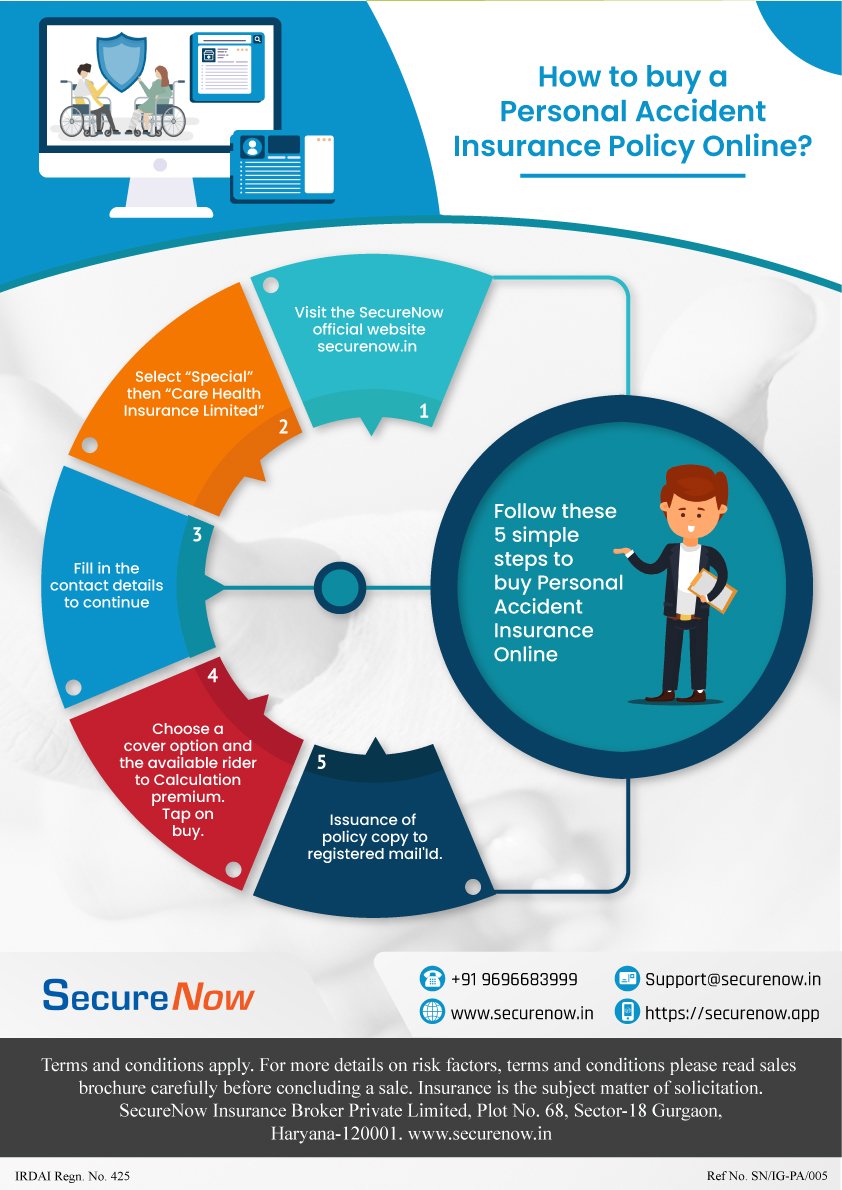
How to Buy Group Personal Accident Insurance Online
Buying Group Personal Accident insurance online usually starts with a quotation request. However, the insurer issues the policy only after underwriting, acceptance and payment. In other words, an online enquiry is not a policy.
- First, identify needs – the reason for cover and the eligible workforce.
- Choose the structure – sum insured basis and benefits.
- Prepare data – a census and the quotation information.
- Visit a verified website – an insurer’s or an IRDAI-licensed intermediary’s.
- Submit the enquiry – complete the online form.
- Review quotations – ask about anything missing or unclear before comparing.
- Then compare – benefits, limits, exclusions, premium, and service.
- Submit underwriting documents – through a secure channel.
- Review the policy – read the draft schedule and wording before accepting.
- Confirm and pay – check the effective date, insured list, premium, and payment process.
- Finally, keep and communicate – store the policy documents and tell employees about the benefits and how to file a GPA claim.
Employers who want to buy Personal Accident Insurance online for a group can request a GPA quotation through SecureNow. Its quote form asks for contact details and employee count. Note, however, that it is a quotation request, not an instant premium calculator or instant issuance; SecureNow does not currently offer a GPA premium calculator. Also, online journeys differ between insurers and intermediaries.
Common Mistakes When Buying GPA Insurance
| Common mistake | Why it matters | How HR can avoid it |
|---|---|---|
| Picking a sum insured without analysis | Cover may be too low, or unaffordable | Start from benefit goals, then test the budget |
| Comparing quotes with different cover | As a result, prices aren’t comparable | Send every insurer the same specification |
| Choosing on premium alone | Cheaper may mean narrower cover | Compare terms before price |
| Assuming all insurers offer the same benefits | Definitions and extensions vary | Read each wording before deciding |
| Overlooking exclusions and sub-limits | Insurers may refuse or reduce claims | Review the GPA exclusions and limits before buying |
| Incomplete or inaccurate employee data | Pricing errors and disputed coverage | Use one verified census |
| Not confirming the eligible population | Some employees may miss out | Agree the eligibility rules in writing before purchase |
| Assuming add-ons are included | Benefits may be missing | Check the schedule |
| Treating an online enquiry as cover | No policy exists until the insurer issues it | Wait until you receive the policy schedule |
| Not checking the schedule and dates | Wrong dates or names | Review before paying |
| Ignoring claim conditions | Late or incomplete claims | Brief HR and employees on the claim process |
| Not keeping records or telling employees | Benefits go unused because employees don’t know about them | Store documents, and also communicate the benefits |
| Assuming GPA meets statutory duties | Legal obligations may be unmet | Check statutory requirements separately |
Conclusion
A good GPA purchase rests on four things: cover chosen for your workforce’s real needs, accurate employee data, quotations compared on the same basis, and a final policy checked before you pay. Above all, buy Group Personal Accident cover, not just a premium: the right policy is one whose benefits, limits and exclusions fit your people.
When you’re ready, request a GPA quotation from SecureNow and compare options for your organisation.
This article is general information, not legal advice. Coverage, processes and requirements depend on the insurer and the policy wording. Insurance is the subject matter of solicitation.
Frequently Asked Questions
Q) Who should buy Group Personal Accident Insurance?
A) Any employer that wants to provide defined accident benefits to employees can consider it. It is particularly relevant for field, travelling, manufacturing and operational workforces, but office-based organisations also buy it as an employee benefit.
Q) Is GPA insurance compulsory for every organisation?
A) We found no general legal requirement to buy GPA. Moreover, the Code on Social Security, 2020 or ESI governs statutory injury compensation separately, so buying GPA does not automatically satisfy those obligations.
Q) How should an employer choose the sum insured?
A) Start with the support you want to give employees and their families, then choose a flat, salary-multiple or graded structure that the insurer offers, and test the cost against your budget.
Q) What employee information is needed for a GPA quotation?
A) Usually the business activity, number of employees, occupation categories and proposed cover. Final underwriting may also need a census file, ages, salaries for salary-linked cover, and claims history, depending on the insurer.
Q) Is it better to buy GPA insurance directly or through a broker?
A) Neither is better in every case. Direct purchase suits teams with insurance expertise, while a broker can collect and compare several quotations and help with administration. Check any broker’s IRDAI licence.
Q) Can an employer buy GPA insurance online?
A) You can usually request a quotation online, but issuing the policy normally also needs underwriting, a proposal, acceptance and payment. The process varies by insurer and intermediary.
Q) How should HR compare GPA insurance quotations?
A) Make sure every quotation covers the same employees, sum insured, benefits and period. Then compare definitions, add-ons, exclusions, premium before tax, total payable, claims support and renewal terms.
Q) What should an employer check before finalising a GPA policy?
A) Check the policy schedule and wording: the insured list, sum insured, benefits, add-ons, exclusions, effective date and premium. Then keep the documents and explain the cover to employees.