


Introduction
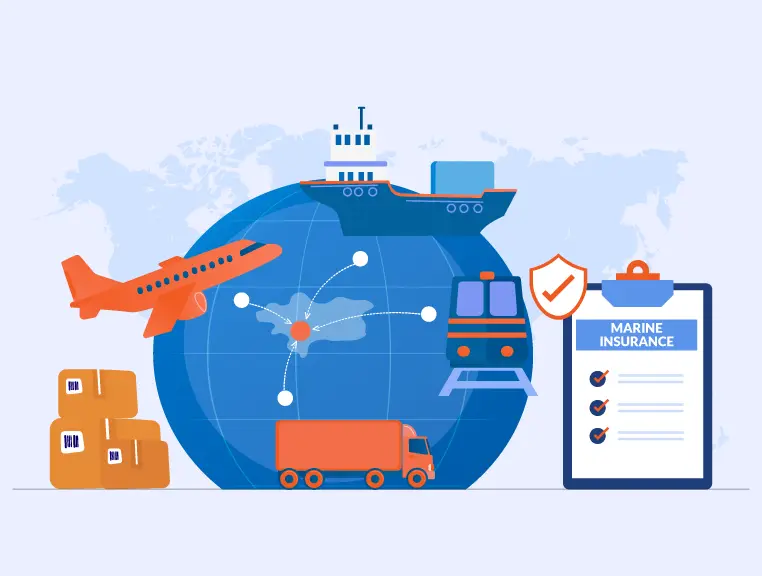
Every year, thousands of shipments leave Indian ports by sea, air, and road. Somewhere between the factory floor and the buyer’s warehouse, cargo faces fire, theft, flooding, container mishandling, and accidents. Marine insurance is the financial safety net that protects goods during this journey.
This guide explains what marine insurance is, how it works in India, and how to choose the right policy. This guide addresses exporters, importers, manufacturers, logistics companies, and finance teams who need clear, practical answers rather than legal jargon.
Key Takeaways
- Marine insurance covers goods in transit by sea, air, road, and rail – not just ocean shipments.
- Cargo insurance protects goods; hull insurance protects the vessel – they are not interchangeable.
- Open policies suit frequent shippers; specific voyage policies suit occasional shipments.
- Coverage depth depends on the Institute Cargo Clause selected – (A), (B), or (C).
- Inland transit insurance matters as much as international cargo cover for businesses with domestic distribution.
- Marine insurance and employers’ liability insurance address different risks and are often both necessary.
- Accurate disclosure, prompt claim notification, and proper documentation are essential to smooth claims settlement.
What is Marine Insurance?
Marine insurance is a category of general insurance that covers physical loss or damage to goods, vessels, and cargo while they travel from one place to another. Despite the name, marine insurance in India extends beyond sea voyages – it also covers air freight, road transport, and rail movement, since most cargo journeys use more than one mode of transport.
At its core, marine insurance answers one question for a business: if my goods are damaged, stolen, or lost during transit, who bears the financial loss? Without a policy, the exporter, importer, or transporter often absorbs the cost themselves. With marine cargo insurance in place, the insurer compensates the insured for the value of the loss, subject to the policy terms.
Marine insurance is one of the oldest forms of insurance in the world, dating back to merchants pooling risk for sea trade centuries ago. In its modern form, it has evolved into a structured product regulated by the Insurance Regulatory and Development Authority of India (IRDAI) and offered by general insurance companies across the country.
Why Marine Insurance Matters?
Cargo moves through multiple hands before reaching its destination – loaders, carriers, port handlers, customs, and warehouse staff. Each handoff carries risk. A few reasons marine insurance matters for Indian businesses:
- Financial protection: A single damaged consignment can wipe out a shipment’s entire profit margin.
- Contractual requirement: Many international buyers, banks, and letters of credit require proof of cargo insurance before releasing payment.
- Business continuity: Claims settlements help businesses restock or replace goods without disrupting cash flow.
- Global trade compliance: Incoterms such as CIF (Cost, Insurance, and Freight) explicitly require the seller to arrange marine insurance.
For exporters and importers operating on thin margins, a single uninsured loss can be far costlier than years of premium payments combined.
IRDAI & Marine Insurance Product Overview
How Marine Insurance is Regulated in India
Marine insurance products in India fall under general insurance and are regulated by the IRDAI. The regulator sets the framework for policy wordings, solvency requirements, and fair claims practices that insurers must follow. While insurers have some flexibility in pricing and add-on covers, base policy language for marine cargo insurance is largely built around internationally recognised Institute Cargo Clauses, adapted for the Indian market.
Who Offers Marine Insurance
Marine insurance is offered by nearly all general insurance companies operating in India, including public sector insurers and private players. Businesses typically buy marine cargo insurance either directly from an insurer, through an insurance broker, or bundled into freight-forwarding and logistics contracts.
Types of Marine Insurance Products Available
Broadly, marine insurance in India is divided into two major product families:
| Product Type | What It Covers | Who Buys It |
| Marine Cargo Insurance | Goods in transit – raw materials, finished products, machinery | Exporters, importers, manufacturers, traders |
| Marine Hull Insurance | The ship or vessel itself, including machinery and equipment | Shipowners, charterers, shipping companies |
Difference Between Cargo Insurance and Hull Insurance
This distinction trips up many first-time buyers, so it deserves a direct answer.
- Cargo insurance protects the goods being transported – it is bought by the business that owns or is responsible for the goods.
- Hull insurance protects the vessel carrying those goods – it is bought by the shipowner or operator, not the cargo owner.
A business exporting textiles needs cargo insurance, not hull insurance. The shipping line, separately, insures its vessel under a hull policy. This guide focuses on marine cargo insurance, since that is what most Indian businesses need.
Types of Marine Insurance
Marine insurance products can be grouped by what they cover and how the coverage is structured. The table below gives a quick overview before we explore each type in detail.
| Policy | Best For | Coverage |
| Marine Open Policy | Businesses with frequent, ongoing shipments | Automatic cover for all shipments within a policy period, up to a set sum insured |
| Marine Specific Voyage Policy | One-off or occasional shipments | Cover for a single, defined voyage or consignment |
| Annual Marine Policy | Businesses wanting yearly cover without per-shipment renewal | Cover for all eligible shipments over a 12-month period |
| Inland Transit Insurance | Domestic movement of goods by road or rail | Cover within India, factory to warehouse or dealer |
| Import Cargo Insurance | Businesses importing raw materials or goods | Cover from the foreign supplier’s warehouse to the Indian destination |
| Export Cargo Insurance | Businesses exporting goods overseas | Cover from the Indian factory/warehouse to the overseas buyer |
| Multimodal Transit Insurance | Shipments using more than one mode of transport | Cover across sea, air, road, and rail legs of a single journey |
Marine Cargo Insurance Explained
Marine cargo insurance is the most commonly bought form of marine insurance in India. It covers the goods themselves – not the vehicle, vessel, or aircraft – against loss or damage during transit. This includes raw materials moving from a supplier to a factory, finished goods moving from a factory to a port, and international shipments moving from an Indian exporter to an overseas buyer.
A typical marine cargo policy covers perils such as fire, collision, overturning of the carrying vehicle, theft, and, depending on the clause selected, additional risks like water damage, breakage, or leakage. Coverage can extend on a warehouse-to-warehouse basis, meaning protection starts when goods leave the sender’s warehouse and continues until they reach the final destination warehouse, not just while at sea or in the air.
Scope of Marine Insurance
Marine insurance is broader than many businesses assume. The diagram below shows how the scope branches out from cargo insurance into different transit scenarios.
Marine Insurance
│
▼
Cargo
│
├── Imports (foreign supplier → Indian destination)
│
├── Exports (Indian origin → overseas buyer)
│
├── Domestic Transit (factory → warehouse → dealer, within India)
│
├── Storage Extension (temporary halts, warehousing during transit)
│
└── Multimodal Transit (sea + air + road + rail combined in one journey)
Imports: Covers goods from the moment they leave the foreign supplier’s premises until they reach the Indian buyer’s warehouse, including the ocean or air leg and inland transit after customs clearance.
Exports: Covers goods from the Indian exporter’s warehouse until delivery to the overseas buyer, satisfying Incoterm requirements like CIF where the seller must insure the shipment.
Domestic transit: Covers goods moving entirely within India – factory to depot, depot to dealer, or between company warehouses – by road or rail.
Storage extension: Many policies extend cover to short-term storage during transit, such as goods held at a port warehouse awaiting onward movement.
Multimodal transit: A single shipment often moves by truck, then ship, then truck again. Marine insurance is designed to cover the entire journey under one policy, regardless of how many modes are used.
How Marine Insurance Works
Understanding the mechanics of a marine insurance policy helps businesses buy the right cover and avoid claim disputes later.
- Proposal and disclosure: The insured provides details of the goods, transit route, mode of transport, and value. Accurate disclosure matters, since marine insurance is built on the principle of utmost good faith.
- Premium calculation: The insurer calculates premium based on cargo type, packaging, transit mode, distance, and claims history.
- Policy issuance: The insurer issues a policy – either an open policy for ongoing shipments or a specific policy for a single voyage.
- Declaration (for open policies): Under an open policy, the insured declares each shipment as it happens, and cover applies automatically up to the agreed sum insured.
- Loss event: If goods are damaged, lost, or stolen during transit, the insured must notify the insurer promptly and take reasonable steps to minimise further loss.
- Survey and documentation: The insurer or its surveyor assesses the damage, and the insured submits supporting documents.
- Claim settlement: Once the claim is verified against policy terms, the insurer indemnifies the insured for the covered loss.
Special Characteristics of Marine Insurance
Marine insurance operates on a set of legal principles that distinguish it from other insurance products. Understanding these helps businesses avoid claim rejections.
| Principle | Meaning |
| Utmost Good Faith | Both parties must disclose all material facts honestly. Hiding poor packaging or a risky route can void a claim. |
| Insurable Interest | The insured must have a financial stake in the goods at the time of loss – ownership, risk, or contractual liability. |
| Indemnity | The insurer compensates for the actual financial loss, not more, restoring the insured to their pre-loss position. |
| Subrogation | After paying a claim, the insurer gains the right to recover the loss from a third party responsible for the damage, such as a negligent carrier. |
| Contribution | If a shipment is insured under more than one policy, insurers share the claim proportionately, preventing double recovery. |
| Proximate Cause | Claims are assessed based on the most direct, effective cause of loss, not a distant or incidental one. |
| Assignment | Marine policies can usually be transferred to a new owner of the goods, such as when goods are sold mid-transit. |
| Floating Policies | A single policy can cover multiple shipments over a period, with values declared as each shipment moves. |
| Warehouse-to-Warehouse Cover | Protection starts at the sender’s warehouse and continues to the receiver’s warehouse, not just during the sea or air leg. |
| Agreed Value | For certain cargo, the insured and insurer fix the value upfront, simplifying claims settlement. |
Real-world example: A textile exporter ships fabric rolls from Surat to a buyer in Germany. Midway, a fire breaks out in the port warehouse where the container is temporarily stored. Because the policy includes warehouse-to-warehouse cover, the loss is still payable, even though it happened before the ship departed.
Marine Insurance Policy Contract
Ten Elements of a Marine Insurance Policy Contract
A marine insurance policy is a legal contract, and like any contract, it contains defined elements. Knowing these helps businesses read their policy documents with confidence.
| Element | Meaning |
| Parties | The insurer (who provides cover) and the insured (who owns the insurable interest in the goods) |
| Subject Matter | The goods, cargo, or property being insured |
| Sum Insured | The maximum amount the insurer will pay in the event of a total loss |
| Premium | The amount paid by the insured in exchange for the cover |
| Voyage | The defined route and journey the goods will travel, from origin to destination |
| Perils Covered | The specific risks insured against, such as fire, collision, theft, or water damage |
| Exclusions | Losses or circumstances the policy does not cover |
| Claims Conditions | The procedures, timelines, and documentation required to file and settle a claim |
| Duties of the Insured | Obligations such as prompt notification of loss and taking reasonable care to minimise damage |
| Policy Conditions | General terms governing the validity, cancellation, and renewal of the policy |
Types of Marine Policies
Open Policy
A marine open policy suits businesses that ship goods regularly. Instead of buying a new policy for every consignment, the business declares each shipment under one running policy, valid for a fixed period (often 12 months) or until it exhausts the sum insured. Exporters, importers, and manufacturers with continuous shipping activity find this the most practical option.
Specific Voyage Policy
A marine specific voyage policy covers a single shipment for one defined journey. It suits businesses that ship only occasionally, such as a one-time machinery export or an infrequent import order.
Annual Policy
An annual marine policy provides cover for all eligible shipments over a 12-month period without requiring shipment-by-shipment declaration in some structures, simplifying administration for businesses with predictable shipping patterns.
Inland Transit Insurance
Inland transit insurance covers goods moving within India by road or rail – for example, from a manufacturing plant to a regional warehouse, or from a warehouse to a retail dealer network. It is essential for businesses with domestic distribution networks, not just international trade.
Import Cargo Insurance
Import cargo insurance protects goods from the point they leave the foreign supplier’s premises until they reach the Indian buyer’s final destination. It typically covers the international leg plus onward inland transit after customs clearance.
Export Cargo Insurance
Export cargo insurance covers goods from the Indian seller’s warehouse until they reach the overseas buyer. Under Incoterms like CIF, the exporter is contractually required to arrange this cover on the buyer’s behalf.
Multimodal Transit Insurance
Multimodal transit insurance covers shipments that use more than one mode of transport within a single journey – such as truck to port, ship to a foreign port, and truck again to the final warehouse. A single policy covers the entire chain, avoiding coverage gaps between transport modes.
Perils Covered
Coverage under marine cargo insurance is generally structured around Institute Cargo Clauses, offering three broad tiers:
- Institute Cargo Clauses (C): The narrowest cover, limited to major perils like fire, explosion, vessel sinking, and collision.
- Institute Cargo Clauses (B): A mid-level cover, adding risks like earthquake, flood, washing overboard, and water damage.
- Institute Cargo Clauses (A): The broadest cover, insuring against all risks of physical loss or damage except those specifically excluded.
Most businesses shipping high-value or fragile goods opt for Clause (A) for wider protection, while low-risk bulk commodities are sometimes insured under Clause (C) to reduce premium costs.
Major Exclusions
Marine insurance, like all insurance products, does not cover every possible loss. Common exclusions include:
- Loss due to wilful misconduct of the insured
- Ordinary leakage, wear and tear, or inherent vice of the goods
- Loss caused by inadequate or improper packing
- Delay, even if caused by an insured peril
- Loss arising from insolvency of the carrier
- War and strikes, unless specifically added back through extension clauses
- Loss from inherent defects in the cargo itself
Businesses should read exclusions carefully and discuss add-on covers with their insurer or broker where standard exclusions pose a real risk to their cargo type.
Choosing the Right Marine Insurance Policy
Selecting the right marine insurance policy depends on shipment frequency, cargo type, and trade direction. A few practical guidelines:
- Frequent shippers should consider an open or annual policy to avoid repeated paperwork.
- Occasional shippers are usually better served by a specific voyage policy.
- High-value or fragile cargo benefits from Institute Cargo Clauses (A) for broader protection.
- Businesses with domestic distribution should not overlook inland transit insurance, which is often underestimated.
- Exporters selling on CIF terms must factor marine insurance into their landed cost and contractual obligations.
Decision Tree: Which Marine Insurance Policy Should You Buy?
- If you are an Importer → Choose Import Cargo Insurance, extendable with Inland Transit cover for onward domestic movement after customs clearance.
- If you are an Exporter → Choose Export Cargo Insurance, especially if selling under CIF or CIP Incoterms where insurance is your contractual responsibility.
- If you are a Manufacturer with regular raw material inflows and finished goods outflows → Choose a Marine Open Policy covering both import and domestic legs.
- If you are a Distributor moving goods to dealers within India → Choose Inland Transit Insurance.
- If you are a Logistics Company handling third-party cargo → Consider a Marine Open Policy structured around your typical routes and cargo mix, discussed with your insurer.
- If you are a Domestic Transporter operating within India only → Inland Transit Insurance is the appropriate fit, rather than an international cargo policy.
Marine Insurance vs Employers’ Liability Insurance
People sometimes confuse these two products because both fall under general insurance, but they protect entirely different interests.
| Feature | Marine Insurance | Employers’ Liability Insurance |
| Purpose | Protects goods/cargo during transit | Protects employers against liability for employee injury or death at work |
| What is Insured | Cargo, goods, or vessel | The employer’s legal liability |
| Risks Covered | Fire, theft, collision, water damage, transit accidents | Workplace injury, occupational disease, death arising from employment |
| Who Buys | Exporters, importers, manufacturers, traders | Employers with workers not covered under statutory workmen’s compensation |
| Claims | Filed by the cargo owner for physical loss/damage | Filed by or on behalf of an injured employee against the employer |
| Legal Requirement | Not mandatory by law, but often contractually required | Employer liability itself is a legal exposure; insurance is a risk-transfer tool |
| Beneficiary | The business owning or responsible for the goods | The injured employee or their dependents, via the employer |
Why businesses often need both: A manufacturing or trading company typically has two distinct exposures – physical loss to the goods it ships (marine insurance) and legal liability toward its workforce (employers’ liability insurance). Neither product substitutes for the other, and most established businesses carry both as part of a complete risk management programme.
Current Industry Trends & Outlook
Marine insurance in India is evolving alongside global trade patterns and technology. Key trends shaping the market:
- Supply chain diversification: Businesses are spreading sourcing and shipping routes across multiple countries, changing risk profiles and insurance needs.
- Digital cargo tracking: Real-time GPS and RFID tracking are giving insurers and businesses better visibility into shipment location and condition.
- AI in logistics: Predictive analytics is helping identify high-risk routes and shipment types before losses occur.
- IoT shipment monitoring: Sensors tracking temperature, humidity, and shock are becoming common for sensitive cargo like pharmaceuticals and electronics.
- Climate-related cargo risks: Extreme weather events are increasing the frequency of transit-related claims, pushing insurers to reassess risk models.
- Rising geopolitical risks: Shipping route disruptions and regional conflicts are prompting businesses to review war and strikes cover more closely.
- ESG considerations: Sustainability expectations are influencing packaging standards and carrier selection, indirectly affecting cargo risk.
- Growth in Indian exports: As India’s export base expands across sectors, demand for marine cargo insurance is rising in parallel.
- E-commerce logistics: Smaller, more frequent shipments driven by online retail are reshaping how insurers structure open policies.
- Multimodal transportation: Increasing reliance on combined sea-air-road journeys is driving demand for seamless multimodal cover.
Real Claim Example
A Mumbai-based electronics importer brought in a container of consumer devices from South Korea under a marine open policy with Institute Cargo Clauses (A). During inland transit from the port to the company’s warehouse, the truck met with an accident, damaging a significant portion of the shipment. Because the policy included warehouse-to-warehouse cover and the accident fell within the insured perils, the insurer settled the claim after survey and documentation, allowing the business to replace stock without absorbing the full loss.
Common Buying Mistakes
- Under-insuring cargo to save on premium, leaving a shortfall at claim time.
- Ignoring inland transit risk, assuming marine cover only applies to the sea or air leg.
- Choosing the cheapest clause (C) cover for high-value or fragile goods that need broader protection.
- Delaying claim notification, which can complicate or weaken a claim.
- Not disclosing packaging or route details accurately, risking claim rejection under utmost good faith.
- Overlooking storage extension needs when goods are likely to sit in a warehouse mid-transit.
Myth vs Fact
| Myth | Fact |
| Marine insurance only covers ships at sea | It also covers air, road, and rail transit, and often the full warehouse-to-warehouse journey |
| Domestic shipments don’t need marine insurance | Inland transit insurance is a form of marine insurance for movement within India |
| Marine insurance is mandatory by law | It is not legally mandatory, but often required contractually or under Incoterms like CIF |
| All marine policies cover the same risks | Coverage varies significantly between Institute Cargo Clauses (A), (B), and (C) |
| Marine insurance covers delay in delivery | Delay is generally excluded, even if caused by an insured peril |
| Poor packaging damage is always covered | Loss due to inadequate packing is typically excluded |
| A single marine policy covers unlimited shipments forever | Open policies run for a defined period and up to a set sum insured |
| Hull insurance and cargo insurance are the same thing | Hull insurance covers the vessel; cargo insurance covers the goods being transported |
| Marine insurance claims take months to settle | Claims move faster with prompt notification and complete documentation |
| Small businesses don’t need marine insurance | Any business with cargo in transit carries financial exposure, regardless of size |
Conclusion
Marine insurance is not a niche product that only large shipping companies need – it is a practical necessity for any business that moves goods, whether across an ocean or across a state. Cargo faces risk at every stage of its journey, from raw material imports to finished goods reaching a retail dealer. This guide’s coverage of scope, characteristics, and policy types equips businesses to choose cover that genuinely protects their financial interests, rather than leaving gaps that surface only when they file a claim.
Frequently Asked Questions (FAQs)
Q) What is Marine Insurance?
A) Marine insurance is a contract where an insurer compensates the insured for loss or damage to goods, cargo, or vessels during transit by sea, air, road, or rail. It protects businesses from financial loss when shipments are damaged, lost, or stolen while in transit, and is regulated in India by the IRDAI.
Q) How does Marine Cargo Insurance work?
A) The insured declares cargo details and value, pays a premium, and receives a policy – either open or voyage-specific. If a loss occurs during the insured journey, the insured notifies the insurer, a surveyor assesses the damage, and the insurer settles the claim based on policy terms, subject to exclusions.
Q) What is covered under a Marine Cargo Policy?
A) Coverage typically includes fire, collision, vessel sinking, theft, and, under broader clauses, water damage, breakage, and handling accidents. The exact scope depends on whether the policy follows Institute Cargo Clauses (A), (B), or (C), with (A) offering the widest protection.
Q) What is the scope of Marine Insurance?
A) Marine insurance covers imports, exports, domestic transit, storage extensions during transit, and multimodal journeys combining sea, air, road, and rail. It is not limited to international shipments; it also covers goods moving entirely within India.
Q) What are the characteristics of Marine Insurance?
A) Key characteristics include utmost good faith, insurable interest, indemnity, subrogation, contribution, proximate cause, assignment, floating policies, warehouse-to-warehouse cover, and agreed value. These principles govern how policies are underwritten and how claims are assessed.
Q) What is a Marine Insurance Policy Contract?
A) It is a legal agreement between insurer and insured covering ten core elements: parties, subject matter, sum insured, premium, voyage, perils covered, exclusions, claims conditions, duties of the insured, and policy conditions.
Q) What is the difference between Marine Insurance and Cargo Insurance?
A) Marine insurance is the broader category, covering both cargo and vessels (hull). Cargo insurance is a specific type of marine insurance that covers only the goods being transported, not the ship or aircraft carrying them.
Q) What is the difference between Marine Insurance and Employers’ Liability Insurance?
A) Marine insurance protects goods during transit against physical loss or damage. Employers’ liability insurance protects a business against legal liability for employee injury or death arising from employment. They cover entirely different risks and are often both necessary for the same business.
Q) Which Marine Insurance policy is best for exporters?
A) Exporters typically need Export Cargo Insurance, especially under CIF or CIP Incoterms where arranging insurance is a contractual obligation. Frequent exporters often combine this with a Marine Open Policy to cover ongoing shipments without renewing cover each time.
Q) Is Marine Insurance mandatory in India?
A) Marine insurance is not mandated by law in most cases, but it is frequently required contractually – by overseas buyers, banks issuing letters of credit, or Incoterms like CIF that place the insurance obligation on the seller.
Q) What is Warehouse-to-Warehouse coverage?
A) Warehouse-to-warehouse cover extends protection from the moment goods leave the sender’s warehouse until they reach the receiver’s warehouse, rather than covering only the sea or air leg of the journey. This closes gaps during loading, inland transit, and temporary storage.
Q) What are Institute Cargo Clauses (A), (B), and (C)?
A) These are standardised sets of marine cargo cover. Clause (C) covers major perils like fire and collision; Clause (B) adds risks like flood and water damage; Clause (A) offers the broadest all-risks cover except for specific exclusions.
Q) What is excluded under Marine Insurance?
A) Common exclusions include wilful misconduct, inherent vice or ordinary wear and tear, inadequate packing, delay, carrier insolvency, and war or strikes unless specifically added back through extensions.
Q) How is a Marine Insurance claim settled?
A) The insured notifies the insurer promptly after a loss, provides supporting documents, and a surveyor assesses the damage. Once verified against policy terms and exclusions, the insurer indemnifies the insured for the covered financial loss.
Q) What documents are required for a Marine Insurance claim?
A) Typically required documents include the insurance policy copy, invoice, packing list, bill of lading or airway bill, survey report, and evidence of the loss such as photographs or a damage certificate from the carrier.
Q) How is Marine Insurance premium calculated?
A) Premium depends on factors like cargo type, value, packaging quality, transit mode, route risk, and the insured’s claims history. Higher-risk cargo or routes, and broader clauses like Institute Cargo Clauses (A), generally attract higher premiums.
Q) Who should buy Marine Cargo Insurance?
A) Any business that owns goods in transit should consider marine cargo insurance – exporters, importers, manufacturers, traders, distributors, and logistics companies handling third-party cargo.
Q) What is the difference between Open Policy and Specific Voyage Policy?
A) An open policy covers all shipments declared under it during a policy period, suited to frequent shippers. A specific voyage policy covers a single defined shipment, suited to occasional or one-off consignments.
Q) Can Marine Insurance cover inland transportation?
A) Yes. Inland transit insurance is a form of marine insurance covering goods moving within India by road or rail, such as factory-to-warehouse or warehouse-to-dealer movement.
Q) What are the latest trends in Marine Insurance?
A) Current trends include digital cargo tracking, AI-driven risk assessment, IoT shipment monitoring, climate-related risk reassessment, growing geopolitical risk considerations, ESG-linked packaging standards, and rising demand driven by India’s export growth and e-commerce logistics.
Q) What is the difference between Marine Hull Insurance and Marine Cargo Insurance?
A) Hull insurance covers the ship or vessel itself, including its machinery, and is bought by shipowners. Cargo insurance covers the goods being transported and is bought by the business that owns or is responsible for those goods.
Q) Does Marine Insurance cover theft during transit?
A) Yes, theft is typically covered under standard marine cargo policies, though coverage details vary by the Institute Cargo Clause selected and any specific exclusions in the policy.
Q) What happens if goods are sold while in transit?
A) Marine insurance policies can usually be assigned to the new owner of the goods through the principle of assignment, allowing coverage to continue without interruption when ownership changes mid-transit.
Q) Do e-commerce businesses need Marine Insurance?
A) Yes. E-commerce businesses shipping goods domestically or internationally face the same transit risks as traditional traders, and growing shipment volumes have made cargo insurance increasingly relevant for this sector.
Q) Is storage during transit covered under Marine Insurance?
A) Many marine policies include a storage extension, covering goods held temporarily at a port, warehouse, or transit hub as part of the insured journey, rather than only while goods are actively moving.