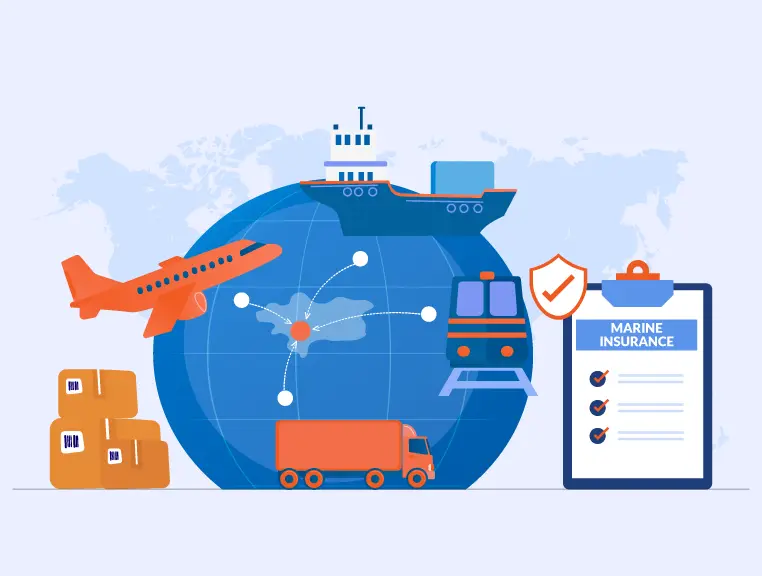



Every consignment that leaves a factory gate in India – whether it is travelling to Rotterdam by sea, to Dubai by air, or to a warehouse in Pune by road – carries a risk of loss or damage somewhere between origin and destination. Businesses use four terms almost interchangeably to describe the insurance that protects that journey: marine insurance, cargo insurance, freight insurance and shipping insurance. In practice, each term has a distinct legal meaning, a distinct buyer, and a distinct scope of cover. Confusing one for another can leave a genuine gap in protection at the exact moment you need a claim.
This guide untangles the four terms in plain, practical language for Indian exporters, importers, manufacturers, traders, freight forwarders, logistics companies and e-commerce businesses. It explains what each policy actually covers, who typically buys it, how the four products relate to one another, and how to decide which one – or which combination – fits a given shipment.
Ask five people in a logistics office to define “shipping insurance,” and you will likely get five different answers – some will describe cargo cover, others will describe freight liability, and a few will simply call all of it “marine insurance.” This is not a trivial mix-up. In the Marine Insurance Act, 1963, which governs marine cover in India, “marine insurance” is a specific legal contract with a defined scope. Cargo insurance and freight insurance are commercial products that sit under this broader marine umbrella, while “shipping insurance” is largely a retail and courier-industry term with no single statutory definition.
Key Takeaways
- Marine insurance is the broad umbrella category covering cargo, hull and liability under the Marine Insurance Act, 1963.
- The goods’ owner buys cargo insurance, and it pays out on a no-fault, declared-value basis.
- The forwarder or carrier buys freight insurance, and it pays out on a fault-based, weight/volume basis.
- Shipping insurance is an informal, lower-limit protection commonly used for parcels and smaller domestic shipments.
- A single shipment can, and often does, involve more than one of these policies working together – each protecting a different party’s interest.
- Matching the right policy to the right party, based on ownership of risk under the Incoterm, is the single most important decision in cargo protection.
Marine insurance is the broad legal and commercial category covering loss or damage to ships, cargo and freight interests during transit by sea, air, road, rail or a combination of these (multimodal transport).
Cargo insurance: The owner of the goods (exporter, importer, trader or manufacturer) buys cargo insurance to cover the full declared value of goods against loss or damage in transit.
Freight insurance: A freight forwarder or carrier typically arranges freight insurance to cover its own liability for loss or damage caused by its negligence, and it pays out based on weight or volume rather than the full value of goods.
Shipping insurance is a general, non-technical term – often used by couriers and e-commerce platforms – for basic cover against loss, theft or damage of a parcel in transit; it is narrower than a full marine cargo policy.
Definition & Scope Comparison
Before comparing the four products in detail, it helps to see them side by side. The table below summarises what each policy covers, who typically buys it, the main risk it addresses, and where Indian trade and logistics commonly use it.
| Insurance Type | What It Covers | Who Buys It | Main Risk Covered | Typical Use Cases |
|---|---|---|---|---|
| Marine Insurance | Loss or damage to cargo, hull, freight interest and related liabilities during transit by sea, air, road or rail | Exporters, importers, shipowners, traders, manufacturers | Physical loss, damage or total loss of the insured marine subject-matter | Export-import shipments, vessel owners, multimodal transport operators |
| Cargo Insurance | Full declared value of goods in transit, regardless of who is at fault | Cargo owner – exporter, importer, trader, manufacturer, e-commerce seller | Loss, theft, damage or non-delivery of the goods themselves | International and domestic consignments, high-value or fragile goods |
| Freight Insurance | Freight forwarder’s or carrier’s liability for loss/damage caused by their own negligence, usually capped by weight or volume | Freight forwarders, carriers, logistics companies, transporters | Legal liability of the transport provider, not the full value of the goods | Multi-client consolidated freight, trucking and forwarding operations |
| Shipping Insurance | Basic protection against loss, theft or damage of a parcel/shipment while in transit, often with lower limits | Individual shippers, small e-commerce sellers, courier customers | Non-delivery, damage or theft of the shipped item | Courier parcels, e-commerce fulfilment, small domestic consignments |
Understanding Marine Insurance
Marine insurance is the oldest and broadest of the four categories. Under Section 3 of the Marine Insurance Act, 1963, a contract of marine insurance is one where the insurer agrees to indemnify the insured against marine losses – that is, losses incidental to a marine adventure. This adventure is not limited to the sea leg alone; Indian law and standard market practice extend marine cover to incidental land, air and inland waterway transit connected with a sea voyage, which is why a marine policy still insures an export shipment moving by truck from a factory in Ludhiana to a port in Mundra.
Marine insurance generally splits into three broad branches. It protects the goods being transported. Marine hull insurance protects the vessel itself, along with its machinery and equipment, and shipowners buy it rather than cargo owners. Marine liability insurance, including protection and indemnity (P&I) cover, protects shipowners and operators against third-party liabilities such as collision, pollution or crew injury claims. For most Indian exporters and importers, “marine insurance” in everyday conversation actually means marine cargo insurance – the subset most relevant to businesses moving goods rather than owning ships.
Insurers commonly write marine cargo policies in India under the Institute Cargo Clauses (ICC), an internationally recognised set of clauses – ICC (A), ICC (B) and ICC (C) – that define the scope of cover from broadest to narrowest. ICC (A) is close to an all-risk cover, ICC (B) covers a defined list of perils such as fire, stranding, and washing overboard, and ICC (C) covers only major casualties like fire, explosion and vessel sinking. Choosing between them is a function of cargo type, route risk, and budget.
Understanding Cargo Insurance
Cargo insurance is the product most Indian exporters and importers actually transact when they say they are “taking marine insurance.” The owner of the goods – or whoever bears the risk of loss under the applicable trade term (Incoterm) – purchases this policy to protect the declared value of the goods while they travel from origin to destination.
The defining feature of cargo insurance is that it indemnifies the cargo owner regardless of who caused the loss. If incorrect stacking damages goods inside a container, a truck meets with an accident, a ship encounters heavy weather, or certain named perils strike with no clear party at fault, a cargo policy responds. This is fundamentally different from a liability-based product, where cover only triggers if a specific party – the carrier or forwarder – was negligent.
A business can buy cargo insurance as a single-transit policy for a one-off shipment, or as an open cover / annual turnover policy that automatically insures every eligible shipment it makes during the policy year. Exporters and importers who ship regularly usually find the open cover structure more efficient, since it removes the need to declare and insure each consignment individually.
Understanding Freight Insurance
Freight insurance is often the most misunderstood of the four terms because Indian trade uses the word “freight” loosely to mean both “the goods being transported” and “the charges paid for transporting them.” In an insurance context, freight insurance usually refers to liability cover taken by a freight forwarder, carrier or logistics company to protect itself against claims arising from loss or damage to a customer’s goods while those goods are in the forwarder’s custody.
Because freight insurance is a liability product, it typically responds only when the forwarder or carrier is shown to be negligent or at fault, and payouts are usually calculated on a weight or volume basis rather than the declared commercial value of the goods. A shipment of one kilogram of textiles and one kilogram of electronic components may attract the same freight liability payout per kilogram, even though their market values differ enormously. This is why freight insurance, however useful for the forwarder, is rarely a substitute for cargo insurance from the cargo owner’s point of view.
Freight insurance is not a mandatory cover in India, but most established freight forwarders and carrier legal liability policyholders maintain it as standard practice, since it protects their balance sheet from claims that could otherwise arise from a single damaged consignment. The cost of this cover is frequently built into the freight quotation passed on to the shipper, even though the shipper is not the named insured.
Understanding Shipping Insurance
Unlike marine, cargo and freight insurance, “shipping insurance” is not a term defined in Indian insurance law. It is a commercial, largely retail-facing label used by couriers, e-commerce logistics providers and some freight companies to describe basic protection against loss, theft or damage during transit. Shipping insurance is commonly bundled into a courier’s service offering, sold as an add-on at checkout on e-commerce platforms, or offered by parcel-delivery companies as a flat-rate protection plan.
Shipping insurance policies tend to have lower sums insured, simpler wording and narrower scope than a formal marine cargo policy underwritten by a general insurer. They are well suited to smaller, lower-value domestic parcels but are generally not adequate for high-value international consignments, project cargo, or goods that require cover against a wide range of named perils. Businesses that outgrow basic shipping insurance – because their shipment values, routes or risk exposure increase – typically graduate to a dedicated marine cargo policy.
Marine Insurance: the statutory, umbrella category of insurance covering marine adventures – cargo, hull and liability – under the Marine Insurance Act, 1963.
Cargo Insurance: a marine insurance sub-product bought by the cargo owner to cover the declared value of goods in transit.
Freight Insurance: liability cover bought by a forwarder or carrier for its own negligence-based exposure, typically paid on a weight/volume basis.
Shipping Insurance: an informal, retail-facing term for basic parcel or consignment protection, common in courier and e-commerce contexts.
Marine vs Cargo Insurance
The confusion between marine insurance and cargo insurance is understandable because, in most day-to-day business conversations, the two terms describe the same purchase. When an exporter says “I have taken marine insurance for this shipment,” they almost always mean they have taken a marine cargo policy. The distinction becomes important only when precision matters – for instance, when reading a policy wording, comparing quotes, or explaining coverage to a bank for a letter of credit.
Ownership and Who Is Insured
Several different parties can take out marine insurance, as a category, depending on which branch of the policy is in question. A shipowner takes marine hull insurance. A cargo owner takes marine cargo insurance. A charterer or operator may take marine liability cover. Cargo insurance, by contrast, always has one type of policyholder: the party that owns, or bears risk in, the goods being transported.
Coverage and Risks
Marine insurance as an umbrella term can extend to hull damage, machinery breakdown on a vessel, third-party liability, and general average contributions – none of which have anything to do with the value of a specific cargo owner’s goods. Cargo insurance is narrower and more specific: it exists purely to indemnify the value of the insured goods against the perils listed in the applicable Institute Cargo Clauses.
Practical Example
A textile exporter in Tiruppur ships knitwear to a buyer in Germany. The exporter buys a marine cargo insurance policy (a sub-type of marine insurance) covering the FOB or CIF value of the shipment under ICC (A) terms. Separately, the shipping line that owns the vessel carrying the container has its own marine hull and P&I insurance – cover the exporter never sees or pays for directly, but which exists under the same broad marine insurance umbrella.
Marine vs Cargo Insurance: Comparison Table
| Aspect | Marine Insurance (umbrella) | Cargo Insurance (sub-type) |
|---|---|---|
| Scope | Covers hull, cargo, freight interest and marine liabilities broadly | Covers only the goods being transported |
| Typical Policyholder | Shipowners, operators, cargo owners (depending on branch) | Cargo owner – exporter, importer, trader, manufacturer |
| Governing Framework | Marine Insurance Act, 1963; ICC clauses; P&I rules | Institute Cargo Clauses (ICC A/B/C) under a marine policy |
| Claim Trigger | Depends on branch – hull damage, liability event, or cargo loss | Physical loss, damage, theft or non-delivery of goods |
| Common Buyer Question | “What does my overall marine cover include?” | “Is my shipment’s value protected if it is lost or damaged?” |
Marine vs Shipping Insurance
People frequently use marine insurance and shipping insurance as synonyms in casual conversation, and in many contexts that substitution does no real harm. But from an underwriting and claims perspective, the two sit at different levels of formality, regulation and scope, and treating them as identical can lead a business to under-insure a valuable shipment.
Similarities
- Both aim to protect goods while they travel from one point to another.
- Both can, in principle, apply to sea, air, road, rail or multimodal movements.
- Buyers purchase both in anticipation of loss, damage or theft during the journey.
- Logistics or shipping providers frequently offer both alongside their services as an add-on.
Differences
An IRDAI-licensed general insurer formally regulates and underwrites marine insurance; the Marine Insurance Act, 1963, governs it, and insurers typically write it under internationally recognised Institute Cargo Clauses. It carries a defined legal framework for warranties, disclosure, subrogation and claims. A courier, logistics platform or e-commerce marketplace, in contrast, frequently offers shipping insurance as a value-added service or a simplified protection plan, and may not always underwrite it with the same rigour, sum-insured flexibility or clause-based structure as a formal marine cargo policy.
Scope and Coverage Depth
Insurers can write a marine cargo policy under ICC (A) terms for the full commercial invoice value of goods, plus a margin for anticipated profit, and it can respond to a broad range of perils unless specifically excluded. Shipping insurance plans usually cap cover at a fixed declared value or a maximum limit per shipment, and the list of covered events tends to be shorter and less negotiable. For high-value, fragile or export-critical shipments, relying on basic shipping insurance alone can leave a significant protection gap.
Industry Terminology and Common Misconceptions
Myth vs Reality
Misconception: “Shipping insurance and marine insurance are the same thing, just different names.”
Reality: Shipping insurance is usually a narrower, retail-style protection plan; marine insurance is a regulated, clause-based product with broader and more flexible scope.
Misconception: “If my courier offers shipping insurance, I do not need a separate cargo policy.”
Reality: For high-value, international or business-critical shipments, a dedicated marine cargo policy usually offers materially better protection and a clearer claims process.
Cargo vs Freight Insurance
People often confuse cargo and freight insurance because both relate to goods in transit, and shipping quotations frequently discuss both together. The clearest way to separate them is to ask a single question: who is the named insured, and what exactly does the policy protect – the value of the goods, or the liability of the party moving them?
Cargo Owner vs Freight Forwarder vs Carrier
A cargo owner – the exporter, importer, trader or manufacturer – buys cargo insurance to protect the value of their own goods. A freight forwarder arranges transportation on behalf of the cargo owner and typically buys freight insurance (often bundled with carrier legal liability cover) to protect itself from claims if its own negligence causes loss or damage. A carrier – a shipping line, airline, trucking company or railway – usually operates under its own liability regime, such as the Carriage of Goods by Sea Act or the Carriers Act, and may hold separate liability insurance for that exposure.
A logistics provider that both forwards freight and operates its own fleet may need to think about both sides: freight/liability insurance for its own operational exposure, and it may also facilitate – but not itself benefit from – the cargo insurance that its customers buy to protect their goods.
Practical Example
An electronics importer in Noida engages a freight forwarder to consolidate and ship components from Shenzhen. The importer takes a cargo insurance policy covering the full invoice value of the electronics. The freight forwarder separately carries freight liability insurance to protect itself if its own handling error damages any client’s cargo. If the shipment is damaged in a way unrelated to the forwarder’s negligence – say, a storm at sea – the importer’s cargo policy responds; the forwarder’s freight insurance may not, since no negligence occurred.
Cargo vs Freight Insurance: Comparison Table
| Aspect | Cargo Insurance | Freight Insurance |
|---|---|---|
| Who Buys It | Cargo owner (exporter, importer, trader, manufacturer) | Freight forwarder, carrier or logistics company |
| Basis of Cover | Full declared value of goods, regardless of fault | Forwarder/carrier’s liability, usually only if negligent |
| Payout Calculation | Based on invoice or declared commercial value | Usually based on weight or volume of goods |
| Trigger for Claim | Loss, damage, theft or non-delivery of goods | Proof of forwarder/carrier negligence or fault |
| Who Benefits Directly | The cargo owner | The forwarder/carrier (though cost may be passed on) |
| Mandatory in India? | Not legally mandatory, but commercially essential | Not legally mandatory; widely adopted as best practice |
Complete Comparison Table
The table below brings all four products together across the features that matter most when deciding which policy – or combination of policies – a shipment actually needs.
| Feature | Marine | Cargo | Freight | Shipping |
|---|---|---|---|---|
| Regulatory basis | Marine Insurance Act, 1963 | Sub-type of marine policy | General liability contract | Informal / platform terms |
| Typical buyer | Shipowner/cargo owner | Cargo owner | Forwarder/carrier | Individual shipper/seller |
| Sum insured basis | Varies by branch | Invoice / declared value | Weight or volume | Fixed/capped limit |
| Fault required? | Depends on branch | No | Usually yes | Varies by provider |
| Modes covered | Sea, air, road, rail, multimodal | Sea, air, road, rail, multimodal | Mode used by the forwarder | Usually courier/parcel networks |
| Best suited for | Shipowners, large exporters/importers | All cargo owners | Forwarders protecting their own risk | Small parcels, domestic e-commerce |
Scope Comparison
| Policy | Covers | Doesn’t Cover |
|---|---|---|
| Marine Insurance | Cargo, hull, and marine liability depending on the branch purchased | Non-marine risks unrelated to the insured adventure |
| Cargo Insurance | Full value of goods against listed perils during transit | Freight forwarder’s own liability; delay without physical loss (unless specifically added) |
| Freight Insurance | Forwarder/carrier liability for negligence-based loss or damage | Full commercial value of goods; losses with no proven negligence |
| Shipping Insurance | Basic loss, theft, or damage of the shipped parcel up to a set limit | High-value goods beyond the cap; many named perils covered under ICC (A) |
Buyer Comparison
| Buyer | Recommended Insurance |
|---|---|
| Exporter shipping high-value goods internationally | Marine cargo insurance (ICC A) – often as an open cover policy |
| Importer of machinery or capital equipment | Marine cargo insurance covering full replacement/invoice value |
| Freight forwarder handling multiple clients’ cargo | Freight/carrier legal liability insurance |
| Domestic manufacturer moving goods interstate | Inland transit insurance (a domestic cargo insurance variant) |
| E-commerce seller shipping via courier | Cargo insurance for bulk stock movement; shipping insurance for parcel-level cover |
| Shipping line/vessel owner | Marine hull insurance plus P&I liability cover |
Risk Comparison
| Risk | Marine | Cargo | Freight | Shipping |
|---|---|---|---|---|
| Fire/explosion | Covered (hull & cargo branches) | Covered | Only if forwarder negligent | Sometimes covered |
| Theft / pilferage | Depends on branch | Covered under ICC (A); limited under (B)/(C) | Only if forwarder negligent | Often covered with limits |
| Rough handling damage | Depends on branch | Covered under ICC (A) | Only if forwarder negligent | Rarely fully covered |
| Vessel sinking / total loss | Covered | Covered under all ICC clauses | Not directly relevant | Not typically covered |
| General average contribution | Covered | Covered | Not applicable | Not typically covered |
| Forwarder negligence | Not applicable | Not applicable (no-fault basis) | Core covered risk | Not applicable |
Cost Comparison (Illustrative Only)
Premiums for all four products depend on multiple variables, and insurers cannot quote fixed pricing without underwriting details. The table below lists the factors insurers typically weigh when calculating premiums for each product.
| Policy | Premium Factors |
|---|---|
| Marine Insurance | Vessel age and condition, trade route, cargo type, sum insured, claims history |
| Cargo Insurance | Nature of goods, packaging, route, mode of transport, declared value, ICC clause chosen |
| Freight Insurance | Volume/weight of freight handled, claims history, geographic spread, cargo categories carried |
| Shipping Insurance | Declared parcel value, delivery mode, destination, provider’s standard rate card |
Advantages & Limitations
| Insurance | Advantages | Limitations |
|---|---|---|
| Marine Insurance | Broad, internationally recognised framework; flexible across cargo, hull and liability needs | Can be complex to structure across multiple branches; needs expert broking |
| Cargo Insurance | Covers full declared value; no-fault basis; strong support for trade finance and letters of credit | Premium adds to landed cost; requires accurate value declaration |
| Freight Insurance | Protects forwarder’s balance sheet; often reduces disputes with clients | Payout basis (weight/volume) rarely matches true value of goods; fault must be proven |
| Shipping Insurance | Simple, fast to buy, low cost, convenient for small shipments | Lower limits; narrower peril list; often unsuitable for high-value or international cargo |
Exporter Decision Table
| Shipment Type | Recommended Insurance |
|---|---|
| First-time export, single consignment | Single-transit marine cargo policy (ICC A) |
| Regular monthly exports across multiple buyers | Open cover / annual turnover cargo policy |
| High-value machinery or project cargo | Marine cargo insurance with tailored clauses and survey requirements |
| Goods moved via multiple freight forwarders | Cargo insurance in the exporter’s own name, independent of forwarder cover |
| Domestic distribution between warehouses | Inland transit insurance policy |
Decision Framework
Use the step-by-step framework below to identify which insurance product fits a given shipment. Work through the questions in order – each answer narrows the recommendation.
Step 1 – Are you shipping goods?
No → You likely need marine hull or liability insurance (vessel/operator side), not cargo cover.
Yes → Go to Step 2.
Step 2 – Is the movement domestic or international?
Domestic → Consider inland transit insurance (a cargo insurance variant for movement within India).
International → Go to Step 3.
Step 3 – Do you own the cargo?
Yes → You need cargo insurance (marine cargo policy) to protect the value of your goods.
No, you are arranging transport for someone else’s cargo → Go to Step 4.
Step 4 – Do you own or operate the vessel/fleet?
Yes → You need marine hull insurance and P&I liability cover.
No, you are a forwarder/logistics provider → Go to Step 5.
Step 5 – Do you need protection against claims for your own negligence while handling clients’ freight?
Yes → You need freight/carrier legal liability insurance.
No, you only need basic loss/theft cover for smaller parcels → Consider shipping insurance as a supplementary, lower-cost option.
Cargo owner, international shipment, high value → Marine cargo insurance (ICC A recommended).
Cargo owner, domestic shipment → Inland transit insurance.
Freight forwarder/logistics company → Freight or carrier legal liability insurance.
Shipowner/vessel operator → Marine hull insurance plus P&I cover.
Individual seller / small parcel shipper → Shipping insurance, upgrading to cargo insurance as shipment value grows.
Which Insurance Fits Your Business?
The right policy depends less on industry label and more on one question: are you the owner of the goods, the mover of the goods, or the owner of the transport asset? The scenarios below map common Indian business types to the insurance product that best fits their exposure.
| Business Type | Typical Exposure | Recommended Insurance |
|---|---|---|
| Exporters | Own the goods until the risk transfers per the agreed Incoterm (FOB, CIF, etc.) | Marine cargo insurance, ideally as an open cover policy for regular shipments |
| Importers | Take on risk once goods are shipped or landed, depending on Incoterm | Marine cargo insurance covering full invoice/replacement value |
| Manufacturers | Move raw materials and finished goods between plants, warehouses and ports | Inland transit insurance for domestic legs; marine cargo insurance for export legs |
| Traders | Buy and sell goods, often without ever physically handling them | Cargo insurance in their own name to protect margin and contractual obligations |
| E-commerce Businesses | Ship high volumes of lower-value parcels via courier networks | Shipping insurance for parcel-level cover; cargo insurance for bulk stock transfers |
| Logistics Companies | Handle multiple clients’ goods without owning them | Freight/carrier legal liability insurance for their own negligence exposure |
| Shipping Companies | Own or operate vessels carrying cargo for various clients | Marine hull insurance plus P&I liability cover |
| Freight Forwarders | Arrange transport and consolidate cargo on behalf of shippers | Freight liability insurance, often paired with errors & omissions cover |
| SMEs | Typically ship lower volumes with tighter budgets | Single-transit cargo insurance scaled to shipment value; shipping insurance for smaller parcels |
| Large Enterprises | Ship high volumes across multiple routes and modes | Annual open cover marine cargo policy with negotiated clauses and survey terms |
Common Mistakes
Even experienced trading businesses make avoidable errors when choosing between marine, cargo, freight and shipping insurance. The most frequent mistakes include:
- Assuming the freight forwarder’s freight insurance protects the full value of the cargo owner’s goods.
- Relying on a courier’s basic shipping insurance for high-value or business-critical international shipments.
- Under-declaring the value of goods to reduce premiums, which can proportionately reduce the claim payout.
- Choosing ICC (C) – the narrowest cargo clause – purely on cost, without assessing route and handling risk.
- Not renewing or updating an open cover policy’s declared turnover as export volumes grow.
- Treating “marine insurance” and “cargo insurance” as always meaning the exact same scope of cover in contract wording.
- Failing to align the insured party (buyer or seller) with the Incoterm that determines who bears transit risk.
- Not appointing a surveyor promptly after a suspected loss, which can weaken a claim.
Practical Examples
Exporter shipping textiles overseas
A garment exporter in Tiruppur ships knitwear to a buyer in Hamburg on CIF terms.
Best-fit insurance: Marine cargo insurance (ICC A) – the exporter bears risk until the goods reach the buyer under CIF and must insure accordingly.
Importer buying machinery
A Pune-based manufacturer imports CNC machines from Germany on FOB terms.
Best-fit insurance: Marine cargo insurance taken by the importer, since risk transfers at the port of shipment under FOB.
Freight forwarder arranging international transport
A Mumbai-based forwarder consolidates cargo from multiple exporters into one container.
Best-fit insurance: Freight/carrier legal liability insurance to cover the forwarder’s own handling risk; each exporter separately insures their own cargo.
Shipping company operating vessels
A coastal shipping line operates bulk carriers along the Indian coastline.
Best-fit insurance: Marine hull insurance for the vessels plus P&I cover for third-party liabilities.
E-commerce company using courier logistics
An online retailer ships thousands of small parcels daily through courier partners.
Best-fit insurance: Shipping insurance at the parcel level, supplemented by cargo insurance for bulk warehouse-to-warehouse stock transfers.
Manufacturer transporting goods within India
An auto-components manufacturer moves parts between plants in Pune and Chennai by road.
Best-fit insurance: Inland transit insurance, a domestic cargo insurance variant covering road and rail movement
Trader using multimodal transportation
A commodities trader moves goods by rail to a port, then by sea, then by road to the buyer’s warehouse.
Best-fit insurance: Marine cargo insurance covering the entire multimodal journey under a single policy.
Logistics company managing third-party cargo
A 3PL warehouse and transport company handles inventory for several e-commerce brands.
Best-fit insurance: Freight/carrier liability insurance for its own operational exposure; brand owners separately insure their own stock value.
Myth vs Fact
The table below addresses the most common misconceptions Indian shippers hold about marine, cargo, freight and shipping insurance.
| Myth | Fact |
|---|---|
| Marine insurance only covers ships. | It also covers cargo and liability; hull cover is just one branch. |
| Cargo insurance and freight insurance are the same. | Cargo insurance protects the goods’ value; freight insurance protects the forwarder’s liability. |
| Shipping insurance covers every transit loss. | It typically covers a limited list of events, often below the value of a full marine cargo policy. |
| Freight insurance protects the cargo owner. | It primarily protects the forwarder or carrier against its own negligence claims. |
| Marine insurance is only for exporters. | Importers, traders, shipowners and manufacturers all use different branches of marine insurance. |
| Cargo insurance is mandatory in India. | It is not legally compulsory, though it is commercially essential and often required by buyers or banks. |
| Freight insurance covers vessel damage. | Vessel damage is covered under marine hull insurance, not freight liability cover. |
| Shipping insurance only applies to sea transport. | It commonly applies to courier, road and air parcel movements as well. |
| A single policy always covers the entire supply chain. | Different parties (owner, forwarder, carrier) often need separate, complementary policies. |
| Declaring a lower cargo value reduces risk. | It only reduces premium; it also proportionately reduces the claim payout. |
| ICC (C) is sufficient for all cargo types. | ICC (C) covers only major casualties; fragile or high-risk cargo usually needs ICC (A). |
| Marine insurance premiums are fixed by law. | Premiums are risk-based and vary by cargo, route, vessel and insurer. |
| Once goods are on the carrier’s vessel, the shipper has no further risk. | Risk transfer depends on the agreed Incoterm, not merely physical custody. |
| Freight forwarders are always liable for any cargo damage. | Liability under freight insurance applies only where negligence is established. |
Conclusion
Marine, cargo, freight and shipping insurance are related but distinct products, each protecting a different link in the transport chain. Marine insurance is the legal and commercial umbrella; cargo insurance protects the value of the goods for their owner; freight insurance protects the forwarder or carrier against its own liability; and shipping insurance offers a simpler, lower-cost layer of protection for smaller or domestic parcels. Getting this distinction right – and buying the correct combination for a given shipment – is what separates a business that recovers its losses smoothly from one that discovers a coverage gap only after something has gone wrong.
For exporters, importers, manufacturers, traders, freight forwarders and e-commerce businesses operating out of India, the safest approach is to treat cargo insurance as the default protection for owned goods, freight or liability insurance as the forwarder’s own safeguard, and shipping insurance as a supplementary, not a substitute, layer for lower-value parcels. Speaking with a marine insurance specialist before finalising cover ensures the right clauses, sums insured, and policy structure are in place before the next shipment leaves the dock.
Frequently Asked Questions
Q) What is the difference between Marine Insurance and Cargo Insurance?
A) Marine insurance is the broad legal category, defined under the Marine Insurance Act, 1963, that covers cargo, hull and marine liability. Cargo insurance is a specific sub-type of marine insurance bought by the owner of goods to protect their declared value during transit. In everyday usage, when businesses say “marine insurance,” they usually mean marine cargo insurance. The key distinction matters mainly when comparing policy wordings, since marine insurance can also refer to hull or liability cover that has nothing to do with a specific cargo owner’s goods.
Q) Is Freight Insurance different from Cargo Insurance?
A) Yes. Freight insurance is liability cover bought by a freight forwarder or carrier to protect itself against claims arising from its own negligence, and it usually pays out based on the weight or volume of goods. Cargo insurance is bought by the cargo owner to protect the full declared value of the goods, on a no-fault basis. A shipment can be protected by both policies at once, each covering a different party’s interest.
Q) What does Shipping Insurance cover?
A) Shipping insurance is a general, often courier or e-commerce-linked term for basic protection against loss, theft or damage of a parcel or shipment in transit. It typically has lower coverage limits and a narrower list of covered events than a formal marine cargo policy. It suits smaller domestic parcels well but is usually not adequate for high-value or international cargo, where a dedicated marine cargo policy offers stronger, more flexible protection.
Q) Which insurance should exporters buy?
A) Exporters should generally buy marine cargo insurance, ideally structured as an open cover or annual turnover policy if they ship regularly. The exact scope – ICC (A), (B) or (C) – depends on the nature of goods, the route, and the risk appetite of the business. Exporters shipping high-value or fragile goods typically choose ICC (A), the broadest clause available, to minimise the chance of an uninsured loss.
Q) Which policy protects freight charges?
A) Freight insurance is designed to protect the freight forwarder or carrier’s liability exposure rather than the freight charges themselves as a monetary sum. If a business wants to protect the actual freight cost paid, that protection is usually built into the cargo insurance sum insured, since most cargo policies allow the insured value to include freight and other incidental charges alongside the goods’ invoice value.
Q) Does Marine Insurance include Cargo Insurance?
A) Yes. Cargo insurance is one of the three main branches of marine insurance, alongside hull insurance and marine liability insurance. When a business buys a “marine policy” for an export or import shipment, they are almost always buying marine cargo insurance specifically, since hull and liability cover apply to shipowners and operators rather than cargo owners.
Q) Is Cargo Insurance mandatory in India?
A) Cargo insurance is not legally mandatory under Indian law for most shipments. However, it is commercially essential in practice, since buyers, banks issuing letters of credit, and trade finance arrangements frequently require proof of adequate cargo cover before releasing payment or shipping documents. Businesses that skip cargo insurance bear the full financial risk of loss or damage themselves.
Q) Who should buy Freight Insurance?
A) Freight insurance is typically bought by freight forwarders, carriers and logistics companies that handle goods belonging to multiple clients. It protects them against claims if their own negligence – such as mishandling, incorrect loading or documentation errors – causes loss or damage to a client’s cargo. Cargo owners generally do not buy freight insurance directly; they buy cargo insurance instead.
Q) Can Shipping Insurance cover inland transport?
A) Yes, many shipping insurance products offered by couriers and logistics platforms do cover inland road and rail movement, particularly for domestic parcel delivery. However, for larger or higher-value inland shipments, businesses are usually better served by an inland transit insurance policy, which is a domestic variant of marine cargo insurance offering broader and more flexible coverage.
Q) Which insurance is best for importers?
A) Importers should generally buy marine cargo insurance covering the full invoice or replacement value of the imported goods, especially where the Incoterm places transit risk on the importer, such as under FOB or EXW terms. This ensures the importer is protected from the point risk transfers, rather than relying solely on the seller’s or forwarder’s cover, which may not extend to their interest.
Q) What is the difference between Marine Cargo Insurance and Shipping Insurance?
A) Marine cargo insurance is a regulated product underwritten under the Marine Insurance Act, 1963, using internationally recognised Institute Cargo Clauses, and can be tailored to cover a wide range of perils at high sums insured. Shipping insurance is typically a simpler, capped-limit protection plan offered by couriers or e-commerce platforms, suitable for smaller parcels but generally insufficient for high-value or international consignments.
Q) Can one shipment require multiple insurance policies?
A) Yes, this is common. A single international shipment can involve the cargo owner’s marine cargo insurance, the freight forwarder’s freight liability insurance, and the shipping line’s marine hull and P&I cover – all operating simultaneously, each protecting a different party’s distinct financial interest in the same physical movement of goods.
Q) Is Marine Insurance only for sea transport?
A) No. Despite the name, marine insurance extends to incidental land, air and inland waterway transit connected with a marine adventure. For example, the truck journey from a factory to a port, or from a port to a buyer’s warehouse, is typically covered under the same marine cargo policy as the sea leg, provided the policy wording includes warehouse-to-warehouse cover.
Q) What insurance do logistics companies need?
A) Logistics companies that handle goods belonging to other businesses typically need freight or carrier legal liability insurance to protect against claims arising from their own negligence. If they also operate transport assets like trucks or warehouses, they may additionally need asset-specific covers such as motor fleet or fire insurance, separate from the cargo protection their clients arrange independently.
Q) What is the difference between transit insurance and cargo insurance?
A) Transit insurance and cargo insurance are closely related; “transit insurance” is often used specifically for domestic, inland movement of goods within India, while “cargo insurance” is more commonly used for international shipments under a marine policy. Both operate on similar principles – protecting the declared value of goods against loss or damage – but transit insurance policies are usually structured for domestic legal and logistical conditions.
Q) Which insurance covers goods during multimodal transportation?
A) A marine cargo insurance policy written with multimodal or combined transport cover is designed for exactly this scenario, protecting goods continuously as they move by rail, road, sea or air within a single journey. This avoids the risk of coverage gaps that could occur if separate policies were needed for each leg of a multimodal shipment.
Q) What risks are excluded under each insurance type?
A) Cargo insurance under ICC clauses typically excludes inherent vice, inadequate packing, wilful misconduct, and war or strikes unless separately added. Freight insurance excludes losses where no forwarder negligence is proven. Shipping insurance often excludes high-value items, certain fragile goods, or events beyond its stated cap. Marine hull insurance excludes wear and tear and pre-existing unseaworthiness.
Q) How do insurers decide which policy applies?
A) Insurers look at who holds insurable interest in the loss – that is, who suffers a genuine financial loss from the event – and match that party to the relevant policy. A cargo owner’s financial loss triggers cargo insurance; a forwarder’s legal liability triggers freight insurance; damage to the vessel itself triggers hull insurance. Correctly identifying insurable interest is central to a successful claim.
Q) What is the Institute Cargo Clauses (ICC) and why does it matter?
A) The Institute Cargo Clauses are internationally standardised wordings – ICC (A), (B) and (C) – that define the scope of cover under a marine cargo policy, from broadest (A) to narrowest (C). Choosing the right clause affects which perils are covered, making it one of the most important decisions when buying cargo insurance for any shipment.
Q) Do e-commerce businesses need cargo insurance or shipping insurance?
A) Most e-commerce businesses benefit from both, used for different purposes. Shipping insurance is well suited to individual parcel-level protection for customer deliveries, while cargo insurance is more appropriate for protecting bulk stock transfers between warehouses, factories or ports, where shipment values are typically much higher than a single retail parcel.
Q) What happens if goods are damaged but the forwarder was not negligent?
A) In this case, freight insurance is unlikely to respond, since it is a fault-based liability product. The cargo owner’s own cargo insurance policy, which operates on a no-fault basis, would typically be the correct route to recover the loss, provided the cause of damage is a peril covered under the applicable Institute Cargo Clauses.
Q) Can a manufacturer insure goods moving between its own factories?
A) Yes, this is a common use case for inland transit insurance, a domestic variant of cargo insurance. It protects goods moving between a manufacturer’s own facilities, warehouses or distribution centres within India against loss or damage, even though no sale transaction or change of ownership is involved in the movement.
Q) Who is the policyholder in a Marine Hull Insurance policy?
A) The policyholder in a marine hull insurance policy is typically the shipowner or vessel operator, since the policy protects the physical vessel, its machinery and equipment. Cargo owners have no insurable interest in the vessel itself and therefore do not purchase or benefit directly from hull insurance.
Q) What is P&I insurance and how does it relate to marine insurance?
A) Protection and Indemnity (P&I) insurance is a liability-focused branch of marine insurance, typically arranged through specialist P&I clubs, covering shipowners against third-party claims such as collision damage, pollution, or crew injury. It complements hull insurance, which covers physical damage to the vessel, rather than third-party liabilities.
Q) Does cargo insurance cover delay in delivery?
A) Standard cargo insurance under the Institute Cargo Clauses generally excludes pure delay, meaning financial loss caused only by late arrival with no physical loss or damage to the goods is typically not covered, unless a specific delay-related extension has been added to the policy.
Q) Is freight insurance the same as marine cargo insurance for forwarders?
A) No. Freight insurance protects the forwarder’s own liability exposure, while marine cargo insurance protects the value of the goods for their owner. A forwarder may hold freight liability insurance for its own protection while its clients separately hold marine cargo insurance for the goods being transported – the two operate independently.
Q) What documents are needed to buy cargo insurance in India?
A) Insurers typically require details of the goods, invoice value, packing method, mode of transport, route, and the applicable Incoterm. For an open cover policy, insurers also request estimated annual shipment turnover. Accurate documentation at the proposal stage helps ensure a smoother claims process later.
Q) Can shipping insurance be upgraded to cargo insurance?
A) Businesses do not “upgrade” one policy into another; rather, as shipment values, routes or risk exposure grow, businesses typically move away from basic shipping insurance and purchase a dedicated marine cargo insurance policy instead, since it offers materially broader cover, higher sums insured, and clearer claims procedures for growing trade volumes.
Q) Why do banks ask for marine insurance in letter of credit transactions?
A) Banks require evidence of adequate marine cargo insurance in letter of credit transactions to protect the financial interest they hold in the goods as collateral until payment is completed. Without proof of cover – usually a marine insurance certificate or policy – banks may refuse to process documents under the credit.
Q) What is the role of a surveyor in a cargo insurance claim?
A) A surveyor is appointed to inspect damaged or lost cargo, assess the cause and extent of loss, and provide an independent report that supports the insurance claim. Prompt survey appointment after a suspected loss is important, since delays can weaken the evidentiary basis of the claim.
Q) Does marine insurance cover war and strikes risks?
A) War, strikes, riots and civil commotion are typically excluded from standard Institute Cargo Clauses and require separate war risk and strikes clauses to be added to a marine cargo policy. Businesses shipping through higher-risk regions or routes should specifically discuss these extensions with their insurer or broker.
Q) How is the sum insured decided for a cargo insurance policy?
A) The sum insured for cargo insurance is usually based on the CIF (Cost, Insurance, Freight) invoice value of the goods, often with an additional margin – commonly around ten to fifteen percent – to account for anticipated profit, in line with standard marine insurance market practice.
Q) What is the difference between a single-transit policy and an open cover policy?
A) A single-transit cargo insurance policy covers one specific shipment for one journey. An open cover, or annual turnover policy, automatically covers every eligible shipment a business makes during the policy period, based on a declared estimated annual turnover, and is generally more efficient for businesses that ship regularly.