


Quick Answer
Introduction
Every consignment that leaves a factory gate, a port, or an airport carries risk. A container can be damaged in rough seas. A truck can meet with an accident on the highway. A pallet of electronics can be pilfered at a transhipment hub. Marine insurance exists to absorb this financial shock, and the type of policy you choose decides how well it does that job.
Many importers, exporters, and manufacturers in India buy a single marine policy and assume it covers everything. It rarely does. A one-shipment-a-year exporter has very different needs from a factory dispatching goods daily. This guide breaks down every major type of marine insurance policy available in India, explains when to use each one, and gives you comparison tables, decision tools, and real business examples to choose correctly.
Key Takeaways
- Marine insurance policy types are structured around shipment frequency and cargo predictability, not just cargo type.
- Open Cover and Open Policy are frequently confused but differ sharply in legal enforceability, sum insured structure, and cancellation notice.
- Specialised covers – Contingent Cargo, Special Cargo, and Air Freight Insurance – exist because standard cargo policies do not adequately address niche risks.
- Manufacturers with multiple internal transits should evaluate a Sales Turnover Policy rather than stacking multiple standalone policies.
- The right policy is chosen by mapping your shipment pattern against the decision matrix, not by defaulting to whatever was bought last year.
What Are Marine Insurance Policies?
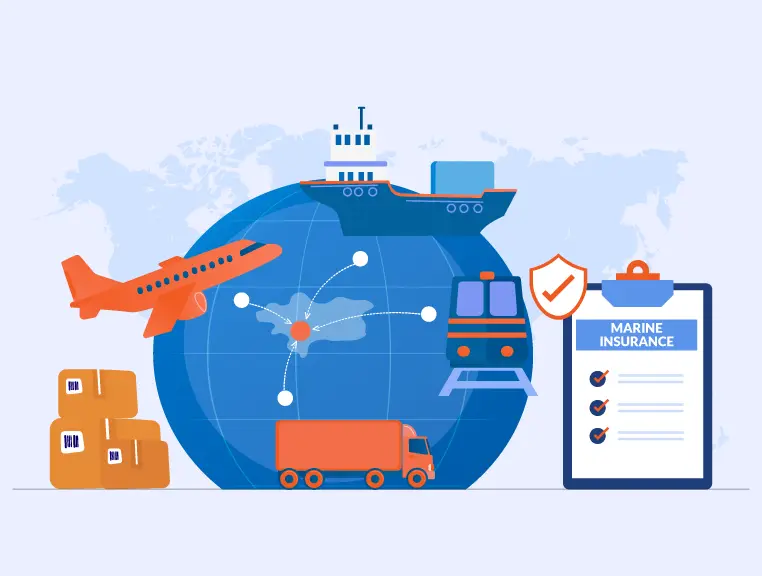
A marine insurance policy is a contract between an insurer and a policyholder (importer, exporter, manufacturer, or logistics company) that indemnifies against financial loss to cargo, freight, or the carrying vessel during transit. Despite the name, marine insurance in India covers sea, air, road, and rail movement – not just ocean voyages.
Marine insurance policies fall into two broad families:
- Cargo-specific policies – cover goods being transported (this is what most businesses need).
- Hull and liability policies – cover the vessel itself and third-party liabilities, used mainly by shipowners and carriers.
This guide focuses on cargo-related marine insurance policies, since that is what concerns importers, exporters, manufacturers, and traders.
Why Do Different Types of Policies Exist?
No two businesses ship the same way. A pharmaceutical exporter sending one consignment every quarter has different risk exposure than an e-commerce company dispatching hundreds of parcels daily. Insurers, therefore, structured marine policies around shipment frequency, predictability, and cargo value, so that:
- Frequent shippers are not burdened with paperwork for every single dispatch.
- Occasional shippers are not forced to buy expensive annual cover they will barely use.
- High-value or hazardous cargo gets underwriting attention proportionate to its risk.
Understanding this logic makes it much easier to pick the right policy rather than defaulting to whatever a broker sold you last year.
Overview of Marine Insurance Policy Types
Here is a snapshot before we go deep into each policy type:
| Policy Type | Ideal For | Typical Tenure |
| Cargo Marine Insurance | Any single or ongoing cargo movement | Per shipment or annual |
| Open Cover | High-frequency importers/exporters | 12 months |
| Open Policy (Floating) | Predictable annual turnover shippers | 12 months or until sum insured exhausts |
| Specific Voyage Policy | One-off or rare shipments | Single voyage |
| Time Policy | Vessel or fleet owners, fixed-period risks | Up to 12 months |
| Blanket Policy | Businesses with multiple locations/cargo types | 12 months |
| Sales Turnover Policy (STOP) | Manufacturers with multiple internal transits | 12 months |
| Contingent Cargo Insurance | Freight brokers | 12 months |
| Special Cargo Insurance | Pharma, electronics, machinery, hazardous goods | Per shipment or annual |
| Air Freight/Air Cargo Insurance | Air importers/exporters | Per shipment or annual |
Cargo Marine Insurance
Cargo marine insurance, sometimes just called a marine cargo policy, is the umbrella term for any policy protecting goods while in transit by sea, air, road, or rail. It typically covers loss or damage from fire, collision, capsizing, theft, pilferage, and natural calamities, depending on the Institute Cargo Clauses (A, B, or C) selected.
What It Covers
- Physical loss or damage to cargo during transit
- Loading and unloading risks
- Warehouse-to-warehouse cover in most policies
- General average contributions (a shared loss principle in maritime law)
Who Should Buy It
Any business that imports, exports, or moves goods domestically in bulk needs a marine cargo policy. It forms the base layer on top of which specific structures – open cover, time policy, blanket policy – are built.
Open Cover in Marine Insurance
An open cover is a standing arrangement between insurer and policyholder to automatically cover all shipments made during a policy period, typically 12 months, without negotiating fresh terms for every consignment.
How Open Cover Works
The insurer and insured agree in advance on rates, cargo types, packing conditions, and permitted voyages. Every shipment that fits these agreed parameters gets covered automatically – the policyholder just declares it.
Key Features
- Valid for 12 months, renewable annually
- No fixed aggregate sum insured – it covers unlimited shipments within the period
- Subject to “Per Bottom” (per vessel) and “Per Location” limits
- Cancellable with 30 days’ written notice
- Best suited to companies with continuous, high-value trade flows
Advantages
- Removes the need to insure every shipment separately
- Pre-agreed rates reduce administrative back-and-forth
- Automatic cover even for shipments declared slightly late, as long as they meet the agreed terms
Limitations
- Per Bottom and Per Location limits cap the insurer’s liability per vessel or warehouse
- Not a stamped, independently enforceable contract on its own – individual certificates are usually issued per declaration
Open Marine Policy (Floating Policy)
An open policy, also called a floating policy, is issued for an agreed aggregate sum insured. As shipments are declared, the sum insured reduces – much like a prepaid balance – until it is exhausted or the 12-month term ends.
How It Differs From Open Cover?
The critical distinction is the “exhaustion” factor. An open cover behaves like a subscription with no aggregate ceiling, while an open policy behaves like a prepaid card: every declared shipment eats into a fixed total.
Key Features
- A stamped, legally enforceable contract from day one
- Fixed sum insured that depletes with each declaration
- Ceases after 12 months or when the sum insured is exhausted, whichever comes first
- Cancellable with 15 days’ written notice
- Can be “topped up” with additional premium if the sum insured runs low
Best For
Businesses with a fairly predictable annual shipment value – for example, a mid-sized exporter who ships a known volume of goods worth roughly the same amount each year.
Open Cover vs Open Policy
This is one of the most commonly confused pairs in Indian marine insurance. Here is the clearest way to separate them.
Comparison Table: Open Cover vs Open Policy
| Feature | Open Cover | Open Policy (Floating Policy) |
| Legal Nature | An agreement to issue cover, not a standalone enforceable contract | A stamped, legally enforceable contract |
| Sum Insured | No fixed aggregate limit for the year | Fixed aggregate amount that reduces with each shipment |
| Tenure | Usually 12 months | Ceases after 12 months or on exhaustion of sum insured |
| Cancellation Notice | 30 days | 15 days |
| Best Suited For | Large, continuous, high-frequency traders | Businesses with predictable annual turnover |
| Key Limitation | Per Bottom and Per Location caps | Fixed sum insured can run out mid-year |
Quick Rule of Thumb
If your shipment volume is unpredictable but frequent, choose Open Cover. If your annual cargo value is fairly predictable, an Open Policy with a matched sum insured is usually more cost-efficient.
Specific Voyage Policy
A specific voyage policy, sometimes called a specific policy, covers a single, defined shipment from one named origin to one named destination. Once that voyage is complete, the policy automatically expires.
Who Should Buy It
- First-time exporters or importers
- Businesses shipping only occasionally – once a quarter or less
- One-off shipments of unusually high value that need bespoke terms
Advantages
- No annual commitment or ongoing premium
- Coverage tailored precisely to that one shipment’s route and cargo
- Simple to understand and administer
Limitations
- Needs to be arranged before every shipment, which is inconvenient for frequent traders
- Can work out more expensive per shipment compared to annual policies if shipping frequency increases
Time Policy
A time marine insurance policy covers cargo, a vessel, or a specific risk for a defined period of time, generally up to 12 months, rather than for a single voyage. It is less common for cargo owners and more relevant for vessel owners, though certain cargo risks (like stock in transit over a season) can also be time-bound.
Benefits of Time Marine Insurance Policy
- Coverage is not tied to a single voyage, so multiple movements within the period are protected
- Useful where the exact number or timing of voyages is not known in advance, only the overall period
- Simplifies renewal planning since the policy period is fixed and known upfront
Who Should Buy It
Shipowners, charterers, and businesses with time-bound but voyage-uncertain cargo movement – for example, seasonal exporters who know they will ship steadily for six months but cannot predict exact voyage dates.
Blanket Policy in Marine Insurance
A blanket policy provides broad, umbrella-style cover across multiple locations, cargo types, or business divisions under a single policy document, instead of arranging separate policies for each.
How It Works
Instead of insuring each warehouse, each product line, or each transit route separately, a blanket policy consolidates them into one sum insured and one set of terms. This is particularly useful for conglomerates or manufacturers with multiple factories and warehouses.
Advantages
- Single point of administration for multiple risks
- Often more cost-efficient than buying several standalone policies
- Reduces the chance of coverage gaps between different transit legs
Limitations
- Requires careful sum insured calculation across all locations to avoid under-insurance
- Claims involving multiple locations can take longer to assess
Who Should Buy It
Businesses with several factories, warehouses, or product categories that all face similar transit risks and want one consolidated marine insurance policy instead of many fragmented ones.
Sales Turnover Policy (STOP)
A sales turnover policy is a highly evolved marine cover suited to manufacturers where goods move several times internally before the final product is ready for sale – from raw material procurement to inter-factory transfer to final dispatch.
What Sales Turnover Policy Covers
Unlike a policy that covers only one leg of transit, STOP covers all internal and external movements under a single umbrella, including:
- Domestic purchase of raw materials and consumables
- Imports of components or raw materials
- Inter-factory, inter-warehouse, or inter-depot transfers
- To-and-fro job work movements
- Domestic sales dispatches
- Exports
How Premium Works?
The sum insured is set equal to the company’s expected annual sales turnover. Premium is charged based on periodic turnover declarations submitted by the policyholder – commonly monthly, with flexibility to declare any time before the 15th of the following month.
Advantages of Sales Turnover Policy
- Premium savings: consolidating multiple transit legs under one policy avoids buying overlapping covers
- Simplified administration: one policy instead of several transit-specific ones
- Flexible declarations: businesses can align declaration timelines with internal data availability
- Intermediate storage cover: many insurers extend cover to short-term storage between transit legs
- Flexible premium payment: quarterly or half-yearly payment options instead of a lump sum upfront
Who Should Buy It
Manufacturing businesses with multiple internal transits – auto component makers, FMCG manufacturers, textile units – where raw material, work-in-progress, and finished goods all move repeatedly between locations.
Air Freight / Air Cargo Insurance
Air freight insurance, also called air cargo insurance, protects goods transported by air against loss or damage during the journey, including ground handling at origin and destination airports.
What It Is
While often bundled under general marine insurance terminology, air cargo insurance is specifically structured around the risks of air transport – shorter transit times, different handling risks, and different loss patterns compared to sea freight.
Who Should Buy It
- Exporters and importers of time-sensitive goods (pharmaceuticals, perishables, electronics)
- E-commerce businesses shipping high-value items internationally by air
- Businesses using air freight for urgent or high-value low-volume shipments
Covered Risks
- Loss or damage during flight, loading, and unloading
- Theft or pilferage at airport warehouses
- Damage during ground handling and customs inspection
- Fire, crash, or accident-related loss
Common Exclusions
- Inherent vice (natural deterioration of goods, such as spoilage not caused by an insured peril)
- Inadequate packing
- Delay-related losses, unless specifically extended
- War and strikes, unless a separate extension is purchased
Air vs Sea Cargo Insurance
| Feature | Air Cargo Insurance | Sea Cargo Insurance |
| Transit Time | Hours to a couple of days | Days to several weeks |
| Premium Rate | Generally lower due to shorter exposure | Generally higher due to longer exposure |
| Typical Cargo | High-value, time-sensitive, perishable goods | Bulk goods, machinery, commodities |
| Risk Profile | Handling damage, theft at airports | Weather, piracy, prolonged transit exposure |
| Claim Frequency | Lower frequency, often handling-related | Higher frequency, more varied causes |
Premium Factors for Air Cargo Insurance
- Nature and value of the cargo
- Route and number of transhipment points
- Packaging standard
- Airline and airport handling reputation
- Claims history of the policyholder
Typical Claims in Air Cargo
Handling damage during loading/unloading, theft of high-value electronics at transit hubs, and damage from rough tarmac handling are among the most common claim types seen in air cargo insurance.
Example
An electronics importer bringing in mobile phone components from East Asia by air typically insures each air waybill shipment, since the value per shipment is high but the transit time is short – making air cargo insurance cost-efficient relative to the value protected.
Contingent Cargo Insurance (Expanded)
Definition
Contingent cargo insurance is a specialised marine cover, primarily used by freight brokers, that fills the gap when a carrier’s general cargo insurance fails to pay a claim – due to insufficient limits, exclusions, or policy cancellation. The word “contingent” reflects that this insurance is secondary, not primary, cover.
When It Applies
It comes into play only after the primary cargo policy (held by the carrier or shipper) has failed to settle a legitimate claim. It does not replace standard cargo insurance – it protects the freight broker’s reputation and finances when the carrier’s insurer does not pay.
Who Should Purchase Contingent Cargo Insurance?
Freight brokers who arrange transportation between shippers and carriers but do not own the cargo themselves. While not legally mandatory, many established shippers only work with brokers who carry this cover, since it signals financial accountability.
Common Scenarios
- A carrier’s cargo policy has coverage limits lower than the shipment value
- The carrier’s insurer denies a claim citing damage exclusions
- The carrier’s cargo policy has lapsed or been cancelled without the broker’s knowledge
Difference From Cargo Insurance
| Aspect | Cargo Insurance | Contingent Cargo Insurance |
| Primary/Secondary | Primary cover | Secondary, activates on primary failure |
| Who Buys It | Shipper or carrier | Freight broker |
| When It Pays | On any covered loss | Only when carrier’s insurer refuses to pay |
| Legal Requirement | Often expected in trade contracts | Not legally mandatory |
Buyer vs Seller Responsibilities Under Incoterms
Responsibility for arranging marine insurance depends on the Incoterm used in the trade contract:
- Under CIF (Cost, Insurance, Freight), the seller arranges and pays for cargo insurance.
- Under FOB (Free on Board), the buyer is responsible for insuring the goods once they cross the ship’s rail.
- Under EXW (Ex Works), the buyer bears risk and insurance responsibility from the seller’s premises itself.
Freight brokers sit outside this buyer-seller insurance chain, which is exactly why contingent cargo insurance exists as an independent safety net for them.
Example
A freight broker arranges transport for an exporter’s machinery consignment. The carrier’s cargo policy caps liability below the shipment value. When the machinery is damaged in transit, the carrier’s insurer pays only a partial amount. The exporter turns to the broker for the shortfall – and the broker’s contingent cargo insurance settles that gap.
Special Cargo Insurance (Expanded)
A special cargo insurance policy is designed for goods that carry higher-than-average risk or need underwriting terms that a standard cargo policy does not offer.
Why These Cargoes Need Specialised Underwriting
Standard marine cargo policies are priced and structured for general merchandise. Cargoes with unusual value, fragility, sensitivity, or hazard profiles need customised clauses, valuation methods, and claim protocols – which is what special cargo insurance provides.
Categories Typically Covered
Pharmaceuticals: Temperature-sensitive medicines and vaccines need cold-chain monitoring clauses and cover for spoilage due to temperature excursions, not just physical damage.
Chemicals: Chemical cargo often needs pollution liability considerations and specific packing-condition clauses, since leakage risk is higher and can trigger third-party claims.
Electronics: High-value, fragile, and highly resalable (making them theft targets), electronics need tighter theft and handling-damage cover along with agreed value clauses.
Perishable Goods: Fruits, vegetables, seafood, and dairy require cover structured around spoilage risk, often with reefer container breakdown as a named peril.
High-Value Machinery: Large capital equipment needs project-specific valuation, often insured on an “as erected” or installation-inclusive basis rather than just transit value.
Hazardous Cargo: Explosives, flammable materials, and dangerous goods need specialised hazard clauses and compliance with IMDG (International Maritime Dangerous Goods) code-linked underwriting.
Artwork: Fine art and antiques need agreed-value cover (not market-value-at-loss cover) and specialist handling clauses, since standard depreciation logic does not apply.
Project Cargo: Oversized, heavy-lift shipments for infrastructure and industrial projects need route surveys, lifting-risk clauses, and often multiple modes of transport insured under one umbrella.
Who Should Buy Special Cargo Insurance
Any business dealing in the categories above should avoid standard cargo policies and instead work with a broker to structure special cargo terms, since standard exclusions can otherwise leave significant gaps.
Complete Policy-Type Comparison Table
| Policy Type | Best For | Shipment Frequency | Coverage Period | Key Benefits | Limitations |
| Open Cover | Large, continuous traders | High, frequent, unpredictable volume | 12 months | No aggregate limit; automatic cover | Per Bottom/Location caps |
| Open Policy | Predictable annual shippers | Moderate to high, predictable value | 12 months or till exhaustion | Enforceable contract; simple top-up | Sum insured can run out |
| Specific Voyage Policy | One-off shippers | Very low (rare shipments) | Single voyage | No annual commitment; tailored terms | Needs arranging every time |
| Time Policy | Vessel owners, seasonal cargo | Period-bound, voyage count uncertain | Up to 12 months | Covers multiple voyages in a period | Less relevant for pure cargo owners |
| Blanket Policy | Multi-location businesses | Any frequency, multiple sites | 12 months | Single policy for multiple risks | Needs careful sum insured planning |
| Sales Turnover Policy | Manufacturers with internal transits | Very high, continuous | 12 months | Covers all internal + external legs | Requires accurate turnover forecasting |
Decision Matrix by Shipment Pattern
| Shipment Pattern | Recommended Policy |
| One shipment per year | Specific Voyage Policy |
| Monthly imports | Open Policy or Open Cover, depending on value predictability |
| Daily dispatches | Sales Turnover Policy or Open Cover |
| Seasonal shipments | Time Policy |
| E-commerce logistics | Blanket Policy or Open Cover |
| Domestic distribution across multiple warehouses | Blanket Policy |
| Global exports, high and steady volume | Open Cover |
| High-value machinery, one-off movement | Special Cargo Insurance (Specific Voyage basis) |
Which Marine Insurance Policy Should You Buy?
Use this decision path based on your business profile.
Decision Tree: Which Marine Insurance Policy Is Right for You?
- Importer or Exporter shipping rarely (a few times a year) → Specific Voyage Policy
- Importer or Exporter shipping frequently with predictable annual value → Open Policy
- Importer or Exporter shipping frequently with unpredictable, high volumes → Open Cover
- Manufacturer with multiple internal transits (raw material to finished goods) → Sales Turnover Policy
- Trader with goods across multiple warehouses or product categories → Blanket Policy
- Logistics Company or Freight Forwarder → Cargo Insurance for owned risk, plus Contingent Cargo Insurance as a broker safety net
- Domestic Transporter with steady road/rail movement → Open Cover or Sales Turnover Policy, depending on internal transit complexity
- E-commerce Seller with frequent domestic dispatches → Blanket Policy or Open Cover, depending on warehouse spread
Practical Examples
A manufacturer shipping goods daily within India. A textile manufacturer with a factory, a dyeing unit, and three regional warehouses moves goods almost every day. A Sales Turnover Policy fits best, since it covers every internal transit leg – raw material, inter-factory transfer, and final dispatch – under one umbrella instead of dozens of individual movements.
An exporter sending one shipment every quarter. A small handicrafts exporter ships once every three months to different buyers. A Specific Voyage Policy makes more sense than an annual policy, since paying for 12 months of standing cover for four shipments a year is not cost-efficient.
A pharmaceutical company exporting temperature-sensitive products. A vaccine exporter needs Special Cargo Insurance structured around cold-chain risk, layered on top of either an Open Cover (if exports are frequent) or a Specific Voyage Policy (if exports are occasional).
An importer receiving machinery from Europe. A one-time import of a manufacturing line from Germany calls for a Specific Voyage Policy with Special Cargo Insurance terms for high-value machinery, given the size, weight, and installation-linked risk involved.
An online retailer with frequent domestic dispatches. An e-commerce seller dispatching hundreds of parcels daily across India from two warehouses is best served by a Blanket Policy, which consolidates cover across both locations and multiple product categories under one policy.
Common Buying Mistakes
- Assuming one policy covers everything. Cargo insurance, hull insurance, and liability insurance serve different purposes – check which risk you are actually transferring.
- Under-declaring shipment value to save premium. This directly reduces the claim payout during a loss.
- Ignoring Per Bottom and Per Location limits under Open Cover, leading to partial recovery on large single-vessel shipments.
- Letting an Open Policy’s sum insured run out without monitoring consumption, leaving later shipments uninsured.
- Buying standard cargo cover for special-risk goods like pharmaceuticals or hazardous chemicals, resulting in claim rejections on technical exclusions.
- Not verifying Incoterm-based insurance responsibility, leading to disputes over who should have bought the policy.
- Overlooking inland transit insurance for the road/rail leg before or after the sea or air voyage.
Myth vs Fact
| Myth | Fact |
| Marine insurance only covers sea transport | It also covers air, road, and rail transit under most modern policies |
| Open Cover and Open Policy are the same thing | They differ in legal enforceability, sum insured structure, and cancellation notice |
| A single marine policy covers all types of goods | High-risk cargo like pharma, chemicals, and hazardous goods needs special cargo terms |
| Air cargo insurance is always costlier than sea cargo insurance | Air cargo premiums are often lower per shipment due to shorter transit exposure |
| Contingent cargo insurance is the same as regular cargo insurance | It is a secondary cover for freight brokers, not a primary cargo policy |
| Marine insurance is only for exporters and importers | Domestic transporters and e-commerce sellers need it too, for inland transit |
| Once bought, a Sales Turnover Policy needs no further declarations | Periodic turnover declarations are required to keep the policy active and accurate |
| Under-declaring cargo value reduces premium without downside | It proportionately reduces the claim payout under the principle of average |
| Marine insurance premiums are fixed across insurers | Premiums vary by cargo type, route, packing, and claims history |
| A Specific Voyage Policy can be used for regular monthly shipments | It is designed for one-off shipments, not recurring high-frequency trade |
| Open Cover has no coverage limit at all | It is still capped by Per Bottom and Per Location limits |
| Marine insurance claims are settled instantly | Claims require survey, documentation, and verification, typically taking a few weeks |
Conclusion
Choosing the right marine insurance policy is not about picking the most comprehensive-sounding name – it is about matching the policy structure to how your business actually ships. A one-shipment exporter overpays with an annual Open Cover, while a daily-dispatch manufacturer is under-protected with a Specific Voyage Policy bought shipment by shipment. Use the comparison tables and decision matrix in this guide to map your shipment frequency, cargo sensitivity, and trade pattern to the policy structure that actually fits – and revisit that choice as your business scales.
Frequently Asked Questions (FAQs)
Q) What are the different types of Marine Insurance policies?
A) The main types are Open Cover, Open Policy, Specific Voyage Policy, Time Policy, Blanket Policy, and Sales Turnover Policy. Businesses also use specialised covers like Contingent Cargo Insurance, Special Cargo Insurance, and Air Freight Insurance depending on their trade pattern and cargo type.
Q) What is an Open Cover in Marine Insurance?
A) An Open Cover is a 12-month standing agreement where the insurer automatically covers all shipments made by the policyholder within agreed terms, without needing a fresh negotiation for every consignment. It is best suited to businesses with frequent, high-volume shipments.
Q) What is the difference between Open Cover and an Open Policy?
A) An Open Cover has no fixed aggregate sum insured and covers unlimited shipments within a year, subject to per-vessel limits. An Open Policy has a fixed sum insured that reduces with every declared shipment until it is exhausted or the year ends.
Q) What is a Specific Voyage Policy?
A) A Specific Voyage Policy covers a single, named shipment from one origin to one destination. It expires automatically once that voyage is complete, making it ideal for businesses that ship only occasionally.
Q) What is a Blanket Marine Insurance Policy?
A) A Blanket Policy consolidates cover for multiple locations, warehouses, or cargo types under one policy document instead of separate policies for each, simplifying administration for businesses with spread-out operations.
Q) What is a Sales Turnover Policy?
A) A Sales Turnover Policy (STOP) covers all internal and external transit legs of a manufacturing business – from raw material procurement to inter-factory transfer to final dispatch – under a single policy, with the sum insured based on expected annual turnover.
Q) What is Contingent Cargo Insurance?
A) Contingent Cargo Insurance is a secondary cover for freight brokers that pays out when a carrier’s primary cargo insurance fails to settle a valid claim, protecting the broker’s finances and reputation.
Q) Who should buy Contingent Cargo Insurance?
A) Freight brokers who arrange shipments between shippers and carriers, but do not own the cargo, should buy this cover. It is not legally mandatory but is often expected by shippers who want assurance of financial accountability.
Q) What is a Special Cargo Insurance Policy?
A) Special Cargo Insurance is a customised policy for goods with higher-than-average risk, such as pharmaceuticals, chemicals, electronics, perishables, machinery, hazardous materials, and artwork, since standard cargo policies do not adequately cover their unique risks.
Q) What is Air Cargo Insurance?
A) Air Cargo Insurance covers goods transported by air against loss or damage, including risks during ground handling, loading, and unloading. It is typically used for time-sensitive, high-value, or perishable shipments.
Q) Which Marine Insurance policy is best for exporters?
A) It depends on frequency: occasional exporters should choose a Specific Voyage Policy, while regular exporters with predictable volumes benefit from an Open Policy, and high-volume exporters are better suited to an Open Cover.
Q) Which policy is suitable for businesses shipping goods every day?
A) Businesses shipping daily, especially manufacturers with multiple internal transits, are best served by a Sales Turnover Policy or an Open Cover, depending on whether the movement is primarily internal or external.
Q) Can one Marine Insurance policy cover all shipments?
A) Yes, an Open Cover or Sales Turnover Policy can cover all shipments made within the policy period, as long as they fall within the agreed cargo types, routes, and value limits.
Q) What is the difference between Cargo Insurance and Marine Insurance?
A) Marine insurance is the broader category covering cargo, hull, and liability risks. Cargo insurance is a subset of marine insurance that specifically protects goods in transit, which is what most importers and exporters actually need.
Q) Which Marine Insurance policy is best for high-value goods?
A) High-value goods such as machinery, electronics, or artwork need a Special Cargo Insurance policy with agreed-value clauses, often layered on top of an Open Cover or Specific Voyage Policy depending on shipment frequency.
Q) Does Marine Insurance cover inland transit?
A) Yes, most modern marine cargo policies in India offer warehouse-to-warehouse cover, which includes the inland road or rail leg before and after the sea or air voyage, though this should be confirmed in the policy wording.
Q) What policy should e-commerce businesses use?
A) E-commerce businesses with multiple warehouses and frequent domestic dispatches generally benefit most from a Blanket Policy, which consolidates cover across locations and product categories.
Q) How do I choose the right Marine Insurance policy?
A) Choose based on shipment frequency, cargo value predictability, and cargo sensitivity. Occasional shippers should pick voyage-specific cover, frequent shippers should pick annual cover, and sensitive cargo needs special underwriting regardless of frequency.
Q) What documents are required to buy a Marine Insurance policy?
A) Typically required documents include invoice details, packing list, mode of transport, route information, cargo description and value, and past claims history if renewing or switching insurers.
Q) How are Marine Insurance premiums calculated?
A) Premiums are calculated based on cargo type, value, shipping route, packing standard, vessel or carrier type, and the policyholder’s claims history, with riskier cargo and routes attracting higher rates.
Q) What is the difference between Open Cover and Time Policy?
A) Open Cover is shipment-declaration based and covers cargo across multiple voyages within a year. A Time Policy covers a defined period regardless of the number of voyages, and is more commonly used for vessels than standalone cargo.
Q) Is Marine Insurance mandatory in India?
A) Marine insurance is not universally mandatory by law, but it is often required contractually under Incoterms like CIF, and lenders or letters of credit frequently mandate proof of coverage for trade finance purposes.
Q) What happens if a shipment is not declared under an Open Policy?
A) Most Open Policies include an automatic coverage clause that protects undeclared shipments as long as they meet the agreed terms, but the policyholder must declare the shipment and pay the premium as soon as the oversight is identified.
Q) Can a Sales Turnover Policy cover exports as well as domestic transit?
A) Yes, a Sales Turnover Policy is designed to cover the full chain of movement, including domestic raw material transit, inter-factory transfers, domestic sales, and exports, under one consolidated sum insured.
Q) What is the ideal policy for a business with seasonal shipping patterns?
A) A Time Policy is often ideal for seasonal shippers, since it covers a defined period rather than a fixed number of voyages, accommodating uncertainty in exact shipment dates within that season.