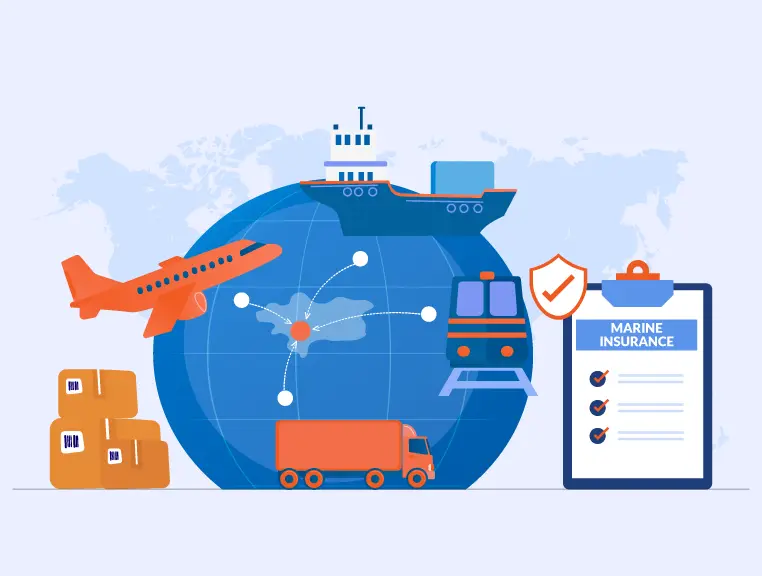



Every consignment that leaves a factory gate, a warehouse, or a port terminal is exposed to risk the moment it starts moving. A container can topple during a crane lift, a truck can overturn on a highway, a vessel can encounter rough seas, or a cargo hold can catch fire mid-voyage. None of these events are rare in the world of trade and logistics, and each one can turn a profitable shipment into a significant financial loss.
This guide explains, in practical and India-specific terms, why Marine Insurance is important for anyone who buys, sells, manufactures, forwards, or moves goods domestically or internationally. It covers the risks involved in transporting goods, the different types of Marine Insurance cover, the responsibilities of the insured, and role-specific guidance for exporters, importers, manufacturers, freight forwarders, logistics companies, wholesalers, retailers, and e-commerce businesses.
Marine Insurance protects the financial value of goods in transit against loss or damage from hazards such as accidents, fire, theft, rough handling, natural disasters, and other transit risks. Without it, a single damaged or lost consignment is paid for entirely out of pocket, which can erase months of margin on a single shipment.
What Is Marine Insurance?
Definition–
Marine Insurance is a contract under which an insurer agrees to indemnify the insured, in the manner and to the extent agreed, against loss of or damage to goods, freight, or other insurable interest during transit by sea, air, rail, or road. In India, the Marine Insurance Act, 1963, governs marine insurance contracts, and the Insurance Regulatory and Development Authority of India (IRDAI) regulates insurers.
Although the word “marine” suggests sea transport, a Marine Cargo Insurance Policy in India typically covers the entire transit journey – from the seller’s warehouse to the buyer’s warehouse – including inland road or rail legs, port handling, and the ocean or air freight leg. This is often called “warehouse-to-warehouse” cover.
Key Takeaways
- Marine Insurance covers goods in transit against accidents, fire, theft, rough handling, and other insured perils, typically warehouse-to-warehouse.
- Every stakeholder in the supply chain – exporters, importers, manufacturers, freight forwarders, logistics companies, wholesalers, retailers, and e-commerce sellers – carries some form of transit risk.
- Small and frequent shipments benefit from Open Cover or blanket policies rather than being left uninsured.
- The insured has ongoing duties: accurate disclosure, proper packaging, prompt loss notice, and cooperation with surveyors.
- Emerging risks such as cyberattacks, climate volatility, and geopolitical disruption mean cover should be reviewed periodically, not bought once and forgotten.
Key Types of Marine Insurance Policies
- Specific Voyage Policy: covers one consignment for a single, defined journey.
- Open Cover / Annual Policy: covers all shipments made by a business over a policy year, useful for frequent exporters and importers.
- Duty Insurance Policy: covers customs duty paid on imported goods that are lost or damaged before clearance, so the duty amount is not wasted on unusable cargo.
- Sales Turnover Policy: an open policy structured around the insured’s projected annual sales turnover rather than individual shipment declarations.
- Inland Transit Policy: covers movement of goods entirely within the country, by road or rail, without an international sea or air leg.
Why Marine Insurance Matters?
Trade runs on trust between buyer and seller, but physical risk does not respect contracts. Once goods leave the seller’s premises, dozens of variables outside anyone’s control – weather, road conditions, port congestion, handling quality, and even criminal activity – can affect whether the shipment arrives intact. Marine Insurance matters because it converts an unpredictable, potentially business-ending loss into a fixed, budgeted cost: the premium.
Financial protection: A single container loss can run into lakhs or crores of rupees. Marine Insurance absorbs this shock instead of the business absorbing it directly.
Business continuity: Claim payouts allow a business to replace or repair goods and keep serving customers, rather than renegotiating contracts or writing off revenue.
Contractual and regulatory expectations: Many buyers, banks, and letter-of-credit terms require proof of adequate cargo insurance before releasing payment or documents.
Competitive credibility: Insured exporters and forwarders are viewed as more reliable trading partners, since they can absorb transit disruptions without defaulting on delivery commitments.
Risks of Transporting Goods: Marine Hazards Explained
Marine Hazards are the physical, environmental, and man-made events that can cause loss or damage to cargo in transit. Understanding these hazards is the first step to appreciating why a Marine Insurance Cover is not optional risk management – it is essential risk management.
| Hazard | Potential Loss | Insurance Response |
|---|---|---|
| Storms and cyclones | Cargo washed overboard, water ingress, vessel delay | Covered under standard Institute Cargo Clauses (A) and, with restrictions, Clauses (B) |
| Rough seas and heavy weather | Container shifting, breakage, wetting damage | Covered under Clauses (A) and (B); partly under (C) if it causes a listed peril |
| Piracy and theft | Full or partial cargo loss, pilferage | Covered under Clauses (A); piracy covered under (B) and (C) as well |
| Fire and explosion | Total or partial loss of cargo and packaging | Covered under all standard clause sets (A, B, and C) |
| Water damage/wetting | Spoilage of moisture-sensitive goods | Covered under (A) and (B); excluded under basic (C) unless vessel is stranded or sunk |
| Loading and unloading accidents | Dropped cargo, crane failure, crushing damage | Covered under (A); covered under (B) only if it falls within listed perils |
| Cargo shifting in transit | Damage from movement inside container or hold | Covered under (A); generally excluded under (C) |
| Container loss overboard | Total loss of container and contents | Covered under (A) and (B) as a named peril |
| Port congestion and delays | Demurrage costs, spoilage of perishables, missed sales windows | Delay itself is typically excluded; consequential spoilage may be covered under (A) with extensions |
| Political risks and war | Seizure, confiscation, blockade | Covered only with War Clauses (Cargo) as an add-on |
| Strikes and civil commotion | Damage or loss during strikes, riots, lock-outs | Covered only with Strikes Clauses (Cargo) as an add-on |
| Natural disasters (earthquake, flood) | Warehouse or in-transit damage | Covered under (A); situational under (B) |
Types of Marine Losses
Marine losses fall into distinct legal and insurance categories. Knowing the difference helps a business understand what a claim settlement will actually look like.
| Type of Loss | Example | Covered? |
|---|---|---|
| Total Loss (Actual) | Ship sinks with cargo; goods destroyed | Yes, under standard cargo policies |
| Constructive Total Loss | Cost of recovering and repairing cargo exceeds its recovered value | Yes, if the insured abandons the goods to the insurer |
| Particular Average (partial loss) | One pallet in a container is water-damaged; the rest is intact | Yes, under Clauses (A) and (B); limited under (C) |
| General Average | Cargo is jettisoned to save the vessel; all cargo owners share the cost | Yes, contribution is recoverable under standard policies |
| Salvage Loss | Damaged goods sold at a reduced price to recover some value | Yes, insurer pays the difference between insured value and salvage proceeds |
| Total Loss of Part of Consignment | One of ten containers is lost; the other nine arrive safely | Yes, treated as a partial claim on the whole insured shipment |
Emerging Transportation Risks
Global trade risk has evolved well beyond storms and theft. Businesses transporting goods today face a newer set of exposures that traditional risk assessments sometimes miss.
- Climate change and extreme weather: More frequent and severe storms are increasing the unpredictability of ocean and coastal routes, and flood-related warehouse losses are rising in Indian port cities.
- Supply chain disruptions: Congestion at major transshipment hubs, container shortages, and rerouting around conflict zones extend transit times and raise handling risk.
- Cyberattacks on shipping systems: Port operating systems, vessel navigation platforms, and container-tracking software have all been targeted, disrupting cargo movement and documentation.
- Geopolitical conflicts: Shipping lane disruptions near contested waters have forced longer, riskier rerouting for vessels carrying Indian export and import cargo.
- Port automation failures: Increasing reliance on automated cranes and terminal systems introduces new mechanical and software failure points during loading and unloading.
- Smart container technology risks: IoT-enabled containers improve tracking but also introduce data and sensor failure risks that can complicate loss documentation.
These emerging risks reinforce why static, one-time risk assessments are no longer enough – Marine Insurance Cover needs to be reviewed periodically as trade routes, technology, and geopolitics shift.
Comprehensive Risk Matrix
| Risk | Likelihood | Business Impact | Marine Insurance Response |
|---|---|---|---|
| Storm/cyclone damage | Medium | High | Covered under Clauses (A)/(B) |
| Theft / pilferage | Medium | Medium-High | Covered under Clauses (A); limited under (B)/(C) |
| Fire on vessel or in warehouse transit | Low-Medium | High | Covered under all standard clause sets |
| Port congestion/delay | High | Low-Medium | Delay excluded; consequential loss may need extension |
| Cyberattack on shipping systems | Medium | Medium | Requires specific cyber-extension; not automatic |
| War / political seizure | Low | Very High | Requires War Clauses (Cargo) add-on |
| Strikes / civil unrest | Low-Medium | Medium-High | Requires Strikes Clauses (Cargo) add-on |
| Rough handling/drops | High | Medium | Covered under Clauses (A); situational under (B) |
| Container loss overboard | Low | High | Covered under (A)/(B) as named peril |
| Spoilage of perishable cargo | Medium-High | High | Requires specialised perishable cargo cover |
Role-Based: Why You Need Marine Insurance
Marine Insurance is not a one-size-fits-all product. The risks a textile exporter faces are different from those faced by an e-commerce company shipping small parcels. The sections below break down the need for cover by business role.
Why Exporters Need Marine Insurance?
Key Transportation Risks
- Long international transit legs across multiple modes of transport
- Currency and buyer-country customs delays that extend exposure time
- Risk transfer terms (Incoterms such as FOB, CIF, CFR) that may leave the exporter liable for part of the journey
Financial Exposure
An exporter typically carries the full invoice value of goods at risk until the agreed Incoterm point of risk transfer. On high-value consignments – machinery, textiles, chemicals, engineering goods – this can represent a large share of a single order’s profit.
Common Claim Situations
- Cargo damaged during ocean transit due to rough seas
- Container mishandled during transshipment at an intermediate port
- Goods rejected by the buyer due to transit damage, with no local recourse for the exporter
Recommended Insurance Solution
An Open Cover (Annual) Marine Policy suits exporters shipping regularly, since every shipment is automatically covered without separate declarations for each voyage.
Practical Example
A Tirupur-based textile exporter shipping garments to Europe under CIF terms insures each consignment; when a container is damaged by seawater during a mid-voyage storm, the policy reimburses the invoice value plus freight, protecting the order’s margin.
Why Importers Need Marine Insurance?
Key Transportation Risks
- Liability begins as soon as risk transfers under the purchase contract, often mid-ocean
- Machinery and equipment imports carry high per-unit replacement cost
- Customs duty is payable regardless of whether goods arrive damaged
Financial Exposure
Importers risk paying full customs duty and shipment cost for goods that may arrive unusable, doubling the financial hit if there is no cover in place.
Common Claim Situations
- Imported machinery damaged during unloading at an Indian port
- Electronics consignment affected by moisture ingress in a container
- Raw material shipment short-landed at the destination port
Recommended Insurance Solution
A Marine Cargo Insurance Policy combined with a Duty Insurance Policy protects both the goods’ value and the customs duty paid on them.
Practical Example
A Pune-based auto-component manufacturer imports precision machinery from Germany; when the machine is damaged during crane unloading at Nhava Sheva, the duty insurance add-on ensures the duty already paid is not a sunk cost on top of the equipment loss.
Why Freight Forwarders Need Marine Insurance?
Key Transportation Risks
- Custodial responsibility for client cargo across multiple carriers and modes
- Liability exposure under carriage contracts that may not fully indemnify the client
- Reputational risk if client cargo is repeatedly lost or damaged without cover
Financial Exposure
A forwarder’s own liability cover (such as a Freight Forwarder’s Liability Policy) is usually capped and conditional, while facilitating or arranging Marine Cargo Insurance for clients closes the gap and builds trust.
Common Claim Situations
- Client cargo damaged while under the forwarder’s consolidation and warehousing
- Air freight consignment damaged during ground handling before flight
- Perishable cargo delayed at a transshipment hub, causing spoilage
Recommended Insurance Solution
Forwarders benefit from offering an Open Cover facility to regular clients and from carrying their own Freight Forwarder Liability Insurance alongside Marine Cargo Insurance.
Practical Example
A Mumbai-based freight forwarder consolidating cargo for multiple SME exporters offers each client a simple declaration-based Marine Insurance option; when one consignment in a consolidated container is damaged, only that client’s declared value is affected and paid out, protecting the forwarder’s relationship with the rest.
Why Manufacturers Need Marine Insurance?
Key Transportation Risks
- Raw material imports and finished goods dispatches both carry transit risk
- Just-in-time production schedules amplify the cost of delayed or damaged deliveries
- Multi-leg domestic transit (factory to port, factory to distributor) adds cumulative exposure
Financial Exposure
Manufacturers often underestimate inland transit risk, assuming risk only exists on the international leg – but road accidents and warehouse fires account for a meaningful share of claims.
Common Claim Situations
- Finished goods damaged in a truck accident en route to the port
- Imported components delayed and spoiled due to port storage conditions
- Fire damage to goods in a third-party transit warehouse
Recommended Insurance Solution
An Inland Transit Policy for domestic movement, combined with Marine Cargo Insurance for international legs, gives door-to-door protection.
Practical Example
A Gujarat-based chemicals manufacturer insures both the domestic truck movement from factory to port and the ocean leg to the export buyer, so a highway accident that damages drums of finished product is covered under the same continuous policy structure.
Why Shippers Need Marine Insurance?
Key Transportation Risks
- Direct financial interest in goods regardless of who arranges transport
- Exposure to loss even when using reputable carriers, since carrier liability is often limited by law
- Multiple cargo owners on a single vessel or truck, increasing dependency on others’ handling
Financial Exposure
Carrier liability under bills of lading or consignment notes is usually capped well below actual cargo value, leaving a wide protection gap that only Marine Insurance closes.
Common Claim Situations
- Goods lost when a carrier’s liability limit falls far short of actual value
- Cargo damaged due to another shipper’s improperly secured goods in a shared container
- Total loss of cargo in a vehicle or vessel accident
Recommended Insurance Solution
A Specific Voyage Policy works well for occasional shippers, while frequent shippers benefit from an Open Cover.
Practical Example
A shipper sending a one-off consignment of finished leather goods discovers that the carrier’s standard liability terms would cover only a fraction of the goods’ value; a specific voyage policy closes this gap for a modest premium.
Why Logistics Companies Need Marine Insurance?
Key Transportation Risks
- Custody of third-party goods across warehousing, transshipment, and last-mile delivery
- Multi-client, multi-commodity exposure that varies daily
- Liability claims from clients when goods are damaged under the logistics company’s watch
Financial Exposure
A logistics company handling hundreds of consignments a month faces cumulative exposure that can exceed its own net worth if even a small percentage of shipments are damaged without cover.
Common Claim Situations
- Warehouse fire damaging stored client goods awaiting dispatch
- Damage during cross-docking between transport modes
- Loss of goods during last-mile delivery in a vehicle accident
Recommended Insurance Solution
A Storage-cum-Transit or Open Cover policy tailored to a logistics company’s throughput volume provides continuous protection across the custody chain.
Practical Example
A third-party logistics provider managing warehousing and distribution for an FMCG brand insures stock under a combined storage-and-transit policy, so a warehouse fire before dispatch is covered under the same policy as an in-transit accident.
Why Wholesalers Need Marine Insurance?
Key Transportation Risks
- Bulk stock movement between distribution centres and retail networks
- Exposure concentrated in single large shipments rather than spread across many small ones
- Dependence on third-party transporters with limited liability cover
Financial Exposure
A wholesaler moving high-value bulk stock in a single truckload risks a disproportionate loss if that one shipment is damaged or lost, since inventory is often concentrated rather than diversified in transit.
Common Claim Situations
- Bulk consignment damaged in a warehouse-to-distributor transit accident
- Stock spoilage due to inadequate handling during seasonal peak dispatch
- Theft from a parked vehicle during an overnight halt
Recommended Insurance Solution
An Inland Transit open policy covering all despatches over a policy year suits wholesalers with regular distribution movement.
Practical Example
An FMCG wholesaler distributing to retailers across three states insures all outward stock movement under one annual transit policy, so a theft from a halted truck overnight is settled without disrupting cash flow.
Why Retail Chains Need Marine Insurance?
Key Transportation Risks
- Frequent, high-volume replenishment shipments between warehouses and stores
- Seasonal spikes in shipment value ahead of festivals and sale periods
- Store-opening consignments carrying concentrated stock value
Financial Exposure
Retail chains often underinsure inter-store and warehouse-to-store movement, assuming risk is low because distances are short – but volume and frequency mean even a low per-shipment risk adds up.
Common Claim Situations
- Damage to store-opening stock during a single large delivery
- Loss of seasonal inventory in transit ahead of a festival sale
- Damage during transfer of stock between stores
Recommended Insurance Solution
A turnover-based open Marine/Inland Transit policy scales automatically with the retailer’s replenishment volume.
Practical Example
A retail chain preparing for a festival season sale insures the surge in warehouse-to-store shipments under its existing open policy, avoiding the need to separately declare each truckload during the busiest weeks of the year.
Why E-commerce Businesses Need Marine Insurance?
Key Transportation Risks
- High parcel volume with many small, low-per-unit-value shipments
- Reliance on courier and logistics partners with limited per-parcel liability
- Returns and reverse logistics adding an extra layer of transit exposure
Financial Exposure
Individually, e-commerce parcels look low-risk, but aggregated across thousands of shipments a month, unrecovered losses from damage and theft can materially affect margins.
Common Claim Situations
- Parcel damaged during courier handling and returned as unsellable
- Bulk stock transfer to a fulfilment centre damaged in transit
- Theft of high-value electronics parcels from a delivery vehicle
Recommended Insurance Solution
A blanket Marine/Transit policy covering all outward and fulfilment-centre shipments, often integrated with the seller’s own logistics data, works better than per-parcel insurance.
Practical Example
An e-commerce seller of consumer electronics insures all outbound fulfilment-centre shipments under a blanket policy; when a batch of smartphones is damaged in a delivery-vehicle accident, the claim is settled without contesting individual courier liability limits.
Business Comparison: Why Marine Insurance Matters by Business Type?
| Business Type | Major Risks | Why Marine Insurance Matters | Recommended Cover |
|---|---|---|---|
| Exporters | Ocean transit damage, transshipment mishandling | Bears risk until Incoterm transfer point | Open Cover Policy |
| Importers | Unloading damage, moisture ingress | Pays duty regardless of damage | Marine Cargo + Duty Insurance |
| Manufacturers | Inland transit accidents, warehouse fire | JIT schedules amplify delay cost | Inland Transit + Marine Cargo |
| Freight Forwarders | Custodial liability, consolidation damage | Protects client trust and own liability gap | Open Cover facility + Liability cover |
| Logistics Companies | Multi-client custody, cross-dock damage | Cumulative exposure across many shipments | Storage-cum-Transit Policy |
| Shippers | Carrier liability shortfall, shared-container damage | Carrier limits rarely match actual value | Specific Voyage or Open Cover |
| Wholesalers | Bulk shipment concentration risk | Single loss can be disproportionately large | Inland Transit open policy |
| Retail Chains | Seasonal volume spikes, store transfers | Frequency compounds small per-trip risk | Turnover-based open policy |
| E-commerce Businesses | Courier handling damage, reverse logistics | Per-parcel value is low, but volume is high | Blanket transit policy |
Marine Insurance for Small Consignments
A common question from small exporters and first-time shippers is whether a low-value or one-off consignment is worth insuring. The short answer: in almost every case, yes – the premium is a small fraction of the shipment value, while the downside of an uninsured loss is total.
Should You Insure a Small Shipment?
- Small exporters: A single lost sample shipment can cost a new buyer relationship, not just the goods themselves.
- Courier shipments: Standard courier liability terms are usually capped far below actual value, especially for documents, samples, or branded goods.
- Air cargo: Faster transit reduces exposure time but not exposure to handling damage, which remains a leading cause of air freight claims.
- Sample shipments: Often carry disproportionate business value relative to declared invoice value, since a lost sample can cost an entire export order.
- E-commerce orders: Individually low value, but aggregated volume makes a blanket transit policy more economical than self-insuring losses.
- Regular small consignments: An Open Cover with a low minimum premium is usually cheaper over a year than repeatedly self-absorbing small losses.
Small Consignment Decision Table
| Shipment Value | Insurance Recommended? | Why |
|---|---|---|
| Under ₹50,000 (one-off) | Optional but advisable | Premium is minimal; protects a new buyer relationship |
| ₹50,000 – ₹5 lakh | Strongly recommended | Loss would materially affect a small business’s cash flow |
| Above ₹5 lakh | Essential | Uninsured loss can threaten business continuity |
| Frequent small shipments (any value) | Open Cover recommended | Aggregated risk across many shipments outweighs per-shipment cost |
| Sample / promotional shipments | Recommended | Business value often exceeds declared invoice value |
Duties of the Insured Under a Marine Insurance Policy
A Marine Insurance policy is a contract of utmost good faith (uberrima fides). This means the insured has clear, ongoing obligations – not just at the time of buying the policy, but throughout the life of the shipment and any claim.
Core Duties
- Duty of utmost good faith: Disclose all material facts about the cargo, packaging, and voyage honestly at the time of proposal.
- Accurate disclosure: Declare the correct value, nature, and condition of goods; under-declaration can reduce claim payouts proportionally.
- Proper packaging: Use packaging appropriate to the goods and mode of transport; insurers commonly reject claims on the ground of inadequate packaging.
- Risk mitigation: Take reasonable steps to prevent or minimise loss, both before and during transit, as a prudent uninsured person would.
- Prompt loss notification: Inform the insurer and carrier immediately on discovering loss or damage; delayed notice can weaken a claim.
- Salvage responsibilities: Take reasonable steps to preserve and, where possible, recover damaged goods to minimise the insurer’s loss.
- Cooperation with surveyors: Allow and assist the insurer’s appointed surveyor to inspect damaged cargo promptly.
- Document preservation: Retain invoices, packing lists, bills of lading, and transport documents needed to substantiate a claim.
- Compliance with policy warranties: Follow any specific conditions in the policy, such as approved packing standards or container types.
Checklist: What Every Policyholder Must Do
- Declare full and accurate shipment details before transit begins.
- Pack goods to industry-appropriate standards for the transport mode.
- Retain all shipping and purchase documentation.
- Report any loss or damage to the insurer without delay.
- Preserve damaged goods for survey; do not dispose of them.
- Cooperate fully with the appointed surveyor and provide requested evidence.
- Take reasonable steps to minimise further loss after an incident.
- Comply with all policy warranties and special conditions.
Insured Responsibilities: Importance Table
| Duty | Importance |
|---|---|
| Utmost good faith | Non-disclosure can void the policy entirely |
| Accurate value declaration | Under-insurance reduces claim payout proportionally |
| Proper packaging | Poor packaging is a leading cause of claim disputes |
| Prompt loss notification | Delay can be treated as prejudicing the insurer’s investigation |
| Document preservation | Missing documents are a common reason for claim delay |
| Cooperation with surveyors | Enables fair and timely claim assessment |
Practical Business Examples
Textile exporter shipping overseas
A Coimbatore garment exporter ships a container to a European buyer under CIF terms. A storm damages part of the consignment mid-voyage. With an Open Cover Marine policy, the exporter claims the invoice value plus freight, protecting the deal’s margin and the buyer relationship.
Importer receiving machinery
A manufacturing unit imports CNC machines from Japan. The crane drops a crate during unloading at the Indian port. Marine Cargo Insurance combined with Duty Insurance ensures both the machine’s value and the customs duty already paid are recovered.
Freight forwarder handling client cargo
A Delhi-based forwarder consolidates cargo from five SME exporters into one container. One client’s goods are damaged by a leaking neighbouring shipment. Because each client’s goods were separately insured, only the affected client’s claim is processed, with no impact on the others.
Manufacturer transporting finished goods
An auto-parts manufacturer in Chennai dispatches finished components to an export packer by road. The truck meets with an accident en route. An Inland Transit policy covers the domestic leg, keeping the export order on schedule with replacement stock.
E-commerce company shipping small consignments
An online electronics seller ships hundreds of parcels daily through a courier partner. A batch is damaged in a delivery van fire. A blanket transit policy covering all outbound shipments settles the claim without disputing the courier’s limited liability terms.
Food exporter transporting perishable cargo
A spice exporter ships a container to the Middle East. A delay at a transshipment port exposes the cargo to heat for longer than planned, causing spoilage. Specialised perishable cargo cover, which extends beyond basic clauses, responds to this delay-related spoilage.
Pharmaceutical exporter using temperature-controlled logistics
A pharma company exports temperature-sensitive formulations in a reefer container. A refrigeration unit malfunctions mid-voyage. A policy with a temperature-breach extension covers the resulting spoilage, which a standard cargo policy alone may not fully address.
SME exporting for the first time
A first-time handicrafts exporter sends a trial consignment to a new overseas buyer. Uncertain about risk, the exporter takes a Specific Voyage Policy for this single shipment; when a carton is damaged during transshipment, the claim experience builds confidence to insure future shipments under an Open Cover.
Myth vs Fact: Marine Insurance
| Myth | Fact |
|---|---|
| Small shipments don’t need Marine Insurance. | Even small shipments carry disproportionate business risk; premiums are low relative to potential loss. |
| Freight forwarders don’t require insurance. | Forwarders carry custodial and liability exposure that their own liability cover often does not fully address. |
| Marine Insurance only covers sea transport. | Standard Marine Cargo policies cover warehouse-to-warehouse transit, including road, rail, and air legs. |
| Indian exporters don’t need cargo insurance. | Most international buyers and letters of credit expect proof of adequate cargo cover before releasing payment. |
| Proper packaging eliminates all risk. | Good packaging reduces risk but cannot prevent accidents, fire, theft, or natural disasters. |
| Marine Insurance only benefits large companies. | SMEs, first-time exporters, and e-commerce sellers are often more financially exposed to a single loss than large companies. |
| Marine Insurance covers every type of delay. |
Policies generally exclude pure delay; they may cover only consequential loss from a covered peril, such as spoilage from a documented breach. |
| Perishable cargo doesn’t need specialised insurance. | Standard clauses often exclude spoilage from delay or temperature breach; perishable cargo usually needs specific extensions. |
| Once goods are on the carrier, the carrier is fully liable for any loss. |
Bills of lading and consignment notes usually cap carrier liability well below actual cargo value. |
| Marine Insurance premiums are prohibitively expensive. | Premiums are typically a small percentage of shipment value, especially under open, turnover-based policies. |
| A policy is only useful if a total loss occurs. | Most claims involve partial damage, general average contribution, or salvage loss, all of which are recoverable. |
| Domestic shipments don’t need Marine Insurance. | Inland Transit policies cover domestic road and rail movement, where accidents are a common cause of loss. |
| Declaring a lower value reduces the premium without any downside. | Under-declaration reduces the claim payout proportionally under the principle of average. |
Decision Tree: Choosing the Right Marine Insurance Solution
Use this simplified framework to identify the type of Marine Insurance solution that best fits a specific shipment or business pattern.
Decision Framework
Step 1 – Are you transporting goods? If no, Marine Insurance is not applicable.
Step 2 – Is the movement Domestic or International? Domestic points toward an Inland Transit Policy; international points toward Marine Cargo Insurance.
Step 3 – Is the shipment High-value or Low-value? High-value shipments favour dedicated declared cover; low-value, frequent shipments favour an Open Cover or blanket policy.
Step 4 – Is the cargo Perishable or Non-perishable? Perishable cargo needs specialised extensions for delay and temperature breach.
Step 5 – Is it Own Cargo or Third-party Cargo? Third-party custody (forwarders, logistics companies) needs custodial and liability-aware cover in addition to cargo insurance.
Outcome – Match the answers above to: Specific Voyage Policy, Open Cover Policy, Inland Transit Policy, Duty Insurance, or specialised perishable/temperature-controlled cargo cover.
Marine Insurance Benefits
| Benefit | Business Advantage |
|---|---|
| Financial protection against transit loss | Converts unpredictable loss into a fixed, budgeted premium cost |
| Duty protection on imports | Prevents customs duty from being a sunk cost on damaged goods |
| Continuous cover across transport legs | Removes gaps between road, rail, sea, and air segments |
| Faster recovery after a loss | Claim payouts fund replacement stock without waiting for disputes with carriers |
| Stronger buyer and lender confidence | Meets letter-of-credit and contractual insurance requirements |
| Support for General Average contribution | Recovers the insured’s share of jointly incurred voyage costs |
| Flexibility across policy types | Open Cover, Specific Voyage, and Inland Transit options fit different business patterns |
Conclusion
Goods in transit are, by definition, outside anyone’s direct control. Weather, human error, mechanical failure, and criminal activity are permanent features of moving cargo across cities, countries, and oceans. Marine Insurance does not eliminate these risks, but it ensures that when something goes wrong, the financial consequence does not fall entirely on the business that can least afford to absorb it.
Whether you are a first-time exporter sending a trial consignment, an established manufacturer moving finished goods daily, or an e-commerce business shipping thousands of parcels a month, the underlying logic is the same: the cost of the premium is small and predictable, while the cost of an uninsured loss is large and unpredictable. That asymmetry is, ultimately, why you need Marine Insurance.
Frequently Asked Questions
Q) Why is Marine Insurance important?
A) Marine Insurance is important because it protects the financial value of goods while they are being transported by sea, air, road, or rail. Transit exposes cargo to accidents, fire, theft, rough handling, and natural disasters. Without cover, the full cost of any loss falls on the business, which can disrupt cash flow, damage buyer relationships, and in serious cases threaten business continuity. A modest premium replaces this unpredictable exposure with a fixed, budgeted cost.
Q) Why do exporters need Marine Insurance?
A) Exporters typically bear risk for goods until an agreed point in the shipment, depending on the Incoterms used in the sale contract. If cargo is damaged or lost before that point, the exporter absorbs the loss even though the goods have technically been sold. Marine Insurance protects the exporter’s margin and cash flow, and many overseas buyers and letters of credit require proof of adequate cargo cover before releasing payment.
Q) Why should importers buy Marine Insurance?
A) Importers remain liable for customs duty on goods regardless of whether those goods arrive damaged. If an uninsured shipment is damaged during unloading or transit, the importer loses both the value of the goods and the duty already paid. Marine Insurance, especially combined with Duty Insurance, protects both the cargo’s value and the customs cost, preventing a double financial hit from a single incident.
Q) Is Marine Insurance necessary for small consignments?
A) Yes, in most cases. While the premium for a small consignment is proportionally low, the potential business impact of an uninsured loss – including a damaged sample shipment that costs a new buyer relationship – can be disproportionately high. Frequent small shippers are usually better served by an Open Cover policy that automatically insures every shipment, rather than deciding case by case.
Q) What risks does Marine Insurance protect against?
A) Marine Insurance typically protects against fire, explosion, storms, rough seas, piracy, theft, water damage, cargo shifting, loading and unloading accidents, and container loss, depending on the clause set selected. War, strikes, and political risks require separate add-on clauses. The exact scope depends on whether the policy is written under Institute Cargo Clauses (A), (B), or (C), with (A) offering the broadest protection.
Q) Does Marine Insurance cover theft?
A) Yes, theft is generally covered under Institute Cargo Clauses (A), which provides all-risk cover subject to standard exclusions. Coverage under Clauses (B) and (C) is more limited and may only respond to theft connected to a listed peril, such as an accident during loading. Businesses handling higher-value or theft-prone goods should confirm which clause set their policy uses before relying on it.
Q) What are Marine Hazards?
A) Marine Hazards are the physical, environmental, and man-made events that can cause loss or damage to cargo in transit. Common examples include storms, cyclones, rough seas, fire, theft, piracy, water damage, loading and unloading accidents, cargo shifting, and container loss. Emerging hazards also include cyberattacks on shipping systems, port automation failures, and climate-driven extreme weather, all of which increase the unpredictability of modern trade routes.
Q) What are the different types of Marine losses?
A) Marine losses are generally classified as total loss, constructive total loss, particular average (partial loss), general average, and salvage loss. A total loss means the cargo is completely destroyed or missing. A particular average is a partial loss to specific cargo. General average involves cargo owners sharing costs incurred to save a vessel. Understanding these categories helps a business anticipate how a claim will actually be assessed and settled.
Q) Why should freight forwarders insure cargo?
A) Freight forwarders take custodial responsibility for client cargo across multiple carriers, warehouses, and transport modes. Their own liability cover is often capped and conditional, leaving a gap if client cargo is damaged under their custody. Facilitating or arranging Marine Insurance for client shipments protects the forwarder’s reputation, reduces disputes, and reassures clients that their goods are financially protected throughout the journey, not just while under the main carrier’s control.
Q) Is Marine Insurance mandatory in India?
A) Marine Insurance is not universally mandatory by law for every shipment in India, but it is frequently required contractually. Many import letters of credit require proof of cargo insurance before documents are released, and many overseas buyers insist on it as a condition of sale. Regardless of legal mandate, the financial exposure of transporting uninsured goods makes it a practical necessity for most trading businesses.
Q) What duties does the insured have under a Marine Insurance policy?
A) The insured must observe utmost good faith, disclosing all material facts honestly when buying the policy. Ongoing duties include declaring accurate cargo value, using proper packaging, notifying the insurer promptly of any loss, preserving damaged goods for survey, cooperating with the insurer’s surveyor, retaining shipping documents, and complying with any warranties or special conditions stated in the policy. Failing these duties can reduce or void a claim.
Q) Does Marine Insurance cover climate-related risks?
A) Standard Marine Insurance policies cover many climate-related perils such as storms, cyclones, and flood damage, particularly under Institute Cargo Clauses (A). However, increasing frequency and severity of extreme weather means businesses should review their cover regularly rather than assuming an older policy automatically reflects current climate risk. Some emerging climate-linked exposures, such as extended port delays causing spoilage, may need specific extensions beyond a standard policy.
Q) How does Marine Insurance help exporters reduce financial losses?
A) Marine Insurance reduces financial losses by reimbursing the invoice value, freight, and sometimes an agreed profit margin when insured cargo is lost or damaged in transit. This allows an exporter to replace goods, fulfil the order, or recover funds without renegotiating with the buyer or absorbing the full cost internally. It effectively converts a large, unpredictable loss into the smaller, predictable cost of an annual premium.
Q) What happens if cargo is damaged during international transit?
A) If cargo is damaged during transit, the insured should notify the insurer and carrier immediately, preserve the damaged goods, and avoid disposing of them before a survey. An appointed surveyor assesses the extent and cause of damage. Supporting documents such as invoices, packing lists, and bills of lading are required to process the claim. Prompt notification and full cooperation with the surveyor are essential to a smooth settlement.
Q) Why is Marine Cargo Insurance important for SMEs?
A) SMEs often have thinner margins and less financial cushion than large companies, making a single uninsured loss proportionally more damaging. A damaged trial shipment can also cost an SME a new buyer relationship it worked hard to establish. Marine Cargo Insurance lets smaller businesses compete confidently in export and import markets without carrying the full weight of transit risk on their own balance sheet.
Q) What insurance should businesses buy for international shipments?
A) For most international shipments, a Marine Cargo Insurance Policy covering the full warehouse-to-warehouse journey is the core requirement. Businesses importing goods should also consider Duty Insurance to protect customs duty paid on damaged goods. Frequent shippers benefit from an Open Cover policy that automatically insures every shipment, while occasional shippers can use a Specific Voyage Policy for individual consignments.
Q) How do emerging risks affect Marine Insurance?
A) Emerging risks such as cyberattacks on port and shipping systems, port automation failures, and increasingly volatile weather patterns are expanding the scope of what businesses need to consider when buying cover. Many of these risks fall outside standard clause sets and require specific extensions. Businesses should periodically review their Marine Insurance to ensure it reflects current trade routes, technology dependencies, and climate conditions rather than a static, outdated risk picture.
Q) What is the benefit of Marine Insurance for manufacturers?
A) Manufacturers benefit from Marine Insurance because their exposure spans both inbound raw material shipments and outbound finished goods dispatches, often across multiple domestic and international legs. A single accident during inland transit or a warehouse fire before export can disrupt production schedules and delivery commitments. Combining Inland Transit and Marine Cargo cover protects the full door-to-door journey rather than just the international leg.
Q) What is the difference between Marine Insurance and Marine Cargo Insurance?
A) Marine Insurance is the broader legal and contractual category governed in India by the Marine Insurance Act, 1963, covering hull, cargo, and freight interests. Marine Cargo Insurance is a specific type of Marine Insurance focused solely on protecting the goods being transported, rather than the vessel or aircraft itself. Most businesses transporting goods are concerned with Marine Cargo Insurance rather than hull or vessel cover.
Q) Does Marine Insurance cover inland transportation within India?
A) Yes, an Inland Transit Policy is designed specifically for domestic movement of goods by road or rail within India, without an international sea or air leg. Many businesses also use Marine Cargo policies that extend warehouse-to-warehouse, which includes the inland legs on either side of an international shipment. Domestic transit carries real risk, particularly from road accidents, and should not be assumed to be automatically covered.
Q) What is an Open Cover Marine Insurance Policy?
A) An Open Cover, or Annual Marine Insurance Policy, automatically covers all shipments a business makes over a policy year, up to agreed limits, without requiring a separate policy for each consignment. It suits exporters, importers, and logistics businesses that ship regularly, since it removes the administrative burden of insuring each shipment individually and ensures no consignment is accidentally left uninsured.
Q) What is a Specific Voyage Marine Insurance Policy?
A) A Specific Voyage Policy covers a single, defined shipment for one particular journey, rather than a business’s shipments over a full year. It suits occasional shippers, first-time exporters, or businesses sending a one-off high-value consignment who do not need ongoing, continuous cover. Once the covered voyage is complete, the policy terminates and a fresh policy is needed for any subsequent shipment.
Q) What is Duty Insurance under a Marine Insurance policy?
A) Duty Insurance covers the customs duty paid on imported goods that are subsequently found to be lost or damaged before they can be used or sold. Without this cover, an importer could lose both the value of the damaged goods and the duty already paid to customs, effectively paying twice for a shipment that delivers no value. It is usually bought alongside a standard Marine Cargo policy.
Q) What are Institute Cargo Clauses?
A) Institute Cargo Clauses are standardised sets of terms – commonly labelled (A), (B), and (C) – that define the scope of cover under a Marine Cargo Insurance policy. Clauses (A) offer the broadest, all-risk-style cover subject to standard exclusions. Clauses (B) and (C) offer progressively narrower, named-peril cover at correspondingly lower premiums. Choosing the right clause set is central to matching cover with actual cargo risk.
Q) Does Marine Insurance cover perishable goods?
A) Standard Marine Insurance clauses often exclude spoilage caused by delay or temperature breach, which are common risks for perishable goods. Businesses transporting food, pharmaceuticals, or other perishable cargo typically need specialised extensions or dedicated perishable cargo cover that responds to spoilage from refrigeration failure, temperature deviation, or extended transit delay, in addition to standard physical damage perils.
Q) What is General Average in Marine Insurance?
A) General Average is a principle under which all parties with an interest in a sea voyage – the vessel owner and all cargo owners – share proportionally in a loss or expense deliberately incurred to save the voyage as a whole, such as jettisoning cargo during an emergency. A cargo owner’s Marine Insurance policy typically covers their share of a General Average contribution, even if their own cargo was not directly damaged.
Q) How is a Marine Insurance claim settled?
A) A Marine Insurance claim is settled after the insured notifies the insurer promptly, preserves the damaged goods, and submits supporting documents such as invoices, packing lists, and transport documents. The insurer appoints a surveyor to assess the cause and extent of loss. Once the survey report and documentation are complete, the insurer calculates the payout based on the insured value, policy terms, and any applicable average or salvage adjustment.
Q) Can Marine Insurance be bought after goods have already been dispatched?
A) Marine Insurance should ideally be arranged before transit begins, since a policy is generally meant to cover unknown, future events, not losses that have already occurred or that the insured already knows about. Some open policies allow declarations shortly after dispatch under agreed terms, but relying on this is risky. Businesses should build insurance into their shipping process rather than treating it as an afterthought.
Q) What documents are needed to file a Marine Insurance claim?
A) Typically required documents include the insurance policy or certificate, commercial invoice, packing list, bill of lading or airway bill, survey report, and any correspondence with the carrier about the loss. Photographs of damaged cargo and proof of the claimed value also support the claim. Keeping these documents organised and accessible from the start of a shipment speeds up claim processing significantly.
Q) Does Marine Insurance cover war and strike risks?
A) No, war and strike risks are excluded from standard Marine Cargo policies by default and require separate add-on clauses – War Clauses (Cargo) and Strikes Clauses (Cargo) respectively. Businesses shipping through regions with elevated political or civil unrest risk should specifically request these extensions, since a standard policy alone will not respond to losses caused by war, seizure, strikes, or civil commotion.
Q) How much does Marine Insurance typically cost?
A) Marine Insurance premiums are typically a small percentage of the insured shipment value, varying based on the goods, route, packaging, clause set selected, and claims history. Open Cover and turnover-based policies often work out cheaper per shipment than repeated Specific Voyage policies for frequent shippers. Businesses should request quotes based on their actual shipment profile rather than assuming cover is unaffordable.
Q) Is Marine Insurance the same as freight insurance or shipping insurance?
A) The terms are often used loosely and interchangeably, but they can mean different things. Marine Insurance is the formal regulatory and contractual category. Freight insurance sometimes refers specifically to protection of freight charges rather than the goods themselves. Shipping insurance is a general consumer term that may refer to a limited carrier-offered protection rather than a full Marine Cargo Insurance policy. Businesses should confirm exact scope before assuming equivalence.
Q) Can a business insure goods it does not own?
A) A business generally needs an insurable interest in the goods to buy Marine Insurance on them – meaning it would suffer a financial loss if the goods were damaged or lost. Freight forwarders and logistics companies, who hold custodial rather than ownership interest, typically arrange cover on behalf of the cargo owner or carry their own liability cover rather than insuring goods they do not own outright.
Q) Why should logistics companies carry Marine Insurance for client goods?
A) Logistics companies hold custody of goods belonging to multiple clients across warehousing, cross-docking, and last-mile delivery. A single incident, such as a warehouse fire, can create liability across many client relationships at once. Marine or storage-cum-transit insurance tailored to a logistics company’s throughput protects both the client relationships and the logistics company’s own financial stability if a large-scale loss occurs.