Introduction
“How much will it cost?” is usually the first question a board asks about directors and officers insurance. It is also the hardest to answer with a single number.
Unlike some covers, D&O insurance is not priced from a rate card. Each insurer looks at the company, its leadership, its risks, and the cover requested, and then quotes a premium. As a result, two companies of similar size can receive very different quotes. The same company can also receive very different quotes from two insurers.
This guide explains the cost of D&O insurance from the buyer’s side. In particular, it covers what drives the premium, how to judge the right price, how to negotiate, and how the premium is paid.
How Much Does D&O Insurance Cost?
What Is the Cost of D&O Insurance?
The cost of D&O insurance is the premium an insurer charges to provide Directors and Officers Liability Insurance for a policy period, usually one year, plus applicable taxes. Specifically, it reflects two things together: the insurer’s view of the risk, and the scope of cover being bought.
As a result, published “average” figures are of little use. For example, a small private company with a clean record and a modest limit presents a very different risk from a listed company with overseas investors. Premiums also move with market conditions over time. Therefore, any figure you see quoted should be read as an example, not a benchmark.
Ultimately, the only reliable way to know your price is to present your details to insurers and obtain quotations. For a full explanation of what the policy covers, see SecureNow’s guide to Side A, B and C covers in a D&O policy.
How Is a D&O Policy Premium Determined?
In essence, a D&O Policy Premium is set through underwriting: the insurer reviews information about the company and its leadership, assesses the likelihood and potential severity of claims, and prices the cover requested.
In practice, the process usually follows these steps:
- First, the company completes a proposal form. It may also provide financial statements, board details, and a description of its business.
- Risk review. The underwriter first considers the company’s industry, size, finances, ownership, governance, geography and claims history.
- Cover review. Next, the underwriter considers the limit, retention, insuring clauses, and extensions requested.
- After that, the insurer issues a quotation with a premium and its proposed terms, which may include exclusions or conditions.
- Negotiation and binding. Finally, terms may be discussed and adjusted before the policy is bound and paid for.
There is no single formula. Instead, insurers weigh factors differently, and each has its own underwriting guidelines and appetite for particular risks.
What Drives the Cost of D&O Insurance?
In general, the factors below can influence the premium. However, none of them works in isolation, and no single factor fixes the price.
1. Board size
The number of insured people affects the scope of exposure. In particular, insurers may consider:
- The number of directors, including independent and nominee directors
- The number of officers and senior executives covered
- The size of the management team
- The total number of insured individuals
- The complexity of the governance structure, such as board committees and subsidiary boards
In general, more insured individuals can mean more potential defendants. However, a larger board does not automatically raise the premium by a fixed amount. Insurers assess the overall risk rather than applying a per-director charge.
2. Industry and business activity
Above all, industry shapes the kind of claims a company is likely to face. Relevant considerations include:
- Regulatory intensity – sectors with active regulators may therefore face more investigations
- Litigation environment – for example, some sectors attract more disputes with investors, customers or employees
- Business complexity – complex products or operations can also create governance risks
- Financial exposure – businesses handling client funds or significant debt face particular scrutiny
- Stakeholder expectations – investor-backed and consumer-facing businesses may face closer scrutiny
As a result, different industries present different management-liability profiles. Moreover, how an insurer views a particular sector depends on its own experience and appetite.
3. Revenue and turnover
Similarly, business scale is a common underwriting input. Insurers may look at:
- Annual revenue or turnover
- Total or gross consolidated assets
- Number of employees
- Operational complexity
- Geographic footprint
- Debt levels and cash flow
Naturally, a larger business may face larger potential claims. However, premium does not rise in a simple straight line with revenue. In fact, a small company with high-risk activities may pay more than a larger, stable one.
4. Claims history
Insurers usually ask about:
- Previous D&O claims
- Pending claims
- Circumstances that could lead to a claim
- The frequency and severity of past claims
- Litigation involving the company or its directors
- Regulatory matters or investigations
That said, claims history is different from other underwriting information. It tells the insurer what has already happened, while financial and governance information helps it judge what might happen. In addition, a past claim does not automatically cause a particular increase, but it will usually be considered. Known claims and circumstances are also commonly excluded from a new policy, so they should be disclosed accurately.
5. Coverage limits
Put simply, the limit is the maximum the policy will pay. In other words, it caps what the insurer will pay out. As a result, it can affect the premium in several ways:
- Overall or aggregate limit – a higher limit generally means more premium, though not in direct proportion
- Per-claim limits – where the policy sets one
- Side A limits – additional or dedicated limits for individuals, where offered
- Sublimits – lower limits for particular covers, such as investigations
- Defence-cost treatment – whether defence costs reduce the limit or are paid in addition
- Shared limits – all insureds usually share one limit
- Layered or excess structures – larger programmes may instead be split between a primary insurer and excess insurers
6. Retention or deductible
A retention (or deductible) is the part of a covered loss the company bears before the insurer pays. In practice, it commonly applies to company reimbursement (Side B) and entity cover (Side C). By contrast, for individual cover (Side A), it is often nil, depending on the policy.
A higher retention can reduce the premium because the insurer’s share of smaller claims falls. Conversely, a lower retention may increase it. This is also one reason the cheapest quote may carry a higher retention. Ultimately, the right level depends on how much the company can comfortably absorb per claim.
7. Company structure and complexity
Relevant structural factors include:
- Ownership and listing status – for instance, listed companies face securities-related exposures that most private companies do not
- Subsidiaries – how many, where they are, and whether they are covered
- Mergers and acquisitions – planned or recent transactions can also create claims risk
- Ownership structure – family-owned, private equity or venture-backed
- Company age and track record – as a result, younger companies have less history for underwriters to assess
- Governance complexity – multiple boards, committees and reporting lines
8. Geographic exposure
Where a company operates, and where it can be sued, can matter a great deal. Insurers may consider:
- Countries of operation
- Directors or officers based overseas
- Overseas subsidiaries
- Foreign shareholders or listings
- Foreign regulatory environments
- The potential for cross-border litigation
Cover that extends to jurisdictions with high litigation costs – the United States is the usual example – can affect the premium significantly. Consequently, some policies exclude those jurisdictions or offer them only on specific terms.
9. Risk management and governance
In particular, insurers may take into account:
- Corporate governance practices
- Compliance systems
- Board processes and documentation
- Risk management frameworks
- Internal controls and audit quality
- Regulatory compliance history
However, how much weight each factor carries varies by insurer. Good governance is also valuable in its own right, because it reduces the chance of a claim.
10. Policy extensions and additional cover
Naturally, broader cover generally costs more. For example, extensions that can affect the premium include:
- Regulatory investigation cover, where available
- Entity Employment Practices Liability (EPLI), where applicable
- Crisis management or public relations costs
- Outside directorship liability
- Broader entity cover
- Run-off or extended reporting periods
- Worldwide territory and jurisdiction
However, availability varies by insurer and policy. Some extensions, such as entity EPLI, may add noticeably to the premium because employment disputes can be relatively frequent. See EPLI and whether it is covered in D&O insurance.
Cost drivers at a glance
| Cost Driver | How It Can Influence the D&O Premium | What the Buyer Should Check |
|---|---|---|
| Board size | More insured individuals can widen the exposure | Who is insured, including former and outside directors |
| Industry | Some sectors attract more regulatory or legal action | How the insurer views your sector |
| Revenue/turnover | Larger scale can mean larger potential claims | Financial information supplied is accurate and current |
| Claims history | Past or pending matters may affect terms and price | Full, accurate disclosure; any specific exclusions |
| Policy limit | A higher limit generally costs more | Whether the limit suits your exposure |
| Retention | A higher retention can reduce premium | What the company would bear per claim |
| Company structure | Listing, subsidiaries and transactions add complexity | Which entities are covered |
| Geographic exposure | Overseas operations or jurisdictions can raise cost | Territory and jurisdiction wording |
| Risk profile | Governance and controls can influence underwriting | Information presented to insurers |
| Policy extensions | Broader cover generally adds premium | Which extensions you actually need |
Does Board Size Affect D&O Insurance Cost?
It can, but not on its own. After all, a bigger board increases the number of people who could be named in a claim, and insurers may take that into account. They also look at who those people are, what the company does, and what cover is requested.
For instance, a three-person board in a high-risk, investor-backed business may present more risk than a ten-person board in a stable, low-risk company. Similarly, the example later in this article shows why board size alone does not set the price.
Does Industry Affect D&O Insurance Premium?
Yes, industry is commonly one of the most important factors. In particular, businesses in heavily regulated sectors, those handling investor or customer money, and those with complex operations may face more investigations and claims. Insurers therefore price that exposure.
No industry is automatically “safe” or “high-risk”, however. For example, two companies in the same sector can have very different governance, finances, and claims records.
Does Revenue Affect D&O Insurance Cost?
Revenue and assets are standard underwriting inputs, because they indicate the scale of the business and the size of potential claims. However, revenue is only one input. Financial stability also matters: steady cash flow and manageable debt may be viewed differently from volatile finances, even at the same revenue level.
How Does Claims History Affect D&O Premium?
Generally, a company with no claims history is easier to underwrite. By contrast, where there are past or pending claims, insurers may adjust the premium, change the retention, add specific exclusions, or decline to quote. The effect depends on what happened, how it was resolved, and what has changed since.
Disclose claims and circumstances fully, because non-disclosure can put cover at risk when it matters most.
Other Factors That Can Affect D&O Policy Premium
Beyond the headline factors, the premium may also reflect:
- Coverage limits and structure – including sublimits and Side A arrangements
- Retention levels across each insuring clause
- Company structure – subsidiaries, listing status and planned transactions
- Geographic exposure – territory and jurisdiction
- Risk management – governance, controls and compliance
- Extensions – EPLI, investigations, run-off and others
- Business complexity – products, operations and financing
- Market conditions – insurer capacity and appetite at the time of purchase or renewal
What Is the Right Price for D&O Insurance?
The right price to buy Directors & Officers Liability insurance is the premium that buys suitable cover for your actual risks from an insurer capable of handling a claim – not simply the lowest quote.
After all, two D&O quotations with different premiums may not provide equivalent cover. Therefore, to judge whether a price is right, compare:
- Coverage limits and sublimits
- Retention on each insuring clause
- Exclusions and any exceptions to them
- Extensions included or offered
- Defence-cost treatment – advancement, consent and whether costs erode the limit
- The Side A/B/C structure
- The insurer’s D&O experience and claims service
- The actual policy wording
- Your business’s risk profile
Only when these are understood does the premium become meaningful. In short, the right price for Directors and officers liability insurance is really a judgement about value.
Price vs coverage – hypothetical quotations
Illustrative example – actual pricing varies by insurer, risk profile and policy terms.
| Feature | Quote A | Quote B | What the Buyer Should Compare |
|---|---|---|---|
| Premium | Lower | Higher | Whether the difference reflects cover or pricing |
| Policy limit | Lower aggregate limit | Higher aggregate limit | Whether the lower limit is adequate |
| Retention | Higher on Side B and C | Lower | What the company would bear per claim |
| Coverage | Entity cover for securities claims only | Broader entity cover | Whether the company is likely to be sued |
| Exclusions | Broader prior-litigation exclusion | Standard wording | How exclusions affect known risks |
| Extensions | No entity EPLI | Entity EPLI included | Employment claim exposure |
| Defence costs | Reimbursed after consent | Advanced during the claim | Cash-flow impact of a long defence |
| Side A | Within the main limit | Additional Side A limit | Protection for individuals |
| Claims service | To be confirmed | To be confirmed | Insurer’s claims process and contacts |
| Policy wording | Insurer’s standard form | Insurer’s standard form with endorsements | Definitions, conditions and endorsements |
In short, neither quote is automatically better. Quote A may be adequate for a company with limited exposure; on the other hand, Quote B may suit a company with more employees and investor directors.
Pricing differences explained
| Factor | Lower Cost May Reflect | Higher Cost May Reflect | What to Verify |
|---|---|---|---|
| Coverage limit | A lower limit | A higher limit | Whether the limit fits your exposure |
| Retention | A higher retention | A lower retention | Your share of each claim |
| Exclusions | More or wider exclusions | Fewer exclusions – or not | Exclusion wording, clause by clause |
| Extensions | Fewer extensions | More extensions | Which extensions you need |
| Defence costs | Tighter consent or reimbursement terms | Advancement terms | How and when costs are paid |
| Side A | No additional Side A limit | Additional Side A limit | Protection for individuals |
| Claims service | May differ | May differ | Process and responsiveness |
| Insurer underwriting | Greater appetite for your risk | Less appetite, or a different risk view | Why the insurers see the risk differently |
| Policy wording | Narrower definitions | Broader definitions – or not | The actual wording |
Above all, a higher premium does not automatically mean better cover, and a lower one does not automatically mean poor cover. In other words, the table shows what to investigate, not what to conclude.
Video: Right price to buy Directors & Officers Liability insurance
How to Compare D&O Insurance Quotes
Use a structured comparison rather than looking at the premium first:
- Align the basics. First, ask for quotations on the same limit, retention, and policy period.
- List the insuring clauses. Next, confirm Side A, B, and C and any entity cover in each quote.
- Compare exclusions. Note any exclusion that appears in one quote but not another.
- Compare extensions and sublimits. Then record what is included and at what sublimit.
- Check defence-cost terms. In particular, look at advancement, consent, and whether costs reduce the limit.
- Review claims-made provisions. Also check the retroactive date and prior-litigation date – see the importance of the retroactive date.
- Consider the insurer. Also look at D&O experience, claims service, and financial strength.
- Then compare premiums, including taxes.
For insurer-selection criteria, see criteria for selecting a D&O insurance company.
How to Negotiate the Best Price for a D&O Policy
Above all, negotiating the price for D&O policy cover is about getting suitable protection at a fair premium – not about cutting cover to hit a number. Instead, the following approaches are practical and ethical. However, none guarantees a lower premium.
1. Obtain multiple comparable quotes
First, ask several insurers to quote on the same basis: the same limit, retention, core coverage, extensions, and policy period. Otherwise, you cannot tell whether a lower quote is cheaper or simply narrower.
2. Improve the quality of underwriting information
Insurers price uncertainty. Therefore, clear, complete information helps them assess the risk accurately. Useful information includes:
- A clear business description
- Recent financial statements
- Board and governance details
- Claims history and any circumstances
- Risk management and compliance controls
- Corporate structure and subsidiaries
Admittedly, better information does not automatically lower the premium. However, it does reduce the risk that an insurer prices in unknowns.
3. Review the coverage structure
Next, discuss whether adjusting the limit, retention, extensions or structure would change the price. For example, a higher retention on Side B and C, or dropping a jurisdiction where you have no exposure, may reduce the premium.
Remember that every change also changes your protection. Accordingly, only adjust cover you have considered carefully.
4. Ask for a like-for-like comparison
When one quotation is lower, find out why. For example, it may provide:
- A lower limit
- A higher retention
- Narrower coverage
- More exclusions
- Fewer extensions
- Different defence-cost treatment
5. Review renewal pricing
At renewal, compare:
- The current premium with the renewal premium
- Any changes in coverage or wording
- Your claims experience during the year
- Changes in your business risk
- Alternative market quotations, where available
In effect, a renewal is a new underwriting decision. As a result, premiums and terms can change in either direction. SecureNow explains the process in renewing a D&O policy.
6. Use an experienced broker where appropriate
In addition, a broker can help with market comparison, preparing the underwriting submission, negotiating terms, comparing wordings, and supporting claims. Using a broker does not guarantee a lower premium, but it can make comparisons clearer and more complete.
Negotiation checklist
| Before Negotiating | What to Prepare |
|---|---|
| Claims history | List of past and pending claims and any circumstances |
| Financial information | Latest audited financials and key figures |
| Board details | Directors, officers and their roles |
| Business description | Activities, products, locations and customers |
| Existing policy | Current wording, schedule and endorsements |
| Current limits | Aggregate, per-claim and sublimits |
| Current retention | Retention on each insuring clause |
| Existing exclusions | Any specific or unusual exclusions |
| Required extensions | Extensions you need and why |
| Comparable quotations | Quotes obtained on the same basis |
How Is a D&O Policy Premium Paid?
In general, payment terms depend on the insurer, the policy, the quotation, and applicable regulations. Buyers should therefore check the following points.
-
- When premium is payable. Under Section 64VB of the Insurance Act, 1938, an insurer generally cannot assume risk until the premium is received, or guaranteed or deposited in the manner the law allows. In practice, cover usually starts only after payment is received.
- Payment options. For example, insurers commonly accept bank transfers (NEFT/RTGS), cheques or demand drafts and online payment methods. However, available options vary by insurer.
- Policy inception. Payment made by cheque may delay the start of cover until it is realised. Therefore, plan payment ahead of the intended start date.
- Generally, D&O premiums are paid in full for the policy period. Some insurers may offer instalments for larger premiums, but this depends on the insurer and its terms. So do not assume instalments are available.
- In addition, GST is charged on D&O premiums. The September 2025 exemption applies to individual life and health insurance only, so general insurance such as D&O continues to attract GST, currently at 18%. Therefore, check the tax shown on the quotation.
- Non-payment. If the premium is not received, the policy may not start or may be cancelled, depending on its terms.
- Afterwards, keep the payment receipt and check that the policy schedule shows the correct period and premium.
- Renewal premium. Similarly, each renewal is quoted afresh. Pay before expiry to avoid a gap, which matters for a claims-made policy.
- Mid-term changes. For example, adding extensions, subsidiaries or a higher limit during the year may lead to an additional premium; removals may lead to a refund, depending on the policy terms.
| Payment Element | What the Buyer Should Check |
|---|---|
| Total premium | Base premium plus any extension premiums |
| Applicable taxes | GST shown separately on the quotation |
| Payment due date | Date needed for cover to start on time |
| Instalment option | Whether offered, and on what terms |
| Payment frequency | Usually a single annual payment; confirm |
| Policy inception | Start date confirmed after payment is received |
| Renewal payment | Renewal quotation and deadline before expiry |
| Cancellation/non-payment provisions | What the policy says about non-payment and refunds |
Example: D&O Insurance Cost for a Startup With Three Directors
Illustrative example – actual pricing varies by insurer, risk profile, and policy terms.
A startup with three directors does not have a standard D&O premium simply because it has three directors. For example, consider two hypothetical companies, each with a three-member board:
| Factor | Startup 1 | Startup 2 |
|---|---|---|
| Business | B2B software services | Consumer lending app |
| Funding | Founder-funded | Venture-backed, one investor director |
| Revenue | Modest and steady | Growing fast, loss-making |
| Regulatory exposure | Limited | Significant |
| Geography | India only | India, with overseas investors |
| Claims history | None | None |
| Limit requested | Lower | Higher |
| Retention | Standard | Standard |
| Extensions | Core cover | Core cover, investigations, entity EPLI |
On paper, both have three directors and no claims. However, Startup 2 presents more exposure: regulatory scrutiny, investor expectations, overseas links, a higher limit and more extensions. As a result, insurers would be likely to price it differently. Still, the final premium would depend on each insurer’s assessment.
For more on why D&O matters for young companies, see the importance of D&O insurance cover for start-ups.
Common Mistakes When Comparing D&O Insurance Prices
- Choosing only on premium. After all, a cheaper quote may simply buy less cover.
- Comparing different limits. For example, a lower limit makes a quote look cheaper without being better value.
- Ignoring retention. In effect, a high retention shifts cost back to the company.
- Ignoring exclusions. For instance, one broad exclusion can remove cover for your most likely claim. See exclusions in a D&O liability policy.
- Ignoring defence costs. Reimbursement-only terms or limit erosion can create cash-flow problems.
- Ignoring Side A. Individuals may be exposed if the company cannot indemnify them.
- Ignoring claims service. Price means little if a claim is handled poorly.
- Assuming all quotations are equivalent. In fact, D&O wordings are not standard.
- Treating historical or online figures as current market prices. Instead, pricing depends on your risk and changes over time.
D&O Insurance Cost Comparison Checklist
- Compare the same policy limits
- Compare retention on each insuring clause
- Compare the Side A/B/C structure
- Compare exclusions
- Compare extensions and sublimits
- Check defence-cost treatment
- Review claims-made provisions and the retroactive date
- Review the insurer’s D&O experience
- Check claims service
- Review the premium
- Review taxes and charges
- Review payment terms
- Check renewal terms
- Compare the policy wording
- Confirm the quotations are genuinely like-for-like
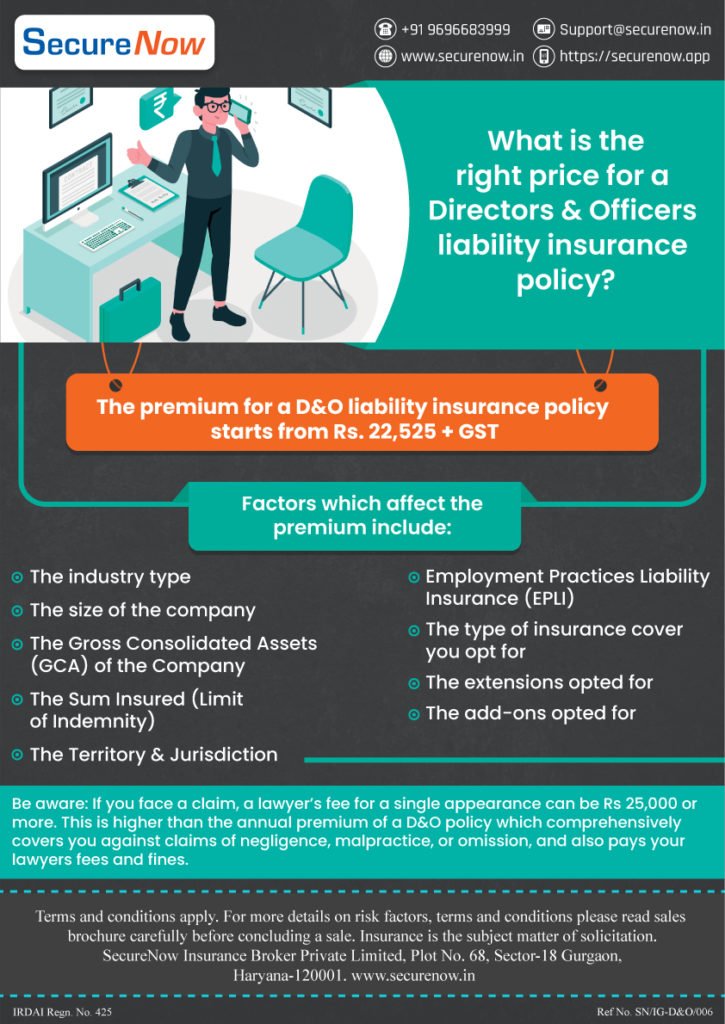
Infographic: Right price for Directors and officers liability insurance
Similarly, this SecureNow infographic summarises the main factors that affect the price of a D&O policy. Also use it alongside the checklist above.
D&O Insurance Cost Comparison Checklist (standalone)
First, print this worksheet, then complete one column per quotation.
| Checkpoint | Quote A | Quote B | Quote C |
|---|---|---|---|
| Same policy limit requested | |||
| Aggregate limit / any one claim limit | |||
| Retention – Side A / B / C | |||
| Side A/B/C structure; additional Side A limit | |||
| Key exclusions (list any not in other quotes) | |||
| Extensions included and sublimits | |||
| Defence costs – advanced or reimbursed; inside or outside limit | |||
| Claims-made provisions; retroactive and prior-litigation dates | |||
| Territory and jurisdiction | |||
| Insurer’s D&O experience | |||
| Claims service – contact and process | |||
| Base premium | |||
| GST and other charges | |||
| Total payable | |||
| Payment terms and due date | |||
| Instalment option (if any) | |||
| Renewal terms or conditions | |||
| Policy wording received and reviewed | |||
| Genuinely like-for-like? (Y/N) |
Conclusion
In short, the cost of D&O insurance depends on who you are and what you buy. Board size, industry, revenue, claims history, structure and geography shape the insurer’s view of the risk. Meanwhile, the limit, retention and extensions shape the price of the cover.
The right price is the one that buys suitable cover from a capable insurer, judged like-for-like. Therefore, use the comparison tables and checklist in this guide before deciding.
To obtain and compare quotations, visit SecureNow’s Directors & Officers Liability Insurance page, or read how to buy a D&O policy.
This article is general information. As such, it does not quote or recommend any premium or insurer. In addition, coverage depends on the specific policy wording. Insurance is the subject matter of solicitation.
Frequently Asked Questions
Q) How much does D&O insurance cost?
A) There is no fixed price. Instead, each insurer sets the premium after assessing the company’s risk and the cover requested. For example, factors include board size, industry, revenue, claims history, the limit, retention, structure, and geography. Therefore, the only reliable way to know the cost is to obtain quotations.
Q) What is the cost of D&O insurance made up of?
A) The cost of D&O insurance is the premium charged for the policy period plus applicable taxes. In turn, the premium reflects the insurer’s view of the risk and the scope of cover, including limits, retention, and extensions.
Q) How is a D&O Policy Premium calculated?
A) Through underwriting. The insurer reviews the proposal form, financial information, board details, claims history and the cover requested, then quotes a premium. There is no single formula; instead, insurers weigh factors differently.
Q) What factors affect D&O insurance cost?
A) Common factors include board size, industry, revenue and assets, claims history, the policy limit, the retention, company structure, geographic exposure, governance and risk management, and the extensions chosen.
Q) Does board size affect D&O insurance premium?
A) It can, because more insured individuals widen the exposure. However, board size is only one factor. For example, a small board in a high-risk business may cost more to insure than a larger board in a low-risk one.
Q) Does revenue affect D&O insurance cost?
A) Revenue and assets are common underwriting inputs because they indicate scale. However, the premium does not rise in a straight line with revenue; industry, finances and cover also matter.
Q) Does claims history affect D&O premium?
A) Usually, yes. For example, past or pending claims may lead to a higher premium, a higher retention, specific exclusions or different terms. The effect depends on the circumstances, so full and accurate disclosure is essential.
Q) What is the right price to buy Directors & Officers Liability insurance?
A) The right price is the premium that buys suitable cover for your risks from a capable insurer. Accordingly, it should be judged by comparing limits, retention, exclusions, extensions, defence costs, Side A/B/C structure, wording and claims service – not the headline premium alone.
Q) Should I choose the cheapest D&O policy?
A) Not automatically. After all, a lower premium may reflect a lower limit, a higher retention, narrower cover or more exclusions. Therefore, compare quotations like-for-like before deciding.
Q) How can I negotiate the price for a D&O policy?
A) Obtain comparable quotes, present clear underwriting information, review the limit, retention and extensions, ask why quotes differ, and compare renewal terms with the market. A broker can help, but no approach guarantees a lower premium.
Q) How is a D&O policy premium paid?
A) Usually in full for the policy period, before cover starts, by bank transfer, cheque, demand draft or online payment, depending on the insurer. In addition, GST applies. Instalments may be available from some insurers but should not be assumed.
Q) Is GST charged on D&O insurance premium?
A) Yes. However, the September 2025 GST exemption covers individual life and health insurance only. Therefore, general insurance such as D&O continues to attract GST, currently at 18%. Always check the amount shown on your quotation.