D&O insurance, or Directors & Officers Liability Insurance, generally covers claims against directors and officers that allege wrongful acts in managing an organisation, such as breach of duty, negligence, misleading statements, or mismanagement. The main benefit is defence costs, which the insurer may pay from the start of a covered claim, along with covered settlements or judgments. Many policies also reimburse the company when it indemnifies its leaders, and some cover the company itself for certain claims.
Insurers usually write this cover on a claims-made basis, so the claim must generally arise, and the insured must report it, during the policy period. The policy limit caps payments, and a retention and sublimits may also apply. Exclusions, such as deliberate fraud or improper personal profit, and policy conditions decide what the insurer actually pays.
Introduction
Buying Directors & Officers Liability Insurance is the easy part. Knowing what it will actually pay for is harder.
Two D&O policies with the same limit can respond very differently to the same claim. One may cover a regulator’s investigation from the first notice; the other may cover nothing until formal proceedings begin. One may protect the company as a defendant; the other may protect only the individuals.
This page explains D&O insurance coverage area by area. It covers who the policy insures, what kinds of claims the policy may respond to, how defence costs work, what the claims-made structure means, how limits and retentions affect a payout, and where the common exclusions sit. Throughout, one rule applies: the actual scope of cover depends on the policy wording, definitions, exclusions, limits and conditions.
If you are new to D&O, start with SecureNow’s overview of Directors & Officers Liability Insurance.
What Is D&O Insurance Coverage?
D&O insurance coverage is the set of promises in a D&O policy to pay loss – mainly defence costs and, where covered, settlements and judgments – arising from claims that allege wrongful acts by insured directors and officers in their managerial capacity, and, depending on the policy, certain loss suffered by the company.
Three definitions in the policy shape almost everything else:
- Insured person – who the policy protects. This usually includes past, present and future directors and officers, and may extend to senior managers, employees in managerial roles, nominee directors on outside boards, and the estates or legal representatives of insured persons.
- Wrongful act – what kind of conduct the policy covers. Policies usually define it broadly as an actual or alleged breach of duty, neglect, error, misstatement, misleading statement or omission in the insured’s capacity as a director or officer.
- Claim – what starts the cover. Depending on the wording, this can include a written demand, civil proceedings, criminal proceedings, regulatory proceedings or a formal investigation.
If a claim does not fit these definitions, the policy may not cover it, however serious it is. That is why reading the definitions matters more than reading the headline benefits. SecureNow explains insured persons in more detail and who a D&O policy covers.
Important Features of D&O Insurance
The important features of D&O insurance fall into two groups: features found in most policies, and features that depend on the insurer, the wording or an endorsement. Keeping the two apart avoids assuming cover that you have not bought.
Common D&O policy features
These are the key features of directors and officers liability insurance that most, though not all, policies share:
- Protection for directors and officers against covered claims made against them personally
- Company reimbursement when the company lawfully indemnifies its directors and officers
- Defence-cost protection, often advanced before a claim concludes, subject to the policy terms
- Claims-made structure, where the claim generally must arise, and the insured must report it, during the policy period
- A policy limit, usually an aggregate for all claims in the period, which defence costs typically reduce
- A retention, often applied to company reimbursement and entity cover rather than to individuals
- Coverage definitions for insured person, wrongful act, claim and loss
- Exclusions for conduct and risks the insurer will not cover
- Claims notification requirements you must meet for cover to apply
Optional or endorsement-specific features
These features vary widely between policies. Some insurers include them as standard; others offer them only by endorsement or not at all:
- Entity (Side C) cover for certain claims against the company itself
- Regulatory and investigation cost cover, sometimes with a sublimit
- Worldwide or extended territory and jurisdiction, relevant for overseas shareholders, operations or subsidiaries
- Prior acts or retroactive cover, protecting decisions taken before the policy began
- Run-off or extended reporting period after a merger, acquisition or non-renewal
- Outside directorship cover for insured persons serving as nominee directors on other boards
- Employment practices liability (entity EPLI) for employment claims against the company
- Public relations or crisis costs following a claim
The important features of Directors & Officers liability insurance are therefore best checked line by line against the actual wording, not against a generic list.
Video: Important features of Directors & Officers liability insurance
In this short SecureNow video, our team walks through the main features of a D&O policy and illustrates them with a case study. Watch it alongside the lists above to see how the features apply in a real claim situation.
D&O Insurance Coverage: A Consolidated Walkthrough
D&O insurance generally responds to claims alleging wrongful management acts by insured individuals, pays defence costs for those claims, and, depending on the policy, reimburses or protects the company. The areas below explain each part of that cover in turn.
Side A, Side B and Side C at a glance
| Insuring Clause | Who It Protects | When It Generally Responds |
|---|---|---|
| Side A | Individual directors and officers | When the company does not indemnify them – for example because it is insolvent, legally prevented, or refuses |
| Side B | The company | When the company has indemnified its directors and officers for a covered claim and seeks reimbursement |
| Side C (entity cover) | The company as a defendant | For certain claims made against the company itself; scope varies and is often securities-focused for listed companies |
Not every policy includes all three, and the terms of each differ between insurers. For a deeper explanation, see SecureNow’s guide to Side A, B and C covers in a D&O policy.
1. Directors and Officers Liability
This is the core of every D&O policy. When an insured director or officer faces a covered claim alleging a wrongful act in their management capacity, the policy may pay their loss. Depending on whether the company indemnifies them, that payment flows through Side A (direct to or for the individual) or Side B (to the company).
The protection is personal in effect. It exists because claims can name individuals, and individuals may otherwise have to fund their defence from their own assets.
2. Defence Costs
Defence costs are often the largest and most immediate part of a D&O claim. Lawyers’ fees, expert costs and court costs begin as soon as a claim arrives, long before anyone decides whether the allegation is true.
Many D&O policies advance defence costs during the claim rather than waiting for the outcome. Defence-cost coverage is still subject to:
- The policy terms and definitions of “loss” and “defence costs”
- The limit of liability, which defence costs usually erode
- Any retention that applies
- Exclusions, and the insurer’s right in many wordings to recover advanced costs if an excluded act is later established
- Conditions such as the insurer’s prior written consent to incur costs
- The circumstances of the claim itself
The policy does not automatically cover every legal expense. Costs incurred without required consent, or before you notify the claim, may fall outside cover.
3. Claims Against Individual Directors and Officers
Claimants can name directors and officers personally in claims arising from their decisions. Examples of potential allegations include:
- Alleged breach of duty owed to the company
- Mismanagement of a project, investment or acquisition
- Governance-related allegations, such as conflicts of interest or improper related-party dealings
- Regulatory allegations under company, securities, tax or sector-specific law
- Shareholder disputes, including oppression and mismanagement claims
These are examples of allegations that can lead to a claim. They are not automatic coverage triggers. Whether the policy covers a particular allegation depends on the definitions, exclusions and conditions in the policy.
4. Entity/Company Coverage
Some D&O policies provide entity cover for certain claims made against the company itself. Where a policy includes this, insurers often call it Side C.
Entity cover is the part of D&O insurance that varies most between policies. For listed companies, insurers frequently limit it to securities claims. For private companies, some policies offer broader entity cover; others provide none. The company should never assume it is a covered defendant simply because it has bought D&O insurance.
5. Employment-Related Management Allegations
Employment disputes often name individual managers as well as the employer. A D&O policy may respond to claims against individual insured persons arising from employment decisions, depending on the wording.
Claims against the company itself for employment practices – such as wrongful termination, harassment or discrimination – often fall outside standard D&O cover. These are the territory of employment practices liability insurance (EPLI), which companies may buy as a D&O extension or as a separate policy. D&O insurance does not automatically replace EPLI. See the comparison later on this page.
6. Regulatory and Investigation-Related Exposure
Directors and officers may face notices, inquiries, or investigations from regulators and authorities. Certain D&O policies address the costs of responding to these matters, subject to the policy wording.
Policies differ on key points:
- Whether an informal inquiry counts as a “claim”, or only formal proceedings do
- Whether the policy covers investigation costs in full or under a sublimit
- Whether the policy covers costs of the company (as opposed to individuals)
- Whether the policy covers fines and penalties, which policies often exclude or the law may not permit
A policy does not cover every regulatory investigation. The definition of “claim” and any investigation extension decide the answer.
7. Shareholder/Investor Claims
Shareholders and investors may allege that directors mismanaged the company, made misleading statements, approved unfair transactions or breached their duties. These allegations are a central D&O exposure, particularly after fundraising or for listed companies.
A D&O policy may respond to such claims against insured persons, and entity cover may respond to certain claims against the company. Cover depends on the wording, including any exclusions for claims brought by major shareholders or by one insured against another.
8. Governance and Management Decisions
Directors and officers approve budgets, sign off accounts, enter contracts, hire and dismiss senior staff, and set strategy. Each decision affects stakeholders who may later disagree with it.
D&O insurance exists because these decisions create liability exposure even when taken honestly and carefully. The policy does not assess whether the decision was wise. It asks whether the resulting claim alleges a covered wrongful act and whether any exclusion applies.
9. Other Policy-Specific Extensions
Additional extensions may be available depending on the insurer and the wording. Some appear under the optional features above. There is no standard list that applies to every D&O policy, so confirm each extension in the schedule or endorsement, including any sublimit attached to it. SecureNow’s page on customising a D&O policy describes common options.
D&O coverage summary
| Coverage Area | What It Generally Addresses | Important Qualification |
|---|---|---|
| Directors/officers liability | Claims alleging wrongful acts by insured individuals | Subject to policy wording |
| Defence costs | Legal defence expenses for covered claims | Subject to limits, retention and terms |
| Entity/company coverage | Certain claims involving the insured organisation | Depends on policy structure |
| Shareholder claims | Certain allegations made by shareholders/investors | Coverage depends on wording |
| Regulatory matters | Certain investigation/regulatory exposures | The policy may not cover every investigation |
| Employment-related management exposure | Certain management-related allegations | EPLI may provide more specific protection |
| Other extensions | Additional risks included by endorsement/policy | Varies by insurer |
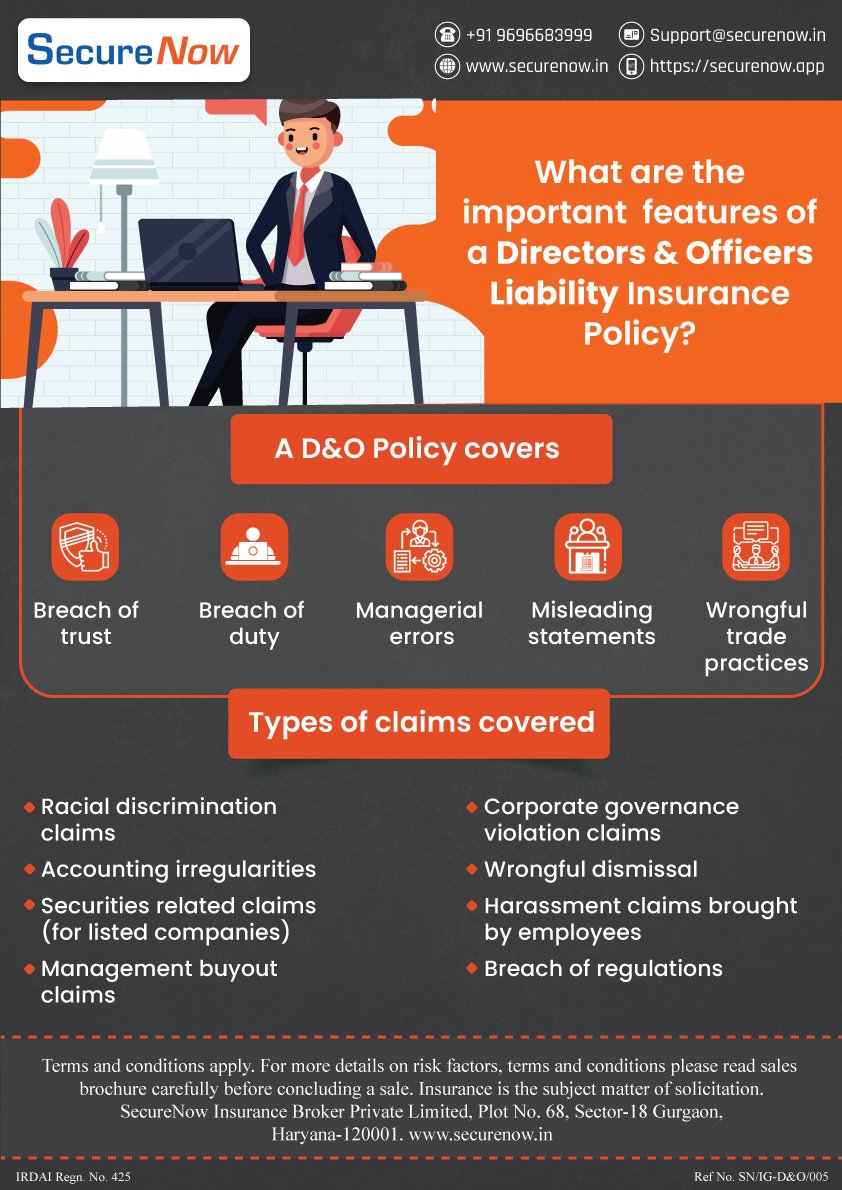
Infographic: Features D&O liability insurance policies commonly include
This SecureNow infographic summarises the types of claims a D&O policy may respond to, and the features buyers should look for. Use it as a quick visual reference; the walkthrough above explains the qualifications that apply to each item.
What Does D&O Insurance Cover? A Practical Summary
| Potential Coverage Area | What It May Cover | Depends On |
|---|---|---|
| Directors/officers liability | Certain claims against insured individuals | Policy wording |
| Defence costs | Legal defence expenses for covered claims | Limits and conditions |
| Entity coverage | Certain claims involving the company | Policy structure |
| Shareholder claims | Certain shareholder allegations | Policy wording |
| Regulatory matters | Certain covered investigation-related exposures | Policy terms |
| Employment-related management claims | Certain management-related allegations | D&O/EPLI wording |
| Other extensions | Additional insured risks | Endorsements/policy terms |
No D&O policy necessarily covers every category in this table. Use it as a checklist when reading your own schedule and wording.
How Does D&O Insurance Work?
D&O insurance works by responding to a claim once the insured properly notifies it, then paying covered loss – mainly defence costs and any covered settlement or judgment – up to the policy limit. The general sequence is below; the exact process depends on the policy and the circumstances.
Step 1 – A management-related allegation arises
A shareholder, regulator, creditor, employee or other party alleges that a director or officer acted wrongfully in managing the organisation.
Step 2 – The insured identifies a claim or circumstance
The allegation becomes a claim when it meets the policy definition – for example, a written demand, legal notice or formal proceeding. Before that, it may be a “circumstance” that could lead to a claim. Many policies let the insured notify circumstances so that a later claim attaches to the current policy.
Step 3 – The insured notifies the insurer according to policy requirements
The company or insured person reports the claim or circumstance in the manner and within the time the policy requires. Late or incomplete notice can put cover at risk.
Step 4 – The insurer reviews the claim and policy coverage
The insurer checks whether the claimant’s allegations fall within the insuring clauses and whether any exclusion or condition applies. It may accept cover, accept subject to a reservation of rights, or decline.
Step 5 – Defence and claims handling proceed according to the policy
Depending on the wording, the insured may choose defence counsel with the insurer’s consent, or the insurer may have a greater role in the defence. Significant costs and any settlement usually need the insurer’s prior written consent.
Step 6 – The insurer handles covered amounts according to the policy
The insurer may pay covered defence costs, settlements, judgments and other covered loss directly or reimburse them, subject to the limit, retention and any sublimits.
Step 7 – The claim concludes
The claim ends through dismissal, withdrawal, settlement or judgment. The insured or the company bears any excluded amounts and anything above the limit.
For documents and practical claim support, see SecureNow’s guide on how to file a D&O insurance claim.
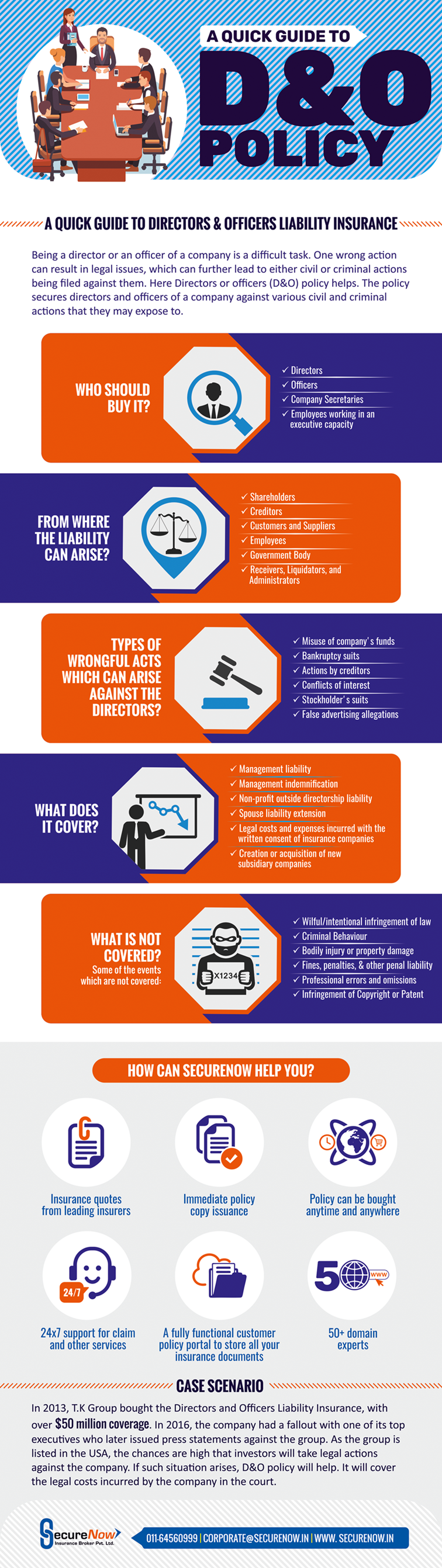
Infographic: Quick guide to a D&O policy
This SecureNow quick guide shows, at a glance, what a D&O policy may cover, who it can cover, and what is commonly excluded. It is a helpful one-page summary to share with board members.
D&O Insurance and the Claims-Made Structure
Insurers commonly write D&O policies on a claims-made basis, but you should always review the specific policy wording.
Under a claims-made policy, the policy that generally responds is the one in force when the claim is first made against the insured and reported to the insurer. The date of the underlying decision matters less, as long as it falls within any retroactive period the policy sets.
This structure has practical consequences:
- Timing of the claim – a claim made after the policy has expired, and outside any extended reporting period, may fall outside cover entirely.
- Reporting requirements – the insured must report claims and, where the policy permits, circumstances according to the policy’s notice provisions.
- Policy period – continuous renewal keeps cover in place; a gap between policies can leave claims made during the gap uninsured.
- Retroactive date – where the policy has one, the policy may exclude wrongful acts committed before that date. Some policies provide full prior acts cover; others do not.
- Extended reporting period – where available, this lets the insured report claims for a limited time after the policy ends, usually for wrongful acts committed before expiry. Terms and costs vary.
- Prior claims and known circumstances – policies commonly exclude matters already notified under an earlier policy, or known before inception.
SecureNow discusses this further in D&O liability insurance – a claims-made policy and explains the importance of the retroactive date.
D&O Policy Limits and Retention
The policy limit is the most the insurer will pay under the applicable policy terms, and the retention is the part of a covered loss the insured bears before the policy responds. Together, they set how much of a claim the policy insures.
| Policy Element | What It Means |
|---|---|
| Policy limit | Maximum amount payable under applicable policy terms |
| Retention | Amount the insured may retain before the policy responds, depending on wording |
| Sublimit | A separate limit that may apply to a particular coverage |
| Policy period | Period during which the policy operates, subject to its terms |
| Retroactive date | Date relevant to coverage for certain prior acts, where applicable |
Why the limit matters
Most D&O limits are an aggregate for all claims in the policy period and all insured persons together. Defence costs usually reduce the limit. A long, expensive defence can therefore leave less – or nothing – for a settlement or judgment. One claim naming several directors shares the same limit.
How the retention works
The retention often applies to company reimbursement (Side B) and entity cover (Side C). Side A cover for individuals frequently carries no retention, but this depends on the wording. A higher retention generally lowers the premium but increases the company’s own share of each claim.
Choosing an appropriate limit
There is no universal D&O limit that suits every business. The appropriate limit depends on the organisation’s risk profile, including its size, sector, shareholder and investor base, borrowing, regulatory environment, overseas exposure and any listing plans. Contractual or regulatory requirements may also set a minimum in some cases. For pricing factors, see SecureNow’s article on D&O insurance cost.
D&O Insurance Exclusions and Limitations
D&O insurance does not cover every allegation or every loss. Exclusions remove certain conduct and risks from coverage, and limitations such as sublimits and conditions restrict how much the insurer pays.
Common exclusions or limitations may include:
- Fraudulent or deliberately dishonest acts, usually once established by a final judgment, adjudication or admission
- Personal profit or financial advantage that an insured obtained improperly and had no legal right to
- Certain criminal acts, particularly where a court establishes wilful criminal conduct
- Certain bodily injury and property damage claims, which other liability policies usually handle
- Certain contractual liabilities, such as amounts owed under a contract the company signed
- Known circumstances and prior claims, including prior or pending litigation and matters notified under an earlier policy
- Claims between insured parties, often with exceptions for certain derivative or insolvency-related claims
- Fines and penalties, where the policy excludes them or the law does not permit insuring them
- Other policy-specific exclusions, such as pollution, war or professional services, depending on the insurer
This is not a universal list. The exact exclusions, and any exceptions to them, vary by policy.
Many policies continue to advance defence costs while fraud or dishonesty remains only an allegation. If the excluded conduct is later established, the insurer may seek repayment. Many wordings also protect innocent insured persons from the misconduct of a colleague through severability provisions. SecureNow’s page on exclusions in a D&O liability policy covers exclusions in more detail.
Coverage vs Exclusions: What Buyers Should Check
Having a D&O policy does not mean the policy covers every claim. Each claim passes through several tests, and it must pass all of them.
| Question | Coverage Perspective |
|---|---|
| Is the person an insured? | Check the policy definition |
| Is the allegation related to a wrongful act? | Review the policy wording |
| Is the claim within the policy period? | Check claims-made requirements |
| Is the claim excluded? | Review exclusions |
| Is the loss within the policy limit? | Check limits and sublimits |
| Was the claim reported correctly? | Follow policy notification conditions |
Working through these questions at the buying stage, rather than after a claim, is the most reliable way to find gaps while you can still fix them.
Illustrative D&O Coverage Examples
The following are illustrative, hypothetical examples. They are not real claims, and they do not describe any specific insurer’s policy or decision. In each case, the outcome depends on the actual policy wording, exclusions, limits and conditions.
Example 1 – Shareholder allegation
A minority shareholder in a private company alleges that the board approved a loss-making acquisition without proper diligence and files a petition naming three directors. The directors notify the insurer promptly. If the petition meets the policy’s definition of “claim”, the allegation fits the definition of “wrongful act”, and no exclusion applies, the policy may fund the directors’ defence costs and, with the insurer’s consent, a covered settlement, up to the limit.
Example 2 – Regulatory investigation
A regulator issues a notice to a company’s CFO asking for documents and an explanation of certain disclosures. Whether the policy covers the costs of responding depends on whether the policy treats this kind of notice as a “claim” or includes an investigation-costs extension. If it does, the policy may cover these costs, possibly under a sublimit. The policy may exclude any penalty the regulator eventually imposes, or the law may make it uninsurable.
Example 3 – Senior executive allegation
A former business partner sues the company’s CEO personally, alleging that statements made during a failed joint venture were misleading. The company indemnifies the CEO and pays the defence costs. Under a policy with Side B cover, the company may seek reimbursement of covered costs above the retention. If the court later finds deliberate dishonesty, the dishonesty exclusion may apply, and advanced costs may be recoverable by the insurer, depending on the wording.
Example 4 – Entity-related claim
Investors in a listed company sue both the directors and the company, alleging that an earnings announcement was misleading. Side A or Side B may cover the directors. Whether the company’s own defence and any settlement fall within cover depends on whether the policy includes entity cover for securities claims. Without entity cover, the company bears its own costs even though its directors have cover.
Example 5 – Claim after the policy lapses
A company does not renew its D&O policy after another business acquires it. Six months later, a former shareholder sues the former directors over the sale process. Because D&O is commonly claims-made, coverage may depend on whether the company arranged a run-off or extended reporting period at the time of the acquisition.
D&O Insurance vs EPLI
D&O insurance focuses on claims alleging wrongful management acts by directors and officers; employment practices liability insurance (EPLI) focuses on employment-related claims such as discrimination, harassment, and wrongful termination. The two can overlap, but they are not interchangeable.
| Point of Comparison | D&O Insurance | EPLI |
|---|---|---|
| Main focus | Management, governance and director/officer liability | Employment-related allegations |
| Typical claimants | Shareholders, investors, regulators, creditors, others | Current, former or prospective employees |
| Who the policy may insure | Directors, officers and, depending on the policy, the company | The employer and relevant insured persons, depending on the policy |
| Employment claims against the company | Often excluded unless the company buys an entity EPLI extension | The core purpose of the cover |
| How to buy it | Standalone D&O policy | D&O extension or standalone policy |
People-intensive businesses should confirm whether anything in their programme covers employment claims against the company. SecureNow explains the options in its guide to EPLI and how it relates to D&O insurance.
Frequently Asked Questions
Q) What does D&O insurance cover?
A) D&O insurance generally covers defence costs and covered settlements or judgments for claims alleging wrongful acts by directors and officers in managing an organisation. Many policies also reimburse the company when it indemnifies its leaders, and some cover the company for certain claims. The policy wording decides the actual scope.
Q) What are the important features of D&O insurance?
A) Common features include protection for directors and officers, company reimbursement, defence-cost cover, a claims-made structure, a policy limit, a retention, key definitions, exclusions and notification requirements. Entity cover, investigation costs, worldwide territory and run-off cover are often optional or vary by insurer.
Q) Who does Directors & Officers Liability Insurance cover?
A) Insured persons usually include past, present and future directors and officers. Depending on the wording, cover may extend to senior managers, employees in managerial roles, nominee directors on outside boards, and the estates or legal representatives of insured persons. Some policies also cover the company for certain claims.
Q) Does D&O insurance cover legal defence costs?
A) Yes, defence costs are usually the main benefit, and many policies advance them before a claim concludes. They are subject to the policy limit, any retention, the insurer’s consent requirements and the exclusions. If an excluded act such as fraud is later established, the insurer may seek repayment.
Q) Does D&O insurance cover the company?
A) It can, in two ways. Side B reimburses the company when it indemnifies its directors and officers. Side C, or entity cover, may cover certain claims against the company itself. Entity cover varies widely and is often limited to securities claims for listed companies.
Q) Is D&O insurance claims-made?
A) Insurers commonly write D&O policies on a claims-made basis, meaning the claim generally must arise, and the insured must report it, during the policy period. Continuous renewal, the retroactive date and any extended reporting period all affect cover. Always review the specific policy wording.
Q) What are common D&O policy exclusions?
A) Common exclusions may include established fraud or deliberate dishonesty, improper personal profit, certain criminal acts, bodily injury and property damage, certain contractual liabilities, prior claims and known circumstances, and claims between insured parties. Fines and penalties are often excluded. Exact exclusions vary by policy.
Q) What is a D&O policy limit?
A) The policy limit is the maximum the insurer will pay under the policy, usually an aggregate for all claims and insured persons in the policy period. Defence costs typically reduce the limit. Sublimits may cap particular covers, such as investigation costs.
Q) What is the difference between D&O insurance and EPLI?
A) D&O insurance covers claims about management decisions and governance. EPLI covers employment-related claims such as discrimination, harassment and wrongful termination. Standard D&O policies often exclude employment claims against the company itself, which is why companies buy entity EPLI as an extension or separate policy.
Q) Does D&O insurance cover regulatory investigations?
A) Some policies cover the costs of responding to regulatory investigations, either as part of the definition of “claim” or through an extension, sometimes with a sublimit. Policies do not cover every investigation, and they often exclude fines or penalties, which may also be uninsurable.
Q) What happens when someone makes a D&O claim?
A) The insured notifies the insurer as the policy requires. The insurer reviews coverage, then defence and claims handling proceed under the policy terms. The insurer pays or reimburses covered defence costs and any agreed settlement or judgment up to the limit, and the claim eventually concludes.
Q) Why is D&O insurance important for directors and officers?
A) Claimants can sue directors and officers personally over decisions they take for the organisation, and defence costs start immediately. D&O insurance gives them a funded defence and may pay covered losses, protecting personal assets and supporting the company’s ability to recruit and retain experienced leaders.