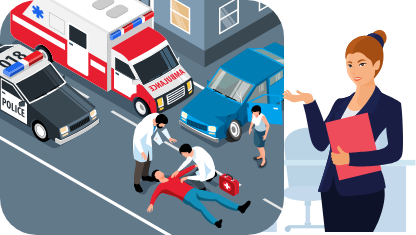


This article is meant to understand the major differences between personal accident insurance and life insurance.
A life insurance policy is a contract between the insured and the insurer under which, the insurance company provides a lump-sum payment to the beneficiaries upon the insured’s death. This is the death benefit. It acts as an income replacement for the family of the life assured. Life insurance caters to anyone who is financially dependent on you in the unfortunate event of death.
Key Takeaways
-
The Coverage Gap: Life insurance is a “Death-only” contract in its basic form. As shown in Scenario 2 of the case study, if an accident leaves you disabled but alive, a standard life policy pays nothing, leaving you to exhaust your savings for medical and living costs.
-
The “Accident Only” Specialist: PA insurance is highly specialized. It covers a subset of risks (accidents) but does so with incredible depth—paying out for burns, fractures, loss of limbs, and even temporary inability to work.
-
Cost-Efficiency: Because PA insurance doesn’t cover death by natural causes or illnesses (which are statistically more common), it is remarkably inexpensive. It allows you to buy a very high “Sum Insured” for a small annual premium.
-
Disability Support: A Personal Accident policy uses a “Percentage Payout” system. For example, losing one limb might trigger a 50% payout of the total sum insured, providing immediate cash to modify your home or lifestyle after a permanent partial disability (PPD).
-
Corporate Tax Advantage: While individuals only get tax breaks on life insurance, companies can treat premiums for both policies as business expenses, making it a tax-efficient way to protect employees.
On the other hand, accidental insurance or personal accident insurance provides protection in case of death and injuries resulting only from an accident. This policy guards an individual only in the event of an accident. The incident may cause impairment, whether short-term or lifelong wounds or even demise. It covers claims of accidental death, accidental disability, or accidental dismemberment.
Major differences between life and accidental insurance
Both life and accidental insurance provide strong financial support in case of the death of the policyholder so that the financial future of the policyholder remains unaffected. These policies make sure that your dependents can lead a decent life economically despite your death. Although both policies primarily cover the death benefit, there is a major difference. Personal accident insurance covers claims to death due to an accident while life insurance covers claims to death in general. The cause could be anything.
Following are the other differences between life insurance and accidental insurance:
- For individuals, life insurance is tax-deductible but accidental insurance does not possess tax benefits. However, for companies, both insurances are treated as expenses and reduce profits
- Life insurance is more expensive while a personal accident policy is cost-effective. This is because accident insurance covers a subset of the risks covered by life insurance
- The accidental policy also covers permanent total or partial disability, accidental dismemberment, burns, fractures, etc. But life insurance does not cover these medical eventualities. It only provides a death benefit.
- One can take an accidental policy as a rider or add-on cover with health insurance or life insurance but life insurance is always a standalone policy.
Read: What is the meaning of life insurance?
Both personal accident insurance and life insurance have a key role in risk management. Should either of these occur, the family would receive a lump sum payment to compensate for the breadwinner’s inability to financially support them. Under both policies, the sum insured goes to the legal heirs, who could be the spouse or other dependents.
Both personal accident insurance and life insurance are important tools in managing risks associated with unexpected events. However, they serve different purposes and provide different types of coverage.
Case Study:
Rohit who was working in a transportation firm had an accident. He lost one limb. The hospitalization cost was about two lakhs. During such a devastating state, his family has no other income. Due to permanent partial disability, Rohit is not even in a condition to work for a long time. Under such a case, there are two scenarios:
Scenario 1: Rohit has a personal accident policy. In such a case, he will receive a 50% or 100% payout of the sum insured depending upon the terms of the policy. He will be compensated for some amount of lost income. Accidental insurance will provide coverage during a such eventuality in order to provide financial stability to the insured.
Scenario 2: Rohit has a life insurance policy. In such a case, he will not receive anything for permanent partial disability as term life insurance covers only the death benefit. All expenses have to be borne by him only. All his savings will be wiped away in such a dark phase.
Summary: Life Insurance vs. Personal Accident Insurance
Hence ignoring these policies could lead to eroded lifelong savings because of mishaps.
Read About: What does personal accident insurance cover?
Frequently Asked Questions (FAQs)
Q1: If I have Life Insurance, do I still need Personal Accident Insurance?
A) Yes. Life insurance only pays out if you die. If you are involved in a serious accident and survive with a disability, your life insurance remains inactive. A PA policy provides the “Living Benefit” to help you survive financially while disabled.
Q2: Does “Natural Death” or death due to a heart attack fall under a PA policy?
A) No. Personal Accident insurance strictly covers “Accidental” events—those that are sudden, unforeseen, and caused by external, visible means. Death due to illness, old age, or natural causes is only covered by a Life Insurance policy.
Q3: Can I get a PA policy as an add-on to my existing health insurance?
A) Yes. Many insurers allow you to add a Personal Accident rider to your health or life insurance. However, buying a Standalone PA Policy often offers more comprehensive features, such as “Weekly Indemnity” (payout for time away from work).
Q4: What is “Dismemberment” coverage?
A) Dismemberment refers to the loss, or the loss of use, of body parts such as limbs, fingers, or sight. A PA policy provides a pre-defined lump sum payout for these specific losses to compensate for the reduction in your future earning capacity.
Q5: Is an accident during a “High-Risk Sport” covered?
A) Standard PA policies often exclude “Hazardous Activities” like paragliding, racing, or bungee jumping. If your lifestyle involves these, you must inform the insurer and potentially pay an additional premium to ensure you are covered during those activities.
Written By-
Gunjan Saxena
MBA Insurance Management
With a robust background in the insurance industry, Gunjan is a seasoned professional who brings 10 years of expertise to group personal accident insurance. Throughout her career, she has demonstrated a deep understanding of the intricacies and nuances of insurance products, particularly in personal accident coverage. Having worked closely with both individuals and businesses, she has gained valuable insights into the diverse needs and challenges faced by clients seeking insurance protection. Her experience encompasses designing tailored insurance solutions, providing expert advice, and guiding clients through the insurance process with confidence and clarity.
Through her articles, Gunjan aims to educate and inform readers about the importance of group personal accident insurance and the benefits it offers in safeguarding against unforeseen events.