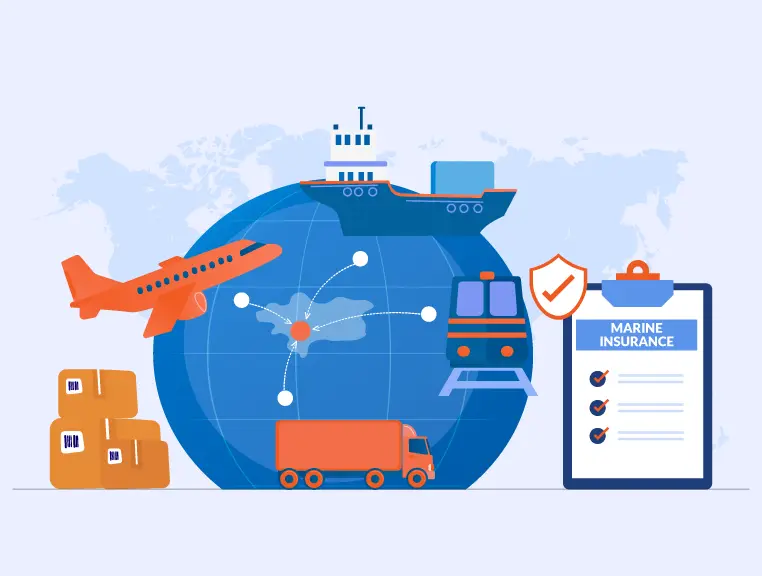



Every marine insurance policy is really a bundle of clauses stitched together. The premium you pay, the coverage you get, and – most importantly – the claim you can recover all trace back to specific wording buried inside the policy document. Yet most exporters, importers, and even seasoned logistics managers skim past these clauses until a claim forces them to read the fine print.
This guide breaks that pattern. It is a complete, plain-English reference to every major clause used in Marine Cargo and Inland Transit Insurance policies in India – what each clause means, where it applies, why it exists, and how it affects a real claim. Whether you are an exporter shipping machinery to Rotterdam or a trader moving goods by road from Ludhiana to Chennai, this glossary aims to be the page you bookmark and return to before every policy renewal.
Key Takeaways
- Marine Insurance clauses determine how, when, and under what conditions a policy responds – not just whether a shipment is insured.
- General Average can create a contribution liability even for undamaged cargo; Particular Average covers individual, unshared losses.
- A Franchise Clause and a deductible work differently – know which one your policy uses.
- The Deviation and Touch & Stay Clauses protect cover during reasonable route changes and scheduled port calls, respectively.
- The Increased Value Clause and Per Bottom Limit directly affect how much you can actually recover, independent of your stated sum insured.
- Exporters should work through a structured clause checklist – ICC selection, General Average, Deviation, Warehouse-to-Warehouse, Increased Value, Pair & Set, delay exclusions, packaging requirements, transit extension, and claim notification – before every policy purchase.
What Are Marine Insurance Clauses?
Marine insurance clauses are the specific contractual provisions within a cargo or transit policy that define, limit, or extend the scope of coverage. A clause can do one of several jobs: it can describe when cover starts and ends (like the At & From Clause), decide who pays for a shared sacrifice at sea (General Average Clause), set a minimum threshold for a claim (Franchise Clause), or protect the insurer against a wilful act by the crew (Barratry Clause).
In simple terms, if the main policy wording tells you that you are insured, the clauses tell you how, when, and under what conditions that insurance actually responds.
Most Indian marine policies follow a mix of:
- Institute Cargo Clauses (ICC) – the London market wording (ICC A, B, and C) adopted globally, including in India, as the base framework for cargo cover.
- Marine Insurance Act, 1963 – the Indian statute that governs the legal principles behind marine contracts, insurable interest, and warranties.
- Insurer-specific or market-specific clauses – additions like the Increased Value Clause or Per Bottom Limit Clause that insurers attach to address particular risks.
Why Marine Insurance Clauses Matter
A policy with the right sum insured but the wrong clauses can still leave a business badly exposed. Three reasons make clause-level understanding non-negotiable.
First, clauses decide claim eligibility. Two businesses can hold policies with identical sums insured, yet only one may recover a claim. This can happen purely because of a difference in wording, such as a Warehouse-to-Warehouse extension or a Deviation Clause.
Second, clauses control cost. Broader clauses widen protection but usually raise the premium. Narrower clauses cut cost but shift risk back onto the business. Reading clauses lets a company make that trade-off consciously instead of by accident.
Third, clauses reflect real shipping risk. Provisions like the Both-to-Blame Collision Clause or the New Jason Clause exist because of specific historical shipping incidents. Understanding them tells you what kind of risk the maritime and insurance industry considered serious enough to write into contracts.
How to Read a Marine Insurance Policy
Reading a marine policy is easier when you approach it in a fixed sequence rather than top to bottom.
- Check the ICC clause set (A, B, or C) – this defines the base perils covered.
- Locate the transit clause – At & From, Inland Transit Clause A, or Warehouse-to-Warehouse, which fixes when cover starts and stops.
- Scan for value-related clauses – Increased Value Clause, Per Bottom Limit, and any sub-limits.
- Check average-related clauses – General Average and Particular Average provisions, since these govern partial loss and shared-sacrifice claims.
- Note exclusion and conduct clauses – Deviation, Barratry, and Franchise clauses, which can reduce or deny a claim if not understood upfront.
- Review claim-notification and documentation clauses – often the most overlooked, and the most common reason claims get delayed or rejected.
A-Z Glossary of Marine Insurance Clauses
Each entry below follows the same structure: definition, purpose, where it applies, a practical example, why it matters, and a common misunderstanding worth clearing up.
General Average Clause
Definition: General Average is a principle where all parties in a sea venture – shipowner and cargo owners – proportionately share a loss when someone makes a deliberate, reasonable sacrifice to save the voyage from a common peril.
Purpose: It spreads the cost of an emergency sacrifice (like jettisoning cargo) across everyone who benefited when the ship and remaining cargo survived, rather than leaving the loss with one party.
Where it is used: It applies to ocean cargo movements, particularly in Marine Cargo Insurance policies covering international shipments.
Practical example: A container ship runs into a severe storm. To keep the vessel stable, the captain orders several containers thrown overboard. The owners of the surviving cargo – even those whose goods were untouched – must contribute toward the loss suffered by the owners of the jettisoned containers.
Importance: Without General Average cover, a business could receive a contribution demand from the shipping line even though its own cargo arrived undamaged.
Common misunderstanding: Many assume General Average applies only when their own cargo is damaged. In reality, insurers can ask cargo owners to contribute even when their shipment is completely intact.
Particular Average Clause
Definition: Particular Average refers to a partial loss or damage suffered by one party’s cargo alone, without any element of shared sacrifice, arising from an insured peril.
Purpose: It defines how insurers assess and compensate partial losses to a single shipment, distinguishing them clearly from General Average losses shared across multiple parties.
Where it is used: Marine Cargo Insurance policies feature it wherever partial damage (as opposed to total loss) needs settlement.
Practical example: A shipment of textiles gets partially wet due to a leak in the hold. The leak affects only that one importer’s cargo; it involves no other party’s goods, and no one made a sacrifice to save the vessel.
Importance: Understanding whether a loss qualifies as Particular Average (individual loss) versus General Average (shared loss) directly affects who bears the cost and how insurers process the claim.
Common misunderstanding: People often use “average” to imply “average value,” when in marine insurance it strictly means “loss” – a Particular Average is a partial loss, not an average calculation.
Franchise Clause
Definition: A Franchise Clause sets a minimum threshold of loss below which the insurer pays no claim, but once the loss crosses that threshold, the insurer pays the entire claim amount – unlike a deductible, where the insurer pays only the amount above the threshold.
Purpose: It discourages small, frequent claims while still giving full protection once damage becomes significant.
Where it is used: Marine Cargo policies commonly include it for bulk commodities such as grain, coal, or agricultural produce, where shippers expect minor handling losses.
Practical example: A policy carries a 3% franchise on a bulk grain shipment. If spillage amounts to 2%, no claim is payable. If spillage reaches 4%, the insurer pays the full 4% loss – not just the amount above 3%.
Importance: Businesses often confuse a franchise with a deductible, which changes the payout arithmetic significantly. Misreading this clause can lead to under- or over-estimating expected recovery.
Common misunderstanding: Assuming that crossing the franchise threshold means only the excess above the limit is paid – under a franchise, the full loss is payable once the threshold is breached.
Deviation Clause
Definition: The Deviation Clause addresses what happens to coverage when a vessel departs from its scheduled or customary route, whether voluntarily or due to unavoidable circumstances.
Purpose: It protects the insured against automatic loss of cover when a ship reasonably changes course – for safety, weather, or operational reasons – while still guarding insurers against reckless or unjustified route changes.
Where it is used: Standard in ocean-going Marine Cargo policies where transit routes can be affected by weather, port congestion, or geopolitical disruption.
Practical example: A vessel carrying export cargo reroutes to avoid a cyclone forming along its original path. Under a properly worded Deviation Clause, coverage continues uninterrupted because the deviation was reasonable and necessary for safety.
Importance: Without this clause, any departure from the intended route – even a safety-driven one – could technically void cover under strict marine law principles.
Common misunderstanding: Exporters sometimes believe any deviation automatically cancels their policy. Reasonable, justified deviations are typically protected; only unreasonable or unexplained deviations put cover at risk.
Touch & Stay Clause
Definition: The Touch & Stay Clause permits a vessel to call at intermediate ports along its journey for purposes like loading, unloading, refuelling, or taking on additional cargo, without this being treated as an unauthorised deviation.
Purpose: It gives shipping lines operational flexibility to serve multiple ports on one voyage while keeping the cargo owner’s insurance intact throughout.
Where it is used: Found in ocean cargo policies covering multi-port voyages, particularly on liner and feeder vessel routes.
Practical example: A vessel carrying export cargo from Mumbai to Hamburg stops at Colombo and Jeddah to load and unload other consignments. Because these stops are part of the vessel’s ordinary, published schedule, the Touch & Stay Clause keeps the original cargo’s cover active throughout.
Importance: It prevents cargo owners from losing coverage simply because their vessel operates a multi-port itinerary, which is standard practice in modern container shipping.
Common misunderstanding: Touch & Stay is often confused with Deviation. Touch & Stay covers planned, scheduled intermediate stops; Deviation covers unplanned route changes.
At & From Clause
Definition: The At & From Clause defines the point at which marine insurance cover begins – either from the moment the vessel is “at” the loading port awaiting cargo, or “from” the point it actually departs, depending on the wording used.
Purpose: It removes ambiguity about the exact start of risk, which matters when cargo is loaded onto a vessel that is already at anchor or berth before departure.
Where it is used: Primarily in voyage-based Marine Cargo policies, especially for bulk and break-bulk shipments where the vessel may stay at port for an extended period before sailing.
Practical example: Workers load a shipment of machinery onto a vessel that has already anchored at the port for several days awaiting full cargo capacity. An “At and From” clause ensures the insurance is active during this waiting period, not just once the ship sails.
Importance: Without clarity here, a loss occurring while the vessel is still at berth – before departure – could fall into a coverage gap.
Common misunderstanding: Businesses often assume cover starts only once the vessel physically leaves port; depending on the wording, cover may already be active while the vessel is anchored at the loading port.
Pair & Set Clause
Definition: The Pair & Set Clause states that when items form a matched pair or set, damage or loss to one part of that pair or set does not automatically entitle the owner to claim for the full set – insurers generally limit the claim to the proportionate value of the damaged piece.
Purpose: It prevents inflated claims where a policyholder seeks full replacement value for an entire set because one component was damaged, unless the set genuinely loses its function or value without that piece.
Where it is used: Relevant to shipments of machinery components, matched equipment, furniture sets, or any goods sold and valued as a unit.
Practical example: A consignment of industrial machinery includes a matched pair of precision rollers. One roller sustains damage in transit. Under the Pair & Set Clause, insurers typically assess the claim on the value of the damaged roller, not the entire matched pair – unless the undamaged roller is genuinely unusable without its pair.
Importance: It sets realistic expectations for claim value on multi-part shipments, which is common in industrial and engineering exports.
Common misunderstanding: Many assume that damage to any one part of a “set” automatically triggers a full-set payout – this depends heavily on whether the remaining items retain independent value or usability.
New Jason Clause
Definition: The New Jason Clause allows a shipowner to recover General Average contributions from cargo owners even when the peril that triggered the sacrifice arose from the vessel’s own fault or unseaworthiness – provided the shipowner exercised due diligence to make the vessel seaworthy.
Purpose: It protects shipowners’ right to claim General Average contributions under US law-influenced contracts, where negligence could otherwise bar such recovery entirely.
Where it is used: Parties commonly insert it into bills of lading and marine cargo policies for shipments involving US ports or US-governed maritime contracts.
Practical example: A vessel suffers an engine fault mid-voyage that investigators later link to a manufacturing defect the owner could not reasonably have detected. The crew jettisons cargo to prevent total loss. Under the New Jason Clause, the shipowner can still claim General Average contributions from cargo interests, despite the underlying fault.
Importance: Cargo owners need to know this clause exists because it can obligate them to contribute financially even in situations where the vessel itself was technically at fault.
Common misunderstanding: People assume any fault by the shipowner voids their right to claim General Average – the New Jason Clause specifically preserves that right when due diligence was exercised.
Running Down Clause (Collision Liability Clause)
Definition: The Running Down Clause, also called the Collision Liability Clause, covers a shipowner’s legal liability for damage caused to another vessel and its cargo following a collision, typically up to three-fourths (¾) of that liability under hull insurance.
Purpose: It provides financial protection to shipowners against third-party liability claims arising from a collision at sea, separate from damage to their own vessel.
Where it is used:. Primarily a feature of Hull Insurance rather than Cargo Insurance, but cargo interests should understand it because it interacts with liability disputes following an accident.
Practical example: Two vessels collide in open waters. Investigators find one ship substantially at fault, and it must compensate the other vessel’s owner for hull damage and, where relevant, cargo loss. The Running Down Clause covers the at-fault shipowner’s liability up to the specified proportion.
Importance: It clarifies that collision liability is a distinct exposure from ordinary hull damage, and helps cargo owners understand where responsibility sits when their goods are affected by a collision.
Common misunderstanding: People often confuse it with cargo damage cover; the Running Down Clause specifically addresses the shipowner’s liability to the other vessel, not damage to the cargo aboard either ship.
Both-to-Blame Collision Clause
Definition: The Both-to-Blame Collision Clause requires cargo owners to indemnify their own carrier for a portion of the liability the carrier faces towards the other vessel, when a court finds both vessels involved in a collision jointly at fault.
Purpose: It closes a legal gap that arises under certain jurisdictions (notably US law), where a carrier who is partly at fault in a collision could otherwise end up bearing a disproportionate share of liability, some of which traces back to cargo interests.
Where it is used: Shippers typically insert it into bills of lading for shipments to or from the United States, and cargo policies covering such routes reference it.
Practical example: Two vessels collide, and a court apportions fault equally between them. The court requires the carrier transporting a particular exporter’s cargo to pay a share of the other vessel’s cargo-owner claims. Under the Both-to-Blame Collision Clause, that carrier can seek reimbursement from its own cargo owners for part of this payment.
Importance: Exporters shipping to jurisdictions where this clause applies should ensure their cargo policy responds to this specific liability, since it can create an unexpected out-of-pocket exposure.
Common misunderstanding: People frequently confuse it with the Running Down Clause. The Running Down Clause covers the shipowner’s own collision liability; the Both-to-Blame Clause shifts part of that liability back onto cargo owners in jointly-at-fault collisions.
Inland Transit Clause A
Definition: Inland Transit Clause A is the broadest of the Institute Cargo Clause-style wordings used for domestic (inland) transit within India, covering loss or damage from a wide range of external causes on an “all risks” basis, subject to standard exclusions.
Purpose: It gives businesses moving goods by road, rail, or a combination of inland modes within India the widest available protection, comparable in structure to ICC A cover for ocean shipments.
Where it is used: Domestic transit of goods between factories, warehouses, and customer locations within India – a staple clause for manufacturers and traders moving stock across states.
Practical example: A truck carrying finished electronic goods from a factory in Pune to a warehouse in Delhi meets with an accident, damaging part of the consignment. Under Inland Transit Clause A, it covers this loss as it falls within the broad “all risks” scope, subject to standard exclusions.
Importance: Choosing Inland Transit Clause A over the narrower Clause B or C options materially widens protection for high-value or damage-prone domestic shipments.
Common misunderstanding: “All risks” does not mean “all losses without exception.” Standard exclusions – such as inherent vice, wilful misconduct, and inadequate packing – still apply even under Clause A.
Per Bottom Limit Clause
Definition: The Per Bottom Limit Clause caps the insurer’s maximum liability for cargo carried on any single vessel (“bottom”) at a specified amount, regardless of the total sum insured under an open cover or annual policy.
Purpose: It manages the insurer’s concentration risk by limiting exposure to any one voyage or vessel, particularly relevant for businesses with high shipment frequency or bulk cargo movements.
Where it is used: Common in open cover or turnover-based Marine Cargo policies where businesses declare multiple shipments under a single annual arrangement.
Practical example: A trading company has an open cover policy with an overall annual sum insured of ₹50 crore, but a Per Bottom Limit of ₹5 crore. If the company loses a single vessel carrying ₹7 crore worth of its cargo, it can recover only ₹5 crore under this policy. The balance remains uninsured unless it arranges additional cover.
Importance: Businesses shipping large-value consignments on a single vessel need to check this limit carefully; exceeding it without additional cover leaves a real, uninsured gap.
Common misunderstanding: Exporters sometimes assume their overall annual sum insured protects every single shipment fully – the Per Bottom Limit can silently cap recovery well below that figure for any one vessel.
Increased Value Clause
Definition: The Increased Value Clause allows the insured to raise the insured value of a cargo shipment above the original invoice value to reflect anticipated resale price, freight, insurance, and other costs, ensuring adequate coverage in the event of a total loss.
Purpose: It prevents underinsurance in situations where the true economic value of a shipment – including profit margin and incidental costs – exceeds the basic invoice value.
Where it is used: Exporters commonly use it for shipments where goods will resell at a marked-up price in the destination market, and businesses apply it in Inland Transit policies for high-value consignments.
Practical example: An exporter ships goods with an invoice value of ₹10 lakh, but expects to resell them for ₹13 lakh after factoring in freight, duties, and margin. An Increased Value Clause allows the policy to reflect this higher figure, so a total loss claim reflects real economic exposure rather than just the invoice price.
Importance: Without this clause, a business recovering only the invoice value after a total loss could still suffer a real financial shortfall relative to expected returns.
Common misunderstanding: People assume the invoice value is always the “correct” insured value – in reality, it often understates the true financial exposure tied to a shipment.
Barratry Clause
Definition: Barratry refers to any wrongful, wilful act that the master or crew of a vessel commits to the detriment of the shipowner or cargo owner – such as deliberate scuttling, smuggling, or intentional deviation for personal gain – and the Barratry Clause confirms the policy covers this peril.
Purpose: It protects cargo owners against deliberate misconduct by the very people entrusted with the safe carriage of goods, a risk that would otherwise sit outside ordinary “accidental loss” coverage.
Where it is used: Standard Institute Cargo Clauses (A) and most comprehensive Marine Cargo policies include it as a named peril.
Practical example: A ship’s crew deliberately sets fire to part of the cargo hold to conceal an earlier theft of goods. Because this is a wilful, wrongful act by the crew against the interests of the cargo owner, it falls under Barratry, and the policy covers it where Barratry is a named peril.
Importance: It reassures cargo owners that intentional misconduct by ship’s personnel – a risk entirely outside their control – does not leave them uninsured.
Common misunderstanding: People sometimes confuse Barratry with ordinary negligence by the crew. Barratry specifically requires a wrongful, wilful act – genuine negligence or an honest error in judgement does not qualify.
A-Z Clause Summary Table
| Clause | Purpose | Applies To | Why It Matters |
|---|---|---|---|
| General Average | Shares sacrifice-related loss across all cargo interests | Ocean cargo | Can create liability even for undamaged cargo |
| Particular Average | Assesses individual, unshared partial loss | Ocean and inland cargo | Distinguishes personal loss from shared loss |
| Franchise Clause | Sets a minimum loss threshold for claims | Bulk commodity shipments | Changes claim arithmetic vs. a deductible |
| Deviation Clause | Preserves cover during reasonable route changes | Ocean cargo | Prevents cover lapse from justified rerouting |
| Touch & Stay | Permits scheduled intermediate port calls | Multi-port ocean voyages | Keeps cover active on liner routes |
| At & From | Defines when cover begins at the loading port | Voyage-based cargo policies | Removes ambiguity on start of risk |
| Pair & Set | Limits claims on matched items to the damaged part | Machinery, equipment, sets | Sets realistic claim expectations |
| New Jason Clause | Preserves shipowner’s General Average rights despite fault | US-linked shipments | Can create contribution liability for cargo owners |
| Running Down Clause | Covers shipowner’s collision liability to other vessels | Hull Insurance | Distinct from cargo damage cover |
| Both-to-Blame Collision | Shifts part of collision liability back to cargo owners | US-linked bills of lading | Creates potential out-of-pocket exposure |
| Inland Transit Clause A | Broadest domestic “all risks” cover | Road/rail transit in India | Widest available domestic protection |
| Per Bottom Limit | Caps liability per vessel under open cover | Open cover/turnover policies | Can cap recovery below annual sum insured |
| Increased Value Clause | Raises insured value above invoice value | Export shipments | Prevents underinsurance on total loss |
| Barratry Clause | Covers wilful misconduct by master/crew | Ocean cargo, ICC A policies | Covers deliberate acts outside insured’s control |
Clause Comparison Tables
General Average vs Particular Average
| Feature | General Average | Particular Average |
|---|---|---|
| Nature of loss | Deliberate, shared sacrifice | Accidental, individual loss |
| Who bears the cost | All cargo interests + shipowner, proportionately | Only the affected cargo owner |
| Trigger | Common peril to the whole voyage | Peril affecting a single shipment |
| Example | Jettisoning cargo to save the vessel | Water damage to one importer’s goods |
| Claim process | Adjusted by a General Average adjuster across all parties | Settled directly between insurer and insured |
At & From Comparison
| Clause | Coverage Begins | Best Use |
|---|---|---|
| At & From Clause | While vessel is at the loading port, or from departure, per wording | Bulk/break-bulk voyage policies with anchorage delays |
| Warehouse-to-Warehouse | From the insured’s warehouse of origin | Door-to-door export/import shipments |
| Inland Transit Clause A | From the point goods leave the sender’s premises | Domestic road/rail transit within India |
Running Down vs Both-to-Blame Collision
| Feature | Running Down Clause | Both-to-Blame Collision Clause |
|---|---|---|
| Who is protected | The shipowner, against liability to the other vessel | The carrier, by recovering part of its liability from cargo owners |
| Insurance type | Hull Insurance | Referenced in bills of lading/cargo policies |
| Applies when | Vessel is found at fault in a collision | Both vessels are found jointly at fault |
| Effect on cargo owner | Indirect – relates to hull, not cargo, damage | Direct – cargo owner may need to reimburse the carrier |
Clause Usage Matrix by Business Type
| Business Type | Recommended Clauses to Review |
|---|---|
| Manufacturer | Inland Transit Clause A, Per Bottom Limit, Increased Value Clause |
| Importer | General Average, Particular Average, Warehouse-to-Warehouse, Pair & Set |
| Exporter | Increased Value Clause, Deviation, Touch & Stay, Pair & Set, ICC A |
| Trader | Franchise Clause, Per Bottom Limit, Inland Transit Clause A |
| Freight Forwarder | Both-to-Blame Collision, Deviation, Barratry, General Average |
| Logistics Company | Inland Transit Clause A, Franchise Clause, claim-notification clauses |
| E-commerce Exporter | Increased Value Clause, Pair & Set, packaging-linked exclusions |
Exporter’s Marine Clause Checklist
Before buying or renewing a Marine Insurance policy. Exporters should work through this checklist rather than relying on the sum insured alone.
| Clause / Item to Check | Mandatory? | Why? |
|---|---|---|
| ICC Clause selection (A/B/C) | Yes | Determines the base scope of perils covered |
| General Average provision | Yes | Ensures contribution liability is covered, not just direct loss |
| Deviation Clause | Yes | Protects cover during justified route changes |
| Warehouse-to-Warehouse extension | Highly recommended | Extends cover beyond just the sea voyage |
| Increased Value Clause | Recommended for resale shipments | Prevents underinsurance versus true economic value |
| Pair & Set Clause | Recommended for machinery/sets | Sets realistic claim expectations on multi-part goods |
| Delay exclusions | Yes – must be reviewed | Most policies exclude pure delay losses; know this upfront |
| Packaging requirements | Yes | Poor packing can void a claim even under “all risks” cover |
| Transit extension / storage-in-transit | Recommended for complex routes | Covers planned halts, transhipment, and warehousing en route |
| Claim notification clause | Yes | Late notification is one of the most common reasons claims are delayed or denied |
Recommendations by shipment type and business size:
- First-time or occasional exporters:.
Prioritise ICC A cover, Warehouse-to-Warehouse extension, and a clear claim-notification clause — simplicity and breadth matter more than fine-tuning limits. - High-value or machinery exporters:.
Focus on the Increased Value Clause, Pair & Set Clause, and Per Bottom Limit — value-related clauses carry the highest financial impact. - High-frequency traders with open cover policies:.
Review the Per Bottom Limit and Franchise Clause closely, since these silently cap or delay recovery across repeated shipments. - Domestic manufacturers and distributors:.
Inland Transit Clause A should be the default choice over narrower B/C wordings, given the relatively small premium difference for materially wider cover.
Common Mistakes When Reading Marine Insurance Clauses
- Treating “all risks” as “all losses.” Even ICC A and Inland Transit Clause A carry standard exclusions like inherent vice and inadequate packing.
- Confusing a franchise with a deductible. Once the loss crosses the threshold, the insurer pays the full amount under a franchise; under a deductible, the insurer pays only the excess.
- Assuming the invoice value is the full insurable value. The Increased Value Clause exists precisely because invoice value often understates real exposure.
- Ignoring the Per Bottom Limit on open cover policies. A high annual sum insured does not guarantee full recovery for any single large shipment.
- Overlooking claim-notification timelines. Insurers reduce or reject many claims not because the loss wasn’t covered, but because the insured didn’t report it within the policy’s required timeframe.
- Assuming any route change voids cover. The Deviation Clause typically protects reasonable, safety-driven deviations.
Practical, Real-World Scenarios
Cyclone-driven deviation:
A vessel carrying textile exports from Chennai to Colombo reroutes around a forming cyclone. Because the deviation is reasonable and safety-related, the Deviation Clause keeps the cargo cover intact for the full voyage.
General Average sacrifice:
During a fire onboard, the crew deliberately jettisons several containers to control the blaze and save the vessel. The average adjuster asks every cargo owner aboard – including those whose containers remained untouched – to contribute toward the loss under General Average.
Matched machinery sets:
A shipment of paired industrial rollers arrives with one roller damaged by moisture. Under the Pair & Set Clause, the insurer assesses the claim on the value of the single damaged roller rather than the full matched pair.
Route change delaying an export order:
Port congestion at the original destination forces an exporter to reroute cargo through an alternate port, delaying delivery by ten days. Policies typically exclude delay itself, but the base policy still covers any physical loss or damage occurring during that extended transit.
High-value cargo under the Increased Value Clause:
The exporter expects a consignment of precision instruments with an invoice value of ₹20 lakh to sell for ₹27 lakh after freight, duty, and margin. The Increased Value Clause aligns the insured amount with this higher figure.
Inland transit accident:
A truck carrying finished goods from a Gujarat factory to a Delhi warehouse overturns on the highway. Because the policy carries Inland Transit Clause A, its broad “all risks” scope covers the resulting damage.
Vessel collision and Both-to-Blame liability:
Two vessels collide and are found jointly at fault. The carrier transporting an importer’s cargo must pay part of the other vessel’s cargo claims, then recovers a share of that payment from its own cargo owners under the Both-to-Blame Collision Clause.
Cargo owner’s General Average contribution:
After a vessel runs aground and the crew offloads cargo to refloat it, the average adjuster sends all cargo owners aboard – whose goods remain undamaged – a General Average contribution demand proportionate to their cargo’s value.
Barratry by the crew:
Investigators later determine that a crew member deliberately started a fire aboard a vessel to cover up cargo theft. Because this is wilful, wrongful act, insurers treat it as Barratry, and the policy covers it under its named perils.
Touch & Stay at intermediate ports:
A container vessel travelling from Nhava Sheva to Rotterdam calls at Salalah and Jeddah as part of its published schedule. These scheduled stops do not affect the cargo owner’s cover under the Touch & Stay Clause.
Myth vs Fact
| Myth | Fact |
|---|---|
| “All risks” cover means every possible loss is paid. | Standard exclusions like inherent vice, wilful misconduct, and inadequate packing still apply. |
| A franchise and a deductible work the same way. | Once the loss crosses the threshold, the insurer pays the full amount under a franchise; under a deductible, the insurer pays only the amount above it. |
| Any route change cancels marine cover. | The Deviation Clause protects reasonable, justified deviations. |
| The invoice value is always the correct insured value. | The Increased Value Clause exists because invoice value often understates true economic exposure. |
| A high annual sum insured guarantees full recovery on every shipment. | The Per Bottom Limit can cap recovery for any single vessel well below the annual figure. |
| Damage to one item in a matched set means the insurer pays out for the whole set. | The Pair & Set Clause usually limits the claim to the damaged item’s proportionate value. |
| General Average only applies if your own cargo is damaged. | Insurers can ask cargo owners to contribute even when their goods arrive undamaged. |
| Marine insurance clauses are identical across all insurers. | Wording, sub-limits, and extensions vary meaningfully between insurers and policies. |
| Barratry and crew negligence are the same thing. | Barratry requires a wilful, wrongful act; honest negligence does not qualify. |
| Delay in transit is always covered if goods eventually arrive undamaged. | Policies typically exclude pure delay losses, even under broad “all risks” wordings. |
| Domestic transit within India doesn’t need Marine Insurance. | Inland Transit Clause A specifically covers domestic road/rail movement, and manufacturers widely use it. |
| Claims are only about proving the loss happened. | Claim-notification timelines and documentation clauses can affect eligibility, independent of the loss itself. |
Decision Tree: Which Marine Insurance Clauses Should Your Business Review?
Use this simple branching guide to identify your starting point.
- Are you an exporter? → Start with Increased Value Clause, Deviation Clause, Pair & Set Clause, and ICC A selection.
- Are you an importer? → Focus on General Average, Particular Average, and Warehouse-to-Warehouse extension.
- Are you a domestic transporter? → Review Inland Transit Clause A and claim-notification timelines closely.
- Is your cargo high-value? → Prioritise the Increased Value Clause and Per Bottom Limit.
- Is your cargo fragile? → Focus on Pair & Set Clause, packaging requirement clauses, and Particular Average provisions.
- Is your cargo bulk (grain, coal, minerals)? → Review the Franchise Clause and General Average provisions.
- Do you ship regularly (open cover)? → Check the Per Bottom Limit and annual sum-insured structure carefully.
- Is this a one-time shipment? → A specific/single-transit policy with clear At & From or Warehouse-to-Warehouse wording is usually simplest.
Conclusion
Marine Insurance clauses are not legal decoration – they are the operating mechanics of the policy. A business that understands General Average, Particular Average, the Deviation Clause, the Increased Value Clause, and the other provisions covered here is in a far stronger position to buy the right cover and recover claims smoothly, rather than discovering gaps only after a loss occurs. Treat this glossary as a working reference for every policy purchase, renewal, and claim discussion going forward.
Frequently Asked Questions
Q) What are Marine Insurance clauses?
A) Marine Insurance clauses are the specific contractual provisions within a cargo or transit policy that define the scope, duration, exclusions, and claim-settlement mechanics of the cover. They determine exactly how, when, and under what conditions the policy responds to a loss, going well beyond the basic sum insured stated on the policy schedule.
Q) Why are Marine Insurance clauses important?
A) They directly affect claim eligibility, cost, and the practical scope of protection. Two policies with identical sums insured can produce very different claim outcomes depending on their clause wording, making clause-level understanding essential before buying or renewing cover.
Q) What is the General Average Clause?
A) General Average is a principle where all parties in a sea venture – the shipowner and cargo owners – share the cost of a deliberate, reasonable sacrifice made to save the voyage from a common peril, such as jettisoning cargo during a storm. Contribution can apply even to cargo owners whose goods were undamaged.
Q) What is the Particular Average Clause?
A) Particular Average refers to a partial loss or damage suffered by a single cargo owner’s shipment alone, arising from an insured peril, without any shared sacrifice involved. It is settled directly between the insurer and the affected policyholder.
Q) What is the difference between General Average and Particular Average?
A) General Average involves a deliberate, shared sacrifice with costs spread across all cargo interests on the voyage. Particular Average involves an accidental, individual loss borne only by the affected cargo owner. The distinction determines who ultimately pays for the loss.
Q) What is the New Jason Clause?
A) The New Jason Clause allows a shipowner to recover General Average contributions from cargo owners even when the triggering peril arose from the vessel’s own fault, provided the shipowner exercised due diligence to keep the vessel seaworthy. It is common on US-linked shipments.
Q) What is the Deviation Clause?
A) The Deviation Clause preserves marine insurance cover when a vessel departs from its scheduled route for reasonable or unavoidable reasons, such as avoiding severe weather. It protects the insured from an automatic loss of cover due to justified route changes.
Q) What is the Touch & Stay Clause?
A) The Touch & Stay Clause allows a vessel to call at intermediate ports for loading, unloading, or refuelling as part of its normal, scheduled itinerary, without insurers treating this as an unauthorised deviation that could affect cargo cover.
Q) What is the At & From Clause?
A) The At & From Clause fixes the point at which marine cover begins – either while the vessel is at the loading port awaiting cargo, or once it actually departs, depending on the specific wording used in the policy.
Q) What is the Pair & Set Clause?
A) The Pair & Set Clause states that damage to one item in a matched pair or set does not automatically entitle the owner to a full-set claim; the insurer generally limits recovery to the proportionate value of the damaged component, unless the remaining items lose independent usability.
Q) What is the Running Down Clause?
A) The Running Down Clause, or Collision Liability Clause, covers a shipowner’s legal liability for damage caused to another vessel following a collision, typically up to three-fourths of that liability, and is a feature of Hull Insurance.
Q) What is the Both-to-Blame Collision Clause?
A) The Both-to-Blame Collision Clause requires cargo owners to reimburse their own carrier for part of the liability the carrier faces towards another vessel when a court finds both ships involved in a collision jointly at fault, mainly relevant on US-linked shipments.
Q) What is the Franchise Clause in Marine Insurance?
A) The Franchise Clause sets a minimum loss threshold below which the insurer pays no claim, but once the loss crosses that threshold, the insurer pays the full loss amount – unlike a deductible, where the insurer compensates only the amount above the threshold.
Q) What is the Per Bottom Limit Clause?
A) The Per Bottom Limit Clause caps an insurer’s maximum liability for cargo carried on any single vessel, regardless of the overall annual sum insured under an open cover policy, which matters for businesses shipping high-value cargo on individual vessels.
Q) What is the Increased Value Clause?
A) The Increased Value Clause allows the insured to raise the insured value of a shipment above the invoice value to reflect anticipated resale price, freight, and other costs, preventing underinsurance in the event of a total loss.
Q) What is Barratry in Marine Insurance?
A) Barratry refers to a wrongful, wilful act by the master or crew of a vessel that harms the shipowner or cargo owner, such as deliberate scuttling or intentional misconduct. It is a named peril typically covered under comprehensive Marine Cargo policies.
Q) What is Inland Transit Clause A?
A) Inland Transit Clause A is the broadest domestic transit wording used in India, offering “all risks” cover for goods moved by road, rail, or a combination of modes within the country, subject to standard exclusions.
Q) Which Marine Insurance clauses should exporters check?
A) Exporters should review ICC clause selection, General Average provisions, the Deviation Clause, Warehouse-to-Warehouse extension, Increased Value Clause, Pair & Set Clause, delay exclusions, packaging requirements, transit extension, and the claim-notification clause before buying cover.
Q) Which clauses affect Marine Insurance claims?
A) Claim outcomes are most affected by average-related clauses (General and Particular Average), value-related clauses (Increased Value, Per Bottom Limit), conduct-related clauses (Deviation, Barratry), and procedural clauses like claim notification.
Q) How do Marine Insurance clauses impact claim settlement?
A) Clauses determine whether a loss is even eligible for a claim, how much is payable, and who ultimately bears the cost. Misreading a clause – such as confusing a franchise with a deductible – can materially change the expected payout.
Q) What clauses are most important for importers?
A) Importers should focus on General Average and Particular Average provisions, the Warehouse-to-Warehouse extension for door-to-door cover, and the Pair & Set Clause when importing machinery or equipment supplied in matched components.
Q) Can Marine Insurance clauses be customised?
A) Yes. While Institute Cargo Clauses provide a standard base wording, insurers commonly add or modify clauses, such as the Increased Value Clause or Per Bottom Limit, to suit a specific business’s shipment profile and risk appetite.
Q) How do I understand the terms in a Marine Insurance policy?
A) Start with the ICC clause set, then check the transit clause defining when cover starts and ends, followed by value-related clauses, average provisions, exclusion clauses, and finally claim-notification requirements – reading in this sequence builds a clear picture quickly.
Q) Are Marine Insurance clauses standardised across insurers?
A) The core framework – Institute Cargo Clauses and the Marine Insurance Act, 1963 in India – provides a common base, but specific wording, sub-limits, and additional clauses vary between insurers, making policy-level comparison important.
Q) What should businesses review before buying Marine Insurance?
A) Businesses should review the ICC clause selection, transit start and end points, value-related clauses, average provisions, conduct-linked exclusions like Deviation and Barratry, and claim-notification timelines – not just the premium and sum insured.
Q) What is a Warehouse-to-Warehouse extension?
A) A Warehouse-to-Warehouse extension broadens cover beyond the sea or transit leg alone, protecting goods from the moment they leave the sender’s warehouse until they reach the buyer’s warehouse, including inland legs on both ends.
Q) Does Marine Insurance cover delay in transit?
A) Standard Marine Insurance clauses typically exclude pure delay – where goods arrive late but undamaged. Physical loss or damage occurring during that extended transit period generally remains covered.
Q) What happens if cargo is not packed correctly?
A) Inadequate packaging is a standard exclusion under most Institute Cargo Clauses, including ICC A and Inland Transit Clause A. A claim linked to poor packing can be reduced or denied even under otherwise broad “all risks” cover.
Q) Why does the Per Bottom Limit matter for high-frequency shippers?
A) Businesses using open cover or turnover-based policies may assume their full annual sum insured protects every shipment, but the Per Bottom Limit can cap recovery for any single vessel well below that figure, creating an unexpected gap on large individual shipments.
Q) What is the role of claim-notification clauses?
A) Claim-notification clauses set out the timeframe and process for reporting a loss to the insurer. Delayed or improper notification is one of the most common reasons genuine claims face reduction or rejection, independent of whether the underlying loss was covered.