Introduction
Directors and Officers (D&O) insurance protects the people who run an organisation against claims alleging wrongful acts in their management roles. When a shareholder sues, a regulator issues a notice, or a lender alleges misleading statements, the policy may pay legal defence costs and, where covered, settlements or judgments.
D&O claims are rarely small or quick. Legal fees begin as soon as an allegation arrives, long before anyone decides whether it is true. Proceedings can run for years.
How you report and manage a claim in the first few weeks can affect whether the policy responds at all. This guide walks through the full journey: what counts as a claim, how to notify the insurer, what documents to provide, how insurers handle defence costs and settlements, and how Side A claims differ. Throughout, one rule applies: your policy wording, not a general guide, decides what happens.
How to File a D&O Insurance Claim?
What Is a D&O Insurance Claim?
A D&O insurance claim is a request for the insurer to respond, under a Directors and Officers liability policy, to a demand or proceeding alleging that an insured director or officer committed a wrongful act in their management capacity.
The policy’s own definition of “claim” matters. Depending on the wording, it may include:
- A written demand for money or other relief
- A civil suit or proceeding
- A criminal proceeding, depending on the wording
- A formal regulatory or administrative proceeding
- A formal investigation or inquiry naming an insured person
Who can bring a claim, and whom it may name
Claims can come from shareholders, investors, lenders, creditors, liquidators or resolution professionals, regulators, employees, customers, suppliers and competitors. The people named may include directors, officers and senior managers. Depending on the policy, a claim may also name the company itself, and the policy may cover it for certain claims.
Claim vs circumstance
A claim is a demand or proceeding that meets the policy definition. A circumstance is something that has not yet become a claim but could reasonably lead to one – for example, an angry letter from an investor, a whistle-blower complaint, or an internal audit finding.
Many D&O policies allow circumstances to be notified during the policy period. If the circumstance later becomes a claim, the insurer may then treat it as made during the earlier policy. This can protect coverage when you renew, change, or do not renew the policy.
When Can You File a D&O Insurance Claim?
You can notify a claim when someone brings an allegation or proceeding that may fall within the policy definition against an insured person or, where covered, the company. Common triggers include:
- A legal notice or lawsuit alleging breach of duty or mismanagement
- A shareholder or investor complaint seeking compensation
- A regulatory notice, inquiry or investigation naming a director or officer
- Allegations of misleading statements in accounts, disclosures or fundraising
- Employment-related allegations against individual managers, where the policy covers them
- Governance-related allegations, such as undisclosed conflicts of interest
Not every allegation will qualify as an insured claim. The allegation must fit the policy definitions, fall within the policy period, and avoid the exclusions. Even so, it is usually better to notify early and let the insurer assess coverage than to decide on your own that the policy does not cover a matter.
For examples of the kinds of lawsuits directors face, see SecureNow’s article on common D&O lawsuits.
Directors and Officers Liability Insurance Claims Process
The Directors and Officers Liability Insurance Claims Process generally runs from the first allegation to final resolution in eight stages. The table summarises what happens at each stage and what the policyholder should do.
| Stage | What Happens | What the Policyholder Should Do |
|---|---|---|
| Claim arises | An allegation, notice or proceeding is received, or a circumstance comes to light | Record the date received; do not admit liability or respond substantively without advice |
| Policy review | The insured checks whether the matter may fall within the policy | Read the definitions, notice clause, exclusions, limits and retention |
| Notice | The insurer is informed in the manner the policy specifies | Notify promptly, usually through the broker, in writing |
| Documentation | The insurer asks for information to assess the claim | Provide the claim documents and a clear factual summary |
| Coverage review | The insurer assesses whether and how the policy responds | Answer questions promptly; ask for the coverage position in writing |
| Defence | Lawyers are appointed, and the defence begins | Follow consent requirements for counsel and costs; keep the insurer updated |
| Negotiation/settlement | Settlement may be explored | Obtain the insurer’s prior written consent before offering or agreeing any settlement |
| Resolution | The claim ends through dismissal, withdrawal, settlement or judgment | Submit final costs as required; keep records in case of related claims |
The next section breaks this process down into practical steps.
Claim Filing Process for Directors & Officers Liability Insurance Policy
D&O Insurance Claim Filing Process: Step-by-Step
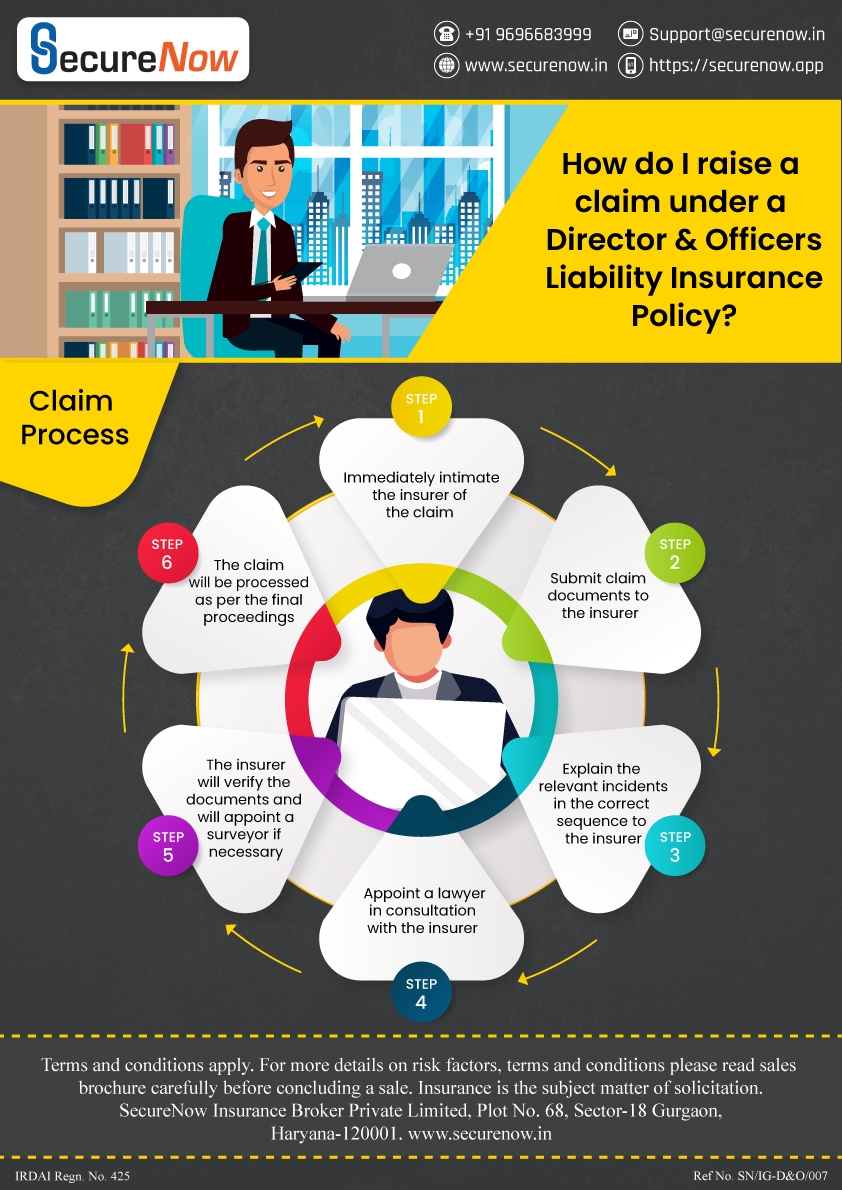
The claim filing process for a Directors & Officers liability insurance policy generally follows seven steps. The exact requirements depend on the policy wording and the insurer.
Step 1 – Identify the claim or circumstance
Start by deciding what has happened. Is it a formal legal proceeding, a regulatory investigation, a shareholder allegation, an allegation against a named director or officer, an employment-related management allegation, or a governance-related complaint? Or is it an early warning sign that could become a claim?
Record when the matter first came to the attention of the company and of each individual. These dates can matter later.
Do not assume that every allegation automatically qualifies as an insured claim. Equally, do not assume it does not. The insurer’s assessment should follow notice, not replace it.
Step 2 – Review the D&O policy
Before or alongside notice, review the policy documents, including the schedule and any endorsements. Key points to check:
- Insuring clauses – which parts of the policy (Side A, B or C) may respond
- Definitions – “claim”, “wrongful act”, “insured person”, “loss” and “defence costs”
- Policy period – whether the claimant made the claim within it
- Claims-made provisions – how and when you must report the claim
- Retroactive date – whether the wrongful act falls after it, where one applies
- Notice requirements – form, recipient and timing
- Exclusions – which may limit or remove cover
- Retention – the amount the insured bears before the policy pays
- Policy limits – overall, per-claim and any sublimits
- Defence-cost provisions – consent, advancement and choice of counsel
- Reporting requirements – ongoing updates the insurer expects
Step 3 – Notify the insurer or broker promptly
Follow the notification clause exactly. The policy may specify:
- How you must give notice, such as in writing or to a named address
- Who must receive it, such as the insurer’s claims department, often via the broker
- What information notice should include
- Time limits or reporting requirements, which vary between policies
There is no single universal deadline. Many policies require notice “as soon as practicable” and within the policy period or any extended reporting period. Late notice can put cover at risk, depending on the wording and the circumstances.
If you have a broker, involve them from the first day. A broker can help frame the notice and manage communication with the insurer. SecureNow offers claims advisory support for this stage.
Step 4 – Submit relevant claim information
The insurer will usually ask for information to understand the allegation. This may include the claim or notice letter, legal or regulatory documents, a description of the allegation and circumstances, the names of the people involved, key dates, proposed defence counsel details, and available supporting documents. Documentation requirements vary by insurer and policy; a detailed checklist appears below.
Disclose facts fully and accurately. Omitting material information can delay the claim or affect coverage.
Step 5 – Insurer reviews coverage
The insurer assesses whether and how the policy responds. It may review:
- Whether the matter falls within an insuring clause
- Whether the people or entity named qualify as insureds
- Whether the claimant made the claim during the applicable policy period
- Whether the insured followed notice requirements
- Which exclusions may apply
- The retention, policy limits and any sublimits
- Defence-cost provisions and other conditions
The insurer may accept cover, accept subject to a reservation of rights (keeping the right to decline later if facts emerge), accept part of the claim, or decline. Ask for its position in writing.
Step 6 – Defence and claims handling
Defence arrangements depend on the policy. Some wordings let the insured choose defence counsel with the insurer’s consent; others give the insurer a greater role or a panel of approved firms. The insurer does not always control the defence or always select the lawyer.
During this stage:
- Agree the appointment of lawyers and their fee rates where the policy requires consent
- Share the defence strategy and material developments with the insurer
- Submit legal invoices as the policy requires
- Cooperate with reasonable requests for information
- Do not make admissions or offers without the insurer’s agreement
Step 7 – Settlement or resolution
A covered claim may end in a judgment after a full defence, a settlement, a dismissal, a withdrawal, or another legal or regulatory outcome. Settlement generally needs the insurer’s prior written consent, and some policies contain provisions on what happens if the insured and insurer disagree about a proposed settlement.
The insurer will not settle every claim. Payment depends on the coverage position, the limits, the retention, and the policy terms.
Video: Claim filing process for Directors & Officers liability insurance policy
In this SecureNow video, our team explains the steps to file a D&O claim, the information you will need, and common reasons claims run into difficulty. Watch it alongside the step-by-step guide above.
What Documents Do You Need to File a D&O Claim?
The exact documentation depends on the claim and the policy. The table lists information insurers commonly request.
| Document / Information | Why It May Be Needed |
|---|---|
| Claim letter or legal notice | Shows what is alleged, by whom, and when the claim was made |
| Court/regulatory documents | Establishes the type of proceeding and its stage |
| Details of the allegation | Helps the insurer match the allegation to the policy definitions |
| Names of insured persons | Confirms who is covered and in what capacity |
| Date of claim/notice | Tests whether the claim falls within the policy period and notice requirements |
| Relevant correspondence | Provides context and shows how the dispute developed |
| Defence counsel information | Supports consent for counsel and fee rates |
| Supporting records | Board minutes, contracts, financial statements or policies relevant to the allegation |
| Previous related notices, where applicable | Checks for prior notifications or related claims |
| Other information requested by insurer | Any further details needed to assess coverage |
Keep copies of everything submitted and a log of all communication with the insurer and broker.
Infographic: How to raise a claim under a D&O policy
What Happens After You Notify the Insurer?
After notice, the insurer usually:
- Acknowledges receipt and assigns a claims handler
- Reviews coverage against the policy wording
- Gathers information, asking for documents or clarification
- Agrees defence arrangements, including counsel and fee rates where the policy requires consent
- Handles the claim as it develops, receiving updates and invoices
- Takes part in settlement discussions where the parties consider settlement, and resolves the claim under the policy terms
Timelines vary widely. A simple demand may resolve in weeks; litigation or regulatory proceedings can take years.
Payment: advancement or reimbursement
Depending on the policy and the claim, the insurer may advance covered defence costs as the insured incurs them, or reimburse them after the insured pays them. Many D&O policies provide for advancement, sometimes subject to an undertaking to repay if the claim later turns out to fall outside cover. Check which approach your policy takes.
Claims Settled by D&O Policy
Claims settled by a D&O Policy depend on the actual policy wording, the facts of the claim, applicable exclusions, limits, retention and other conditions. The table below shows claim types a D&O policy may cover. It is not a guarantee of coverage.
| Example of Claim | Potential D&O Relevance | Coverage Considerations |
|---|---|---|
| Shareholder allegation | High – shareholder claims are a core D&O exposure | May be covered subject to policy terms; check exclusions for major shareholders or insured-vs-insured claims |
| Wrongful management decision | High – falls within the typical definition of wrongful act | Potentially covered, depending on the insuring agreement and exclusions |
| Regulatory investigation | Moderate to high | Depends on whether the policy treats investigations as claims or covers them by extension, often under a sublimit; fines are often excluded or uninsurable |
| Breach of duty allegation | High | May be covered; deliberate breach or improper personal gain is commonly excluded once established |
| Governance-related claim | High | Potentially covered, subject to conflict-of-interest and personal-profit exclusions |
| Allegation against an individual director/officer | High | Side A or Side B may respond, depending on indemnification and the wording |
| Employment-related management claim | Moderate | Claims against individual managers may be covered; claims against the company often need EPLI |
| Misrepresentation in accounts or disclosures | High | May be covered; fraud exclusions apply if deliberate misstatement is established |
| Other management liability allegation | Varies | Depends on the definitions and exclusions |
For employment-related claims, see SecureNow’s article on wrongful employment practice claims.
Can Defence Costs Be Claimed Under a D&O Policy?
Yes, you can claim defence costs under a D&O policy for covered claims, and they are usually its most important benefit. How much the insurer pays depends on the policy limit, any sublimit, the retention, consent requirements, and the exclusions.
What defence costs mean
Defence costs are the reasonable legal fees and expenses incurred in investigating, defending or appealing a covered claim. They may include lawyers’ fees, expert and consultant fees, and court costs. Some policies also cover costs of attending regulatory investigations. What counts depends on the policy’s definition.
Why defence costs matter
In many D&O claims, defence costs are the largest part of the loss. They start at once, continue while the parties contest the claim, and arise even when the allegation eventually fails.
What decides the extent of cover
When asking whether you can claim defence costs under a D&O policy, and to what extent, look at these factors:
- Limit of liability (sum insured). The maximum the insurer pays. In most D&O policies, defence costs are inside the limit, so they reduce what remains for any settlement or judgment. Some policies pay defence costs in addition to the limit; check which applies.
- Any one claim vs annual aggregate. Some Indian D&O policies set a limit for any one claim that differs from the annual aggregate. A 1:1 ratio means the full limit is available for a single claim; a lower ratio caps what one claim can use.
- Particular costs, such as regulatory investigation costs, may have a lower sublimit.
- Retention or deductible. The insured bears costs up to the retention before the policy pays. Retentions often apply to company reimbursement and entity cover rather than to individuals.
- Many policies advance costs during the claim; others reimburse after payment.
- The policy may not cover costs incurred without required prior consent.
- Insurers typically pay reasonable and necessary costs, and may review fee rates and invoices.
- If a court or tribunal later establishes an excluded act, such as deliberate fraud, the insurer may seek repayment of advanced costs.
Covered and uncovered allegations
A claim may include some allegations the policy covers and others it does not, or name some parties the policy insures and others it does not. In that case, the insurer may allocate defence costs between covered and uncovered parts. Allocation provisions vary between policies, so check how yours handles it.
Defence cost checklist
| Defence Cost Issue | What the Policyholder Should Check |
|---|---|
| Defence lawyer | Whether you can choose counsel, whether a panel applies, and whether consent is needed |
| Legal fees | Approved fee rates and how invoices must be submitted |
| Prior approval | Which costs need the insurer’s written consent before they are incurred |
| Defence-cost advancement | Whether costs are advanced during the claim or reimbursed later, and any repayment undertaking |
| Retention | Whether a retention applies and who bears it |
| Policy limit | Whether defence costs erode the limit, and any per-claim cap or sublimit |
| Covered vs uncovered allegations | How the policy allocates costs where only part of the claim is covered |
| Settlement consent | Insurer consent requirements before any settlement offer or agreement |
Side A D&O Policy: How the Claim Process Works
A Side A D&O policy – or the Side A section of a D&O policy – protects individual directors and officers when the company does not indemnify them, for example because it is insolvent, legally prevented from indemnifying, or refuses to do so.
How Side A differs
Most D&O policies have three parts. Side B reimburses the company when it indemnifies its directors and officers. For certain claims, Side C may cover the company itself. Meanwhile, Side A pays the loss directly for the individual when company indemnification is not available. Some organisations also buy a standalone Side A policy, often as additional cover dedicated to individuals.
For more detail, see SecureNow’s guide to Side A, B and C covers.
When Side A may become relevant
Side A does not automatically respond whenever someone sues a director personally. It may become relevant when the individual faces a covered claim, and the company cannot or does not indemnify them. Whether it applies depends on:
- The policy wording and the Side A insuring clause
- Whether the person is an insured person under the policy
- The company’s indemnification rights and obligations, including its articles and any indemnity agreement
- Applicable law on what a company may indemnify
- The circumstances of the claim
- Exclusions and other policy conditions
How the individual interacts with the process
In a Side A situation, the individual director or officer may need to deal with the insurer more directly than usual, especially if the company is in insolvency or in dispute with them.
- The individual, or the company’s legal team if it is still functioning, notifies the insurer or broker in line with the policy.
- Insurer review. The insurer checks the claim, the person’s insured status, and why company indemnification is unavailable.
- Coverage determination. The insurer decides whether Side A responds, and may reserve its rights while it confirms the facts.
- Defence costs. Where covered, the insurer may pay costs directly for the individual. Side A often carries no retention, but this depends on the wording.
- Settlement or resolution. Insurers may also pay any settlement or judgment within the limit, subject to consent requirements and exclusions.
Individuals should keep their own copies of the policy and know how to contact the broker directly. In a crisis, the company’s records and staff may not be available.
Standard D&O context vs Side A D&O
| Feature | Standard D&O Context | Side A D&O |
|---|---|---|
| Primary focus | Protecting individuals and reimbursing the company (and, in some policies, the company itself) | Protecting individuals where company indemnification is unavailable |
| Individual director/officer | Usually protected through company indemnification reimbursed under Side B | Protected directly when the company does not indemnify |
| Entity indemnification | Company pays first, then seeks reimbursement | Not available or not provided |
| When it may become relevant | Company is solvent and willing and able to indemnify | Insolvency, legal prohibition on indemnity, or company refusal |
| Defence costs | Paid to or for the company after any retention | Paid for the individual, often with no retention, subject to wording |
Claims-Made Policies: Why Timing Matters
Insurers commonly write D&O policies on a claims-made basis, but the exact wording varies. Under a claims-made policy, the policy that generally responds is the one in force when the claimant first makes the claim against the insured and the insured reports it to the insurer – not the one in force when the directors took the decision.
This affects claims in several ways:
- Policy period. The policy may not cover a claim made after it expires unless an extended reporting period applies.
- Timely notice. Many policies require you to report claims during the policy period or a short window after it.
- Retroactive date. Where the policy has one, it may exclude wrongful acts before that date. See SecureNow’s explanation of the retroactive date.
- Prior or pending litigation. Policies commonly exclude claims arising from litigation that existed before a set date.
- Renewing without gaps, and with the same insurer where possible, helps avoid disputes over which policy responds.
- Reporting a circumstance during the current policy can attach a later claim to that policy.
For more, read D&O liability insurance – a claims-made policy.
Exclusions and Coverage Limitations
Coverage always depends on the actual policy. Common exclusions may include:
- Fraud or dishonesty, usually once established by a final judgment, adjudication, or admission
- Personal profit or advantage the insured had no legal right to
- Prior or pending litigation existing before a date set in the policy
- Known circumstances notified under an earlier policy or known at inception
- Bodily injury and property damage, where applicable
- Contractual liabilities, where excluded
- Claims between insured parties, often with exceptions
- Fines and penalties, where the policy excludes them or the law does not allow insurance for them
- Other policy-specific exclusions, such as pollution or professional services
The exact wording varies by policy and insurer. SecureNow’s page on exclusions in a D&O liability policy explains these in more detail.
Ways a D&O Claim Can End
A D&O claim can end in several ways:
- Defence to judgment. The parties contest the claim in court or before a regulator, which then decides the outcome.
- The parties negotiate, sometimes through mediation, to narrow or resolve the dispute.
- The claimant agrees to accept a payment or other terms. The policy usually requires insurer consent.
- Dismissal or withdrawal. The court or regulator dismisses the claim, or the claimant drops it, often after a strong defence.
- Other resolution. A regulatory matter may end with no action, a warning or an order; some outcomes, such as fines, may not be insurable.
The insured or the company bears any amounts outside cover, above the limit, or within the retention.
Common D&O Claim Filing Mistakes
These mistakes can create avoidable problems. Not every mistake leads to a denial; the consequence depends on the policy and the circumstances.
- Delayed notification. Waiting to see whether a dispute “goes away” can put cover at risk.
- Not reading the notice provisions. Sending notice to the wrong place or in the wrong form can cause delay.
- Missing documentation. Incomplete information slows the coverage review.
- Unauthorised settlement. Agreeing a settlement without the insurer’s consent may leave it uninsured.
- Incurring costs without consent. The insurer may not reimburse legal fees incurred before approval.
- Failure to cooperate. Not responding to reasonable insurer requests can affect the claim.
- Assuming the policy covers every claim. Plan for the possibility of partial or no cover.
- Ignoring exclusions. Understand early which exclusions the insurer may raise.
- Not preserving documents. The defence may need emails, board minutes and records.
- Not communicating developments. Report material changes, such as new parties or amended claims.
D&O Claim Filing Checklist
- Record the date the claim or circumstance was first received
- Locate the policy schedule, wording and endorsements
- Check the notice clause: form, recipient and timing
- Notify the broker and insurer in writing
- Collect the claim documents and a factual summary
- Identify all insured persons named or involved
- Preserve relevant documents and communications
- Seek the insurer’s consent before appointing counsel or incurring major costs, where required
- Ask for the insurer’s coverage position in writing
- Keep the insurer informed of material developments
- Obtain insurer consent before any settlement
- Keep a log of all correspondence and invoices
Practical D&O Claim Examples
The following are illustrative, hypothetical scenarios. They are not real claims and do not describe any insurer’s decision. An illustrative scenario is not a guarantee of insurance coverage; the actual outcome depends on the policy wording, exclusions, limits and conditions.
Example 1 – Shareholder claim
A minority shareholder files proceedings alleging that three directors approved an unfair related-party transaction. The company secretary notifies the broker the same week with the petition and board minutes. The insurer accepts cover with a reservation of rights on a conflict-of-interest exclusion and agrees defence counsel. The insurer advances defence costs within the limit while the case continues.
Example 2 – Regulatory matter
A director receives a regulator’s notice asking for documents about a disclosure. The policy treats formal investigations as claims but places investigation costs under a sublimit. The insurer covers the costs of responding up to the sublimit. If a penalty follows later, the policy may exclude it, or the law may not allow cover for it.
Example 3 – Employment-related management allegation
A former senior employee alleges that the chief executive dismissed her unfairly and names both the CEO and the company. The D&O policy may respond for the CEO as an insured person. The company’s own exposure depends on whether the programme includes employment practices liability (EPLI) cover. The broker notifies both sections where they exist.
Example 4 – Side A situation
A company enters insolvency proceedings. Creditors then allege that two former directors allowed the company to continue trading improperly. The company can no longer indemnify them. The directors notify the broker directly, and the insurer reviews whether Side A responds. If it does, the insurer may pay defence costs for the directors, subject to the policy terms and exclusions.
Example 5 – Defence costs
A business partner sues a director over statements made during a failed joint venture. He appoints a law firm before telling the insurer and incurs significant fees. When he notifies, the insurer accepts the claim but questions costs incurred before notice and consent. The insurer pays only costs that meet the policy’s consent and reasonableness terms.
Conclusion
To file a D&O insurance claim well, act early, follow the policy’s notice rules, provide complete information, and keep the insurer involved at every stage. Defence costs, settlements and Side A protection can all be valuable – but only within the policy’s definitions, limits, retention and exclusions.
Keep a copy of your policy where directors can reach it, know your broker’s claims contact, and review the notice clause before you need it. If you need help with a live claim, SecureNow’s claims advisory team can assist, and you can compare cover on the Directors & Officers Liability Insurance page.
This article is general information and does not replace the policy wording or legal advice. Claim outcomes depend on the specific policy and facts. Insurance is the subject matter of solicitation.
Frequently Asked Questions
Q) How do I file a D&O insurance claim?
A) Identify the claim or circumstance, review your policy’s notice requirements, and notify the insurer, usually through your broker, in writing. Provide the claim documents, cooperate with the coverage review, follow consent requirements for defence counsel and costs, and obtain the insurer’s consent before any settlement.
Q) What is the Directors and Officers Liability Insurance Claims Process?
A) It is the sequence from claim to resolution: the claim arises, the insured reviews the policy, gives notice, submits documents, the insurer reviews coverage, the defence proceeds, the parties consider settlement, and the claim reaches resolution. The exact steps depend on the policy and insurer.
Q) What documents are required to file a D&O claim?
A) Insurers commonly ask for the claim letter or legal notice, court or regulatory documents, details of the allegation, names of insured persons, key dates, relevant correspondence, defence counsel details, and supporting records such as board minutes. Requirements vary by insurer and policy.
Q) When should a D&O claim be reported?
A) As soon as practicable after you receive the claim, and within the time the policy requires. D&O policies are commonly claims-made, so you generally must report the claim during the policy period or any extended reporting period. Check your policy’s notice clause.
Q) What claims are settled by a D&O Policy?
A) Depending on the wording, a D&O policy may cover claims alleging breach of duty, mismanagement, misleading statements, governance failures and certain regulatory matters, as well as some employment claims against individuals. Coverage depends on the definitions, exclusions, limits, retention and conditions.
Q) Can defence costs be claimed under a D&O policy?
A) Yes, for covered claims. Defence costs are usually the main benefit. They are subject to the policy limit, any sublimit or per-claim cap, the retention, consent requirements and exclusions. In most policies, defence costs reduce the limit available for settlements.
Q) Does D&O insurance pay defence costs before the case ends?
A) Many D&O policies advance defence costs as they are incurred rather than waiting for the outcome, sometimes subject to repayment if the claim later turns out to fall outside cover. Other policies reimburse after payment. Check your policy’s advancement terms.
Q) What is a Side A D&O policy?
A) A Side A D&O policy, or the Side A section of a D&O policy, protects individual directors and officers when the company does not indemnify them – for example, because it is insolvent, legally prevented, or unwilling. Cover remains subject to the policy terms and exclusions.
Q) How does a Side A claim work?
A) The individual or the company notifies the insurer. The insurer reviews the claim, the person’s insured status, and why company indemnification is unavailable, then decides whether Side A responds. Where covered, the insurer may pay defence costs and any settlement for the individual within the limit.
Q) Can a D&O claim be denied?
A) Yes. An insurer may decline a claim if it falls outside the policy definitions or period, if an exclusion applies, if the insured did not meet notice or other conditions, or if the limit runs out. Insurers may also accept part of a claim or reserve their rights.
Q) What happens after notifying the insurer?
A) The insurer acknowledges the notice, reviews coverage, asks for further information, agrees defence arrangements where the policy requires consent, and handles the claim as it develops. It may accept cover, accept with a reservation of rights, or decline.
Q) Can the policy cover a claim if it covers some allegations and excludes others?
A) Often, yes. The insurer may cover the covered allegations and allocate defence costs and any settlement between covered and uncovered parts. How allocation works depends on the policy wording.