





In today’s dynamic world, employee benefits play a pivotal role in attracting and retaining talent. Group health insurance is one such benefit that offers security and peace of mind to employees. Group health insurance is a type of insurance that provides coverage for the medical expenses of a group of people. This group typically consists of employees of a company or members of an organization. A group health insurance offers medical coverage to the members of the group against any health emergencies. Below are some important features of group health insurance:
- Coverage: Group health insurance plans usually cover various medical services such as diagnostic tests, hospitalization, surgery, and preventive care.
- Premiums: Group health insurance premiums are typically paid by the employer or the organization. There are some plans that may require employees to contribute a portion of the premium.
- Eligibility: Group health insurance plans typically have eligibility criterions that must for enrollment. These requirements may include being an employee of the company or organization, meeting certain age or length of service requirements, and not having certain pre existing medical or health conditions.
- Network: Group health insurance plans often have a network of healthcare providers that members can visit for covered treatments. These healthcare entities may include network hospitals, doctors, and other healthcare professionals.
- Coverage limits: Group health insurance plans typically have limits on the amount defined for certain types of medical services, such as prescription drugs or mental healthcare.
- Exclusions: Group health insurance plans may exclude coverage for certain types of medical conditions or services, such as experimental treatments or pre-existing health conditions.
- Renewability: Group health insurance plans may be renewable, that is, coverage can continue from year to year as long as the employer or organization continues to pay the insurance premiums.
Key Takeaways
-
The “Day 1” Promise: The most significant advantage of GHI in 2026 is the waiver of all waiting periods. Whether it’s a pre-existing condition or a surgery required shortly after joining, coverage is effective from the policy’s start date.
-
A Parenting Partner: For growing families, maternity benefits go beyond just the hospital bill. They signal a corporate commitment to your team’s well-being, covering the medical journey from prenatal check-ups to the delivery.
-
Eliminating Hidden Costs: Modern “Zero-Cap” policies ensure that if you have a ₹5 Lakh cover, the entire amount is available for any disease. There are no sub-limits that restrict payments for specific treatments like kidney stones or cataracts.
-
Financial Fluidity: With “No Co-payment,” the insurer bears the entire admissible bill. This is particularly vital in high-cost medical hubs like Gurugram, where a 10% or 20% share could still mean a significant out-of-pocket expense.
-
Extended Care: Protection doesn’t end at the hospital gate. Coverage for 30 days before and up to 60 days after hospitalization ensures that the costs of diagnostic tests, doctor consultations, and recovery medicines are also reimbursed.
Importance of understanding the features of Group Health Insurance
- Smooth Claims Process: Employees who understand the features and coverages of their group health insurance are better equipped to initiate and navigate the claims process. This understanding reduces the chances of delays and denials, ensuring timely medical care and financial relief.
- Informed Choices: When employees are well-informed about the coverage limits, deductibles, and copayments, they can make informed decisions about their healthcare. This, in turn, minimizes unexpected out-of-pocket expenses.
- Effective Communication: Employers who facilitate communication and education regarding health insurance coverage foster a positive relationship with their employees. This contributes to a more harmonious work environment.
- Reduced Friction: When employees are aware of what is covered and what isn’t, they are less likely to dispute claim settlements. This leads to a smoother claims settlement process and minimizes potential disputes between employees and insurance providers.
To conclude, understanding the features and coverages of group health insurance is not just a formality but a critical element in the claims settlement process. It empowers employees to make informed decisions, ensures a smoother claims experience, and fosters positive relationships between employers and their workforce. Group Mediclaim, or group medical insurance, offers tax benefits and pre-added benefits. It covers insured members and their family member, with sum insured options. Choose from various health insurance plans offered, and buy group health insurance with access to a network of hospitals. Lastly, by prioritizing employee education about health insurance cover, companies can create a win-win situation that benefits both their employees and the organization as a whole.
Key Features of Group Health Insurance
Explore the key features of our Group Health Insurance (GHI) plan, designed to safeguard your team’s health and well-being. Explore the benefits below.
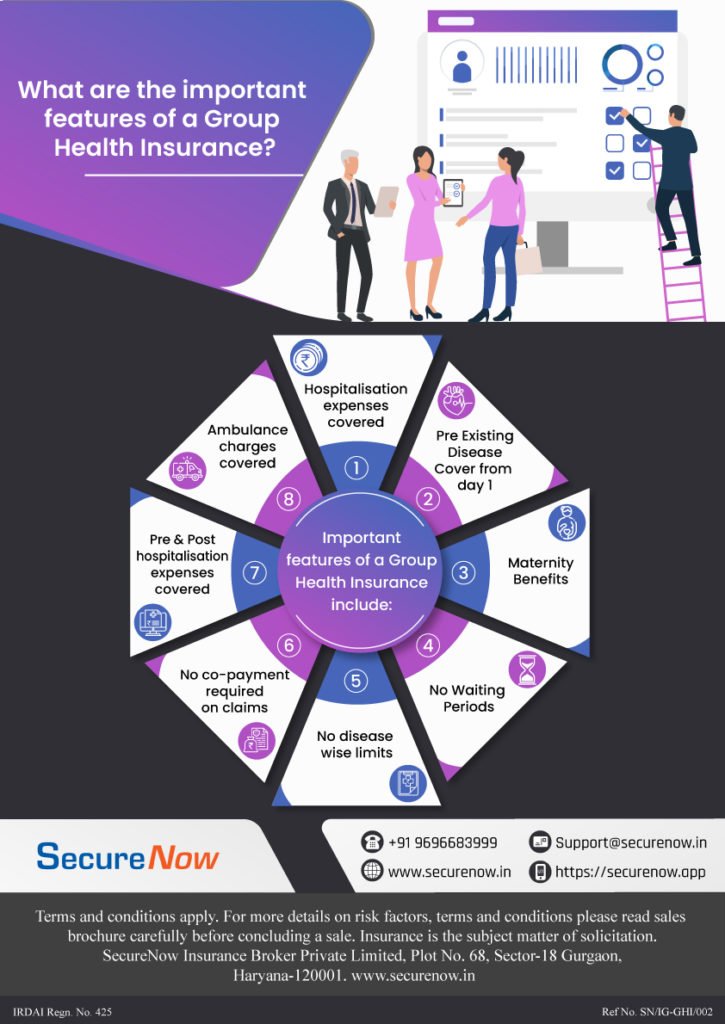
Hospitalization expenses coverage – Hospitalization expenses coverage in group health insurance provides financial protection for hospital stays. This essential feature covers medical bills, surgeries, and related costs, easing the burden on employees and promoting their well-being. Learn more about how this benefit can benefit your team’s health and financial security.
Pre exiting disease coverage from Day 1- Discover the peace of mind that comes with pre-existing disease coverage from day one in your group health insurance. While IRDA guidelines may have some exceptions, this feature offers immediate protection, ensuring your employees’ health is a top priority. Learn more about the exceptional coverage your team deserves.
Maternity Benefits – Maternity benefits in group health insurance offer essential support and peace of mind. Beyond enhancing employee retention, these benefits ensure a smooth transition to parenthood, emphasizing your commitment to your team’s well-being.
No waiting Periods – No waiting period in group health insurance means immediate coverage without delays for pre existing diseases or other health issues. Notably, it applies, notably, from the policy’s effective date, ensuring instant protection
No disease wise limits -This feature in group health insurance ensures comprehensive coverage without specific monetary constraints on individual diseases or conditions. It functions by offering financial support for all medical expenses related to various illnesses. This feature offers comprehensive coverage, with exceptions or limits based on disease types, severity, and policy terms. Therefore, always review your policy documentation to understand any such exceptions for complete clarity on coverage.
No co-payment required on claims – Policyholders are not required to share medical costs when making claims, thanks to this group health insurance feature. This feature is typically straightforward, with no co-payment stipulations for covered services. However, some policies may have exceptions or specific guidelines in unique cases or for certain treatments. So, thoroughly review policy terms to grasp co-payment exceptions or nuances for complete clarity on requirements.
Summary: Key Features & Strategic Benefits
Other benefits:
Ambulance charges covered – Group health insurance often covers ambulance charges, ensuring swift medical transport during emergencies. Some policies may specify coverage limits based on distance or service providers. Additionally, they may include doctor-on-board support for critical cases. Review your policy for specific coverage details.
Please go through below infographic covering pre added benefits of Group Health insurance, which you should know before buying the policy.
Explore SecureNow LinkedIn page to discover excellent policies and learn about the remarkable work we’re doing, customizing products for organizations.
Frequently Asked Questions (FAQs)
Q1: How do I claim for medicines and tests done after I am discharged?
A) These are “Post-hospitalization” expenses. In 2026, most insurers cover these for 60 days after discharge. You should keep all original pharmacy bills and test reports and submit them as a single “Reimbursement Claim” once the recovery period is over.
Q2: Will my newborn be covered even if I haven’t officially added their name yet?
A) Yes, if your policy has Baby Day One cover. While you should intimate your HR within 30 days to formally add the baby to the “Master Policy,” any medical emergencies immediately after birth are covered under the mother’s maternity extension.
Q3: Does “No Disease-wise Limits” mean I can choose a Suite room?
A) Not necessarily. While there are no limits on the disease, there are still limits on the Room Category (usually a Single Private AC Room). If you choose a room above your eligible category, a “Proportionate Deduction” may apply to your entire bill.
Q4: Is an ambulance always free under this policy?
A) The policy covers ambulance charges up to a certain limit (usually ₹2,000–₹5,000). In 2026, many premium plans also include “Doctor-on-board” support for critical emergencies, but it’s always best to check the specific sub-limit in your policy document.
Q5: What if I have a condition I didn’t know about when I joined?
A) In a GHI, it doesn’t matter. Since Pre-existing Diseases are covered from Day 1, even undiagnosed conditions are protected. You don’t need to undergo a medical check-up to prove you are healthy before the coverage starts.
About The Author
Mayank Sharma
MBA Finance
He is a professional who brings extensive knowledge and expertise to the field of group health insurance. He has dedicated 7years to helping individuals and businesses navigate the complexities of insurance. Having worked closely with numerous clients and insurance providers, he deeply understands the nuances of group health insurance policies. With a reputation for providing insightful and informative content, he leverages his industry experience to educate readers about the importance of group health insurance and its benefits. Through their articles, Mayank Sharma aims to empower individuals and businesses to make informed decisions about their healthcare coverage, ultimately promoting healthier and more secure communities.