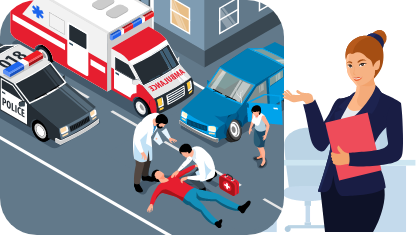


Personal accident insurance and life insurance protect against different financial risks. Personal Accident (PA) insurance focuses on accidents: it pays specified benefits for accidental death and, depending on the policy, for disability caused by an accident. Life insurance pays a death benefit when the insured person dies during the cover, subject to its terms. Some life products also include savings, maturity or other benefits.
Benefits depend on the specific product and policy wording, and products within each category differ. This guide explains how each type works, when each pays out, and why employers often provide both Group Personal Accident (GPA) and Group Term Life (GTL) cover.
Personal accident insurance pays when an accident causes death or a covered disability. It generally doesn’t pay for death from illness. Life insurance pays a death benefit to the nominee when the insured person dies during the cover, whether from illness or an accident, subject to the policy’s exclusions. The two serve different purposes and can complement each other.
What Is Personal Accident Insurance?
Personal accident insurance pays specified benefits when an accident – a sudden, external, and visible event – causes death or a covered disability. Depending on the policy, the benefits may include:
- Accidental death – usually 100% of the sum insured.
- Permanent total disability (PTD) – such as loss of both hands. One published GPA wording pays 100% of the sum insured for this.
- Permanent partial disability (PPD) – the loss of part of the body, paid as a scheduled percentage.
- Temporary total disability (TTD) – a weekly benefit while the person can’t work.
What is paid depends on the sum insured, the benefit schedule, the exclusions, and the conditions. Not every policy includes all four benefits, and not every injury leads to a payment.
Individual vs group cover. Individual personal accident insurance is bought by a person for themselves. Group Personal Accident insurance is bought by an employer for a group of employees under one master policy.
What Is Life Insurance?
Life insurance pays a death benefit – the sum assured – to the nominee if the life assured dies while the cover is in force, subject to the policy’s terms. Three roles matter:
- The policyholder – who owns the policy. In group life cover, this is the employer.
- The life assured – whose life is covered.
- The nominee or beneficiary – who receives the benefit.
Term vs savings products. Term insurance is pure protection: it pays only on death during the term. Both group term products reviewed for this article are described as “pure risk” with no maturity benefit. Savings-oriented or investment-linked life products may also pay a maturity or survival benefit, but not all life insurance does.
The benefit depends on the policy term, the sum assured, the exclusions, and the policy being in force.
Personal Accident Insurance vs Life Insurance – Key Differences
| Comparison factor | Personal Accident Insurance | Life Insurance |
|---|---|---|
| Primary purpose | Financial support after an accident causes death or disability | Financial support for dependants after the insured person’s death |
| Main insured event | An accident causing death or a covered disability | Death during the cover |
| Accidental death benefit | Yes, usually the core benefit | Yes, generally, subject to exclusions |
| Death due to non-accidental causes | Generally not covered | Generally covered, subject to exclusions |
| Permanent disability benefits | Commonly included (PTD; PPD by schedule), depending on the policy | Not in a standard term plan; may be available through a rider |
| Temporary disability benefits | Sometimes included (TTD weekly benefit) | Not in a standard term plan |
| Typical payout structure | Lump sums as a percentage of the sum insured; weekly payments for TTD | Lump-sum sum assured; some products pay maturity benefits |
| Who receives the benefit | The insured person (disability); the nominee (death) | The nominee or legal heir |
| Coverage period | Often one year, renewable | A set term; group term cover is often renewable annually |
| Common exclusions or limitations | Self-injury, intoxication, hazardous activities, pregnancy-related injury (policy-specific) | Suicide within a set period (policy-specific); others per the policy |
| Main policy limits to review | Benefit percentages, weekly caps, aggregate cap at the sum insured | Sum assured; any early-death or suicide clause |
| Common use cases | Income protection after accidental disability; extra accidental-death cover | Protecting dependants against loss of income on death |
| Employer-provided equivalent | Group Personal Accident (GPA) | Group Term Life (GTL) |
In short: PA cover is accident-only but can pay while the insured person is alive and disabled. Life cover pays on death from almost any covered cause, but a standard term plan pays nothing for disability. Neither is a subset of the other.
When Does Personal Accident Insurance Pay Out?
PA insurance pays when an accident leads to an outcome that the policy lists, and no exclusion applies. An accident on its own doesn’t guarantee a payout. The outcome must match a benefit definition, and the claim must be supported by evidence.
| Illustrative situation | Potential Personal Accident benefit | What must be verified |
|---|---|---|
| Accidental death | Death benefit, usually 100% of the sum insured | Cause of death (post-mortem report, FIR); no exclusion; nominee details |
| Permanent total disability | Up to 100% of the sum insured, per the schedule | The loss matches the PTD definition; any 12-month condition in the wording |
| Permanent partial disability | A scheduled percentage, e.g. 30% for hearing in one ear in one published wording | The body part and degree of loss; the doctor’s assessment |
| Temporary total disability | Weekly benefit for certified weeks of total disability | Whether TTD is included; the weekly amount and maximum weeks |
These situations are illustrative. Actual eligibility depends on the policy wording, exclusions, evidence, and claim assessment. SecureNow explains each benefit in its guide to the types of disability covered under GPA.
When Does Life Insurance Pay Out?
A term life policy pays the sum assured to the nominee if the life assured dies during the cover and the policy terms are met. It pays for death from illness as well as accidents – the key difference from PA cover – unless an exclusion applies.
Group term documents commonly contain a suicide clause. One applies it within 12 months of inception, paying at least 80% of premiums. Another applies it only to non-employer-employee groups. Some life products add riders or maturity benefits; others don’t.
| Illustrative situation | Potential Life Insurance outcome | What must be verified |
|---|---|---|
| Death due to an illness during the cover | Sum assured paid to the nominee | Policy in force; any early-death clause; claim documents |
| Accidental death during the cover | Sum assured paid; plus any accidental death rider, if bought | Rider terms; exclusions |
| Death where a policy exclusion may apply | Reduced or no payment under that clause | The exact exclusion wording and its time limit |
| Policy maturity, if the product includes a maturity benefit | Maturity benefit paid | Whether the product has one – term plans generally don’t |
The sum assured, the policy’s status, correct nominee details and the claim documents all matter. See SecureNow’s Group Term Life insurance page for employer cover.
Personal Accident Insurance vs Life Insurance – Worked Examples
These scenarios are hypothetical. The figures are assumptions, and none is a guaranteed claim outcome.
Assumptions: Meera has a PA sum insured of ₹10,00,000 and a term life sum assured of ₹20,00,000. Both policies are in force, and no exclusions apply.
- Accidental death. Meera dies in a road accident. Both policies may pay: up to ₹10,00,000 under the PA policy and ₹20,00,000 under the life policy, ₹30,00,000 in total. Check: the cause of death, the documents, and that no exclusion applies under either policy.
- Death from illness. Meera dies after a sudden illness. The life policy may pay ₹20,00,000. A typical PA policy pays nothing, because there was no accident. Check: the life policy’s exclusions and any early-death clause.
- Accidental disability. Meera loses both hands in a factory accident and survives. A PA policy that, like the ICICI Lombard wording, pays 100% for the loss of two hands could pay ₹10,00,000. A standard term life policy pays no death benefit, because she is alive – unless she has a disability rider. Check: the PTD definition and the 12-month condition in the PA policy; any rider in the life policy.
Why Employers May Provide Both GPA and GTL Insurance
GPA and GTL address different risks, so employers often provide both rather than choosing one. GPA pays for accidental death and disability. GTL pays a death benefit for death from covered causes, accidental or not.
The two policies can overlap on accidental death, where both may pay. GTL fills the gap for death from illness, which GPA doesn’t cover. GPA fills the gap for disability, which a standard death-only GTL policy doesn’t cover.
Employers should look at the two together – benefits, limits, exclusions, eligibility, and cost – and design the package around their workforce. No general legal requirement to buy both was found.
| Employer benefit consideration | GPA | GTL |
|---|---|---|
| Main purpose | Accident-related death and disability benefits | Life cover for employees |
| Accidental death benefit | Yes, subject to the terms | Yes, subject to the terms |
| Death due to covered non-accidental causes | No | Yes, subject to exclusions |
| Disability benefits | Commonly PTD and PPD; TTD in some policies | Not in a standard plan; riders may be available |
| Typical benefit structure | Percentage of the sum insured; weekly TTD | Sum assured per member |
| Important limits and exclusions | Benefit schedule, weekly caps, intoxication and hazardous-activity exclusions | Suicide clause (policy-specific), free cover limit, early-death clauses |
| Role in an employee-benefits package | Protects income after accidental disability | Protects dependants on death |
GPA vs GTL vs GHI – What Is the Difference?
GPA, GTL and Group Health Insurance (GHI) each cover something different, so they are not interchangeable.
- GPA pays benefits for accidental death and disability.
- GTL pays a death benefit.
- GHI pays eligible medical and hospitalisation expenses for illness and injury.
| Feature | GPA | GTL | GHI |
|---|---|---|---|
| Primary purpose | Accidental death and disability benefits | Life cover | Medical expenses |
| Main event or expense covered | An accident causing death or disability | Death | Hospitalisation and treatment |
| Accidental death | Yes | Yes | No death benefit |
| Death from covered non-accidental causes | No | Yes | No death benefit |
| Disability benefits | Yes, per the schedule | Not in a standard plan; possible rider | No |
| Medical and hospitalisation expenses | Only with a medical-expense extension | No | Yes, within limits |
| Typical beneficiary or payment structure | Insured person or nominee; lump sum or weekly | Nominee; lump sum | Hospital (cashless) or reimbursement to the member |
| Main limits to review | Benefit percentages, caps, aggregate limit | Sum assured, exclusions | Sum insured, sub-limits, waiting periods |
How Coverage Limits and Payouts Work
The sum insured or sum assured is the maximum reference amount, not a promise that every claim pays that amount. A GPA disability benefit is usually a percentage of the sum insured, and total payments are capped at the sum insured (ICICI Lombard Section 2.5). A term life death benefit is usually the sum assured, subject to the exclusions.
| Term | How it applies to GPA | How it applies to Life Insurance |
|---|---|---|
| Sum insured or sum assured | Reference amount for the percentage benefits | Amount paid on death |
| Accidental death benefit | Usually 100% of the sum insured | Included in the death benefit; extra if a rider is bought |
| Disability benefit | PTD and PPD percentages; weekly TTD | Only through a rider, if available |
| Death benefit | Accidental death only | Death from covered causes |
| Exclusions | Self-injury, intoxication, hazardous activities, etc. | Suicide clause and others, per the policy |
| Additional benefits or riders | Add-ons such as medical expenses | Riders such as accidental death or critical illness (where available) |
| Claim documentation | FIR, post-mortem report, disability certificates, medical records | Death certificate, claim form, nominee ID; per the policy |
Example (hypothetical): with a GPA sum insured of ₹10,00,000, the loss of hearing in one ear at 30% (one published wording) pays ₹3,00,000, not ₹10,00,000.
Can Personal Accident Insurance Replace Life Insurance?
No – they serve different purposes, so one doesn’t generally replace the other. PA insurance won’t pay if death is caused by illness, so someone relying on it for life cover could leave their family unprotected. Equally, a standard death-only term life policy won’t pay for a disabling accident if the person survives, so it isn’t disability protection.
The right combination depends on your circumstances, existing cover, the policy features and your financial needs.
Common Mistakes When Comparing Personal Accident and Life Insurance
| Common mistake | Why it matters | What to do instead |
|---|---|---|
| Assuming both policies cover the same events | PA is accident-only; life covers death from most causes | Map each policy’s triggers |
| Comparing only the sum insured or sum assured | Payouts depend on percentages and exclusions | Compare benefits and conditions |
| Assuming every GPA policy includes TTD benefits | Some policies don’t include TTD | Check the schedule |
| Assuming every Life Insurance product has maturity benefits | Term plans generally don’t | Check the product type |
| Ignoring exclusions and benefit limits | Claims may be reduced or refused | Read both wordings |
| Assuming one policy can always replace the other | Each leaves a gap the other covers | Review them together |
| Overlooking the differences between GPA, GTL and GHI | They cover different risks | Build the package deliberately |
Conclusion
Personal accident insurance and life insurance answer different questions. PA cover pays for accidental death and, depending on the policy, disability. Life cover pays a death benefit, according to its terms, regardless of the cause. For employers, GPA and GTL complement each other, while GHI pays for medical treatment.
Before deciding, compare the actual coverage, exclusions, limits, and claim conditions of each policy. To review employee coverage, explore SecureNow’s Group Personal Accident insurance options.
This article is general information. Benefits depend on the specific policy wording. Insurance is the subject matter of solicitation.
Frequently Asked Questions
Q) What is the difference between Personal Accident Insurance and Life Insurance?
A) Personal accident insurance pays when an accident causes death or a covered disability. Life insurance pays a death benefit when the insured person dies during the cover, from illness or an accident, subject to its exclusions.
Q) Does Personal Accident Insurance cover death due to illness?
A) Generally no. PA insurance covers death caused by an accident – a sudden, external event. Death from illness is usually covered by life insurance instead.
Q) Does Life Insurance cover accidental death?
A) Generally yes. A term life policy pays the death benefit whether the death was from illness or an accident, subject to its exclusions. Some policies also offer an accidental death rider that pays an extra amount.
Q) Can Personal Accident Insurance pay for disability?
A) Yes, depending on the policy. PA policies commonly pay for permanent total disability and permanent partial disability, as a percentage of the sum insured, and some pay a weekly benefit for temporary total disability.
Q) Why do employers offer both GPA and GTL insurance?
A) Because they cover different risks. GTL protects families when an employee dies from almost any covered cause, while GPA adds benefits for accidental death and for disability, which a standard GTL policy doesn’t provide.
Q) What is the difference between GPA, GTL, and GHI?
A) GPA pays benefits for accidental death and disability. GTL pays a death benefit. GHI pays eligible medical and hospitalisation expenses for illness and injury.
Q) Can Personal Accident Insurance replace Life Insurance?
A) No. PA insurance generally doesn’t pay for death from illness, so it can’t replace life cover. A standard term life policy also doesn’t pay for a disability the person survives.
Q) Does the sum insured guarantee the amount payable?
A) No. Many PA benefits are percentages of the sum insured, and life policies have exclusions. The payout depends on the benefit schedule, exclusions, and the claim assessment.
Q) What should an employer compare when choosing GPA and GTL?
A) Compare the benefits each pays, the sum insured and sum assured, the disability schedule, any riders, exclusions, eligibility rules, free cover limits and cost – and look at the two policies together.
Q) Where can I compare GPA, GTL, and GHI insurance?
A) This article’s comparison table summarises the differences. You can also review SecureNow’s pages on Group Personal Accident, Group Term Life, and Group Health insurance.