Introduction
Buying Directors & Officers Liability Insurance is not like buying a standard motor or fire policy. In fact, two D&O quotations with similar premiums can respond very differently when a claim arrives. For example, one may cover a regulator’s investigation from the first notice; another may not. Similarly, one may protect the company as a defendant; another may protect only the individuals.
Therefore, the insurer you choose, and the wording it offers, matter as much as the price. A D&O policy is tested only when something has gone wrong – a shareholder dispute, a regulatory notice, an employment allegation against a senior manager. Consequently, at that point the quality of the wording and the insurer’s claims capability decide how much protection you actually have.
This guide explains how to find the right insurer for a Directors & Officers liability insurance policy. In addition, it sets out objective criteria you can apply to any insurer, a way to compare quotations like-for-like, and a checklist to use before you buy. However, it does not rank insurers; instead, the right choice depends on your organisation’s own risk profile.
How to Choose the Right D&O Insurer
What Is a D&O Insurer?
In short, a D&O insurer is an insurance company that underwrites Directors and Officers liability insurance – it assesses the risk, issues the policy, and handles and pays covered claims under the policy terms.
In India, D&O insurance is written by general insurers registered with the Insurance Regulatory and Development Authority of India (IRDAI). Each insurer uses its own policy wording, underwriting approach, and pricing, so products under the same name can differ in important ways.
The role of a broker
An insurance broker, such as SecureNow, is an intermediary. However, a broker does not issue the policy. Instead, it can help you describe your risk to insurers, obtain and compare quotations, explain differences in wording, negotiate terms, and support you if a claim arises. In other words, the final contract is between your organisation and the insurer.
Why Choosing the Right D&O Insurance Company Matters
Choosing a D&O insurance company is effectively choosing who you will depend on during one of the most stressful events a board can face. As a result, several things are at stake:
- The policy’s insuring clauses, definitions, and extensions decide which claims are covered at all, so coverage comes first.
- Policy wording. Even two policies described the same way in a brochure can still contain very different exclusions and conditions.
- Claims service. Because D&O claims can run for years, responsiveness, consent decisions, and cost advancement affect directors directly.
- Similarly, an insurer that understands management liability is better placed to assess complex allegations.
- Financial capacity. Equally, the insurer must be able to meet its obligations, sometimes long after the policy was bought.
- Long-term relationship. Because D&O is commonly claims-made, continuity with the same insurer can reduce disputes about which policy responds.
How to Evaluate a D&O Insurer
First, the table below summarises the evaluation criteria. Each is then explained in more detail in the sections that follow.
| Evaluation Criteria | What to Check | Why It Matters |
|---|---|---|
| Coverage breadth | Insuring clauses, Side A/B/C, entity cover, extensions | Decides which claims and parties are covered |
| Policy wording | Definitions, exclusions, conditions, notice and consent clauses | The wording, rather than the brochure, governs a claim |
| D&O experience | Underwriting and claims experience in management liability | Complex claims especially need specialist handling |
| Claims service | Notification process, responsiveness, escalation, defence coordination | Affects how smoothly a claim is handled when it arises |
| Financial strength indicators | Solvency disclosures, regulatory standing, ratings where available | Indicates capacity to meet obligations, even years later |
| Limits | Aggregate limit, per-claim limits, sublimits | Caps what the policy will pay, so it must match your exposure |
| Retention | Amount borne by the insured before the policy pays | Affects your own share of every claim before cover applies |
| Defence costs | Inside or outside the limit, advancement, consent | Defence costs are often the largest part of a claim, particularly in long disputes |
| Exclusions | Conduct, prior litigation, insured vs insured, others | Removes cover for specific situations, so read them closely |
| Service quality | Support at quotation, renewal and claim stages | Affects the overall buying and claims experience |
| Premium/value | Price relative to all of the above | Price is meaningful only when judged against what it buys |
1. D&O claims settlement and claims-handling record
A D&O policy proves its worth only when a claim is made, so claims capability is central.
However, be careful with claim settlement ratios. Insurers and regulators publish claim settlement figures, but these are usually insurer-wide or by broad line of business. In other words, they mix many products and claim types. Therefore, a general figure does not directly measure how an insurer handles D&O claims, which are few, complex and often long-running. Moreover, publicly available D&O-specific claims data is limited. So treat any headline ratio as background only.
Instead, ask about D&O-specific capability:
- Claims experience – has the insurer previously handled D&O claims similar to the risks you face?
- Claims process – how are claims notified, acknowledged, and then assessed?
- Transparency – will the insurer explain its coverage position in writing, particularly if cover is disputed?
- Responsiveness – how quickly does it respond to notices and consent requests during a claim?
- Documentation – what does it generally require, and is the list reasonable?
- Communication – will you have a named claims contact rather than a general inbox?
- Defence coordination – how does it approve counsel and fee rates before work starts?
- Settlement process – how are settlement consent decisions made?
Your broker may also be able to share its experience of how different insurers have handled claims, without naming clients.
2. Coverage breadth
Secondly, compare exactly what each policy covers. Availability also varies by insurer and policy; indeed, no single D&O policy provides every extension.
- Insuring agreements – which clauses are included
- Insured persons – directors, officers, senior managers, employees in managerial roles, former directors, estates and legal representatives
- Side A – protection for individuals when the company does not indemnify them
- Side B – reimbursement to the company when it indemnifies its leaders
- Side C (entity cover) – protection for the company itself for certain claims, such as securities claims, where applicable
- Defence costs – how and when they are paid
- Regulatory investigations – whether covered, and under what limit
- Employment-related exposures – whether claims against individuals and the company are covered, or whether entity EPLI is needed
- Outside directorship liability – cover for insured persons serving on other boards, such as nonprofits or investee companies
- Crisis or public relations costs – where offered
- Other extensions – such as run-off, extended reporting periods or worldwide jurisdiction
For further detail on insuring clauses, see Side A, B and C covers in a D&O policy and customising a D&O policy.
3. Insurer experience with D&O
D&O insurance is a specialist line. Consequently, an insurer’s experience can matter in several ways:
- Underwriting D&O risks similar to yours
- Understanding management-liability exposures, including governance and regulatory issues
- Handling complex, multi-party and long-running claims
- Working with directors and officers personally, especially when they are under significant stress
- Understanding sector-specific risks
- Drafting and interpreting policy wording
- Supporting brokers during underwriting and claims
Therefore, ask each insurer or your broker how long the insurer has written D&O business, what types of organisations it typically insures, and whether it has a dedicated management liability or financial lines team.
4. Policy wording quality
Always compare the actual policy wording, not just a brochure, summary or quotation slip. In particular, these are the key areas to review, in plain language:
- Definitions – what the policy means by “claim”, “wrongful act”, “insured person” and “loss”
- Insuring clauses – the core promises to pay
- Exclusions – what is not covered
- Extensions – additional covers and any sublimits attached
- Conditions – duties you must meet, such as cooperation
- Notice requirements – how and when claims must be reported
- Claims-made provisions – which policy period a claim belongs to when it is made
- Retroactive date – whether earlier decisions are covered, where one applies
- Prior or pending litigation – how disputes that began before the policy are treated
- Defence-cost provisions – advancement, consent and choice of counsel
- Consent provisions – when the insurer’s agreement is needed, including for settlement
- Severability – whether one insured’s misconduct or non-disclosure affects others
- Allocation – how costs are split when only part of a claim is covered
- Conduct exclusions – when fraud or dishonesty exclusions apply, and whether a final judgment is required
Some policies also contain a “hammer clause” that affects what happens if you refuse a settlement the insurer recommends. SecureNow explains this in the hammer clause in a D&O policy.
5. Policy limits and retention
In short, the limit and retention decide how much of a claim is insured.
- Aggregate limit – most D&O limits cap all claims in the policy period together rather than each claim separately.
- Per-claim limits – some Indian policies set a limit for any one claim that differs from the annual aggregate; therefore, check the ratio.
- Sublimits – particular covers, such as investigation costs, may have lower limits.
- Retention or deductible – the amount the insured bears before the insurer pays; it also often applies to company reimbursement and entity cover.
- Defence costs inside or outside the limit – in most D&O policies, defence costs also reduce the limit; some pay them in addition.
- Shared limits – all insured persons, and the company where covered, usually share one limit, so one large claim affects everyone.
- Erosion – a long defence can use up much of the limit before any settlement.
There is no universal “right” limit. Instead, it depends on your size, sector, shareholder base, borrowing, regulatory exposure and any contractual requirements. Also see SecureNow’s article on D&O insurance cost for pricing factors.
6. Claims service
In particular, claims service is about how the insurer works with you in practice. Therefore, ask about:
- Ease of notification – email, portal or letter; who to contact
- Claims contact availability – a named handler or a general inbox
- Responsiveness – typical time to acknowledge a notice and then respond
- Documentation process – what is needed and when
- Escalation mechanism – how to raise concerns if a claim stalls
- Communication during handling – regular updates and written positions
- Legal and defence coordination – panel firms, approval of your own counsel, fee review
7. Financial strength and relevant insurer indicators
Above all, an insurer must be able to meet its obligations, sometimes years after a claim is made. Useful indicators include the following:
- Solvency information. For example, IRDAI requires insurers to maintain a solvency ratio at or above a control level of 150%. In addition, insurers publish solvency figures in their periodic public disclosures, usually on their websites. However, make sure you compare figures for the same reporting period.
- Regulatory standing. Confirm the insurer is registered with IRDAI, and also check for any public regulatory actions.
- Public disclosures. Annual reports and periodic disclosures can also show trends over time.
- Credit ratings, where available from recognised agencies.
However, no single indicator guarantees that a particular claim will be paid. A strong solvency position shows capital adequacy; still, it does not decide whether a claim falls within the policy wording.
8. Industry and business understanding
An insurer’s familiarity with your business can also affect underwriting quality and claims handling. Therefore, consider whether it understands your:
- Industry and its typical claims
- Company size and growth stage
- Ownership structure – family-owned, investor-backed, listed or nonprofit
- International operations and overseas shareholders
- Regulatory environment
- Management structure and board composition
- Overall risk profile, including past claims
Video: Right insurer for a Directors & Officers liability insurance policy
In this SecureNow video, our team explains the main factors to consider when choosing a D&O insurer, including coverage and claims handling. You can also watch it alongside the evaluation criteria above.
D&O Insurance Company Experience With D&O Risks
However, experience is not the same as size or brand recognition. For example, a large insurer may write little D&O business, whereas a smaller one may have a specialist team.
When assessing experience, look for evidence rather than claims: how long the insurer has written D&O, whether it has a dedicated team, whether it offers wording tailored to private, listed and nonprofit organisations, and how it has handled comparable claims. In addition, a broker can often provide practical insight here.
Compare D&O Policy Coverage
Coverage comparison should always happen at clause level. Common areas that differ between insurers include the following:
| Coverage Area | What to Compare |
|---|---|
| Side A | Whether included; whether it has a separate or additional limit; whether a retention applies |
| Side B | The retention that applies when the company reimburses its leaders |
| Side C / entity cover | Whether included; whether limited to securities claims or broader |
| Defence costs | Advancement, consent, inside or outside the limit |
| Regulatory investigations | Whether covered, when cover starts, any sublimit |
| Employment exposures | Cover for individuals; entity EPLI availability |
| Outside directorships | Whether included and on what terms |
| Run-off and extended reporting | Availability and cost following a sale, merger or non-renewal |
| Territory and jurisdiction | Worldwide or limited; especially relevant for overseas exposure |
For the full picture of what D&O policies generally cover and exclude, see SecureNow’s page on exclusions in a D&O liability policy.
Compare Policy Wording
Policy wording is where apparently similar policies diverge. Read the definitions first, because they control everything else. Then check the insuring clauses, exclusions and conditions against the risks you are most concerned about.
In particular, pay close attention to:
- How “claim” is defined – whether it includes investigations and pre-litigation demands
- Whether conduct exclusions require a final judgment before they apply
- Whether severability protects innocent directors from a colleague’s misconduct
- How allocation works when part of a claim is uncovered
- What the claims-made and notice provisions require – see D&O liability insurance – a claims-made policy and the importance of the retroactive date
Claims Handling and Settlement Capability
Claims handling cannot be judged from a brochure. Instead, ask direct questions:
- Who will handle a D&O claim, and are they part of a specialist team?
- How are defence counsel approved, and are panel firms mandatory?
- Are defence costs advanced during the claim or reimbursed afterwards?
- How long does the insurer generally take to confirm a coverage position?
- How are disagreements about settlement resolved?
Also ask for anonymised examples of D&O claims the insurer has handled. Some insurers may decline for confidentiality reasons; still, how they respond is itself useful information. SecureNow’s claims advisory service can support you if a claim arises.
Should You Choose a D&O Insurer Offering the Lowest Premium?
Not automatically. This is because the lowest premium may reflect a lower limit, higher retention, narrower coverage or more exclusions. Equally, the highest premium does not automatically mean broader or better cover.
In fact, premiums differ between insurers for many reasons:
- Different limits, retentions and sublimits
- Different coverage scope, extensions and exclusions
- Different insurer appetite for your sector or size
- Different underwriting assumptions about your risk
- Differences in wording quality and claims service
Therefore, a like-for-like comparison is essential. Before comparing prices, align the quotations: same limit, similar retention, comparable extensions. Then list the remaining differences in wording and service. Only then is the premium difference meaningful.
The aim is total value: the cover you actually get, the insurer’s ability to handle a claim, and the price you pay for both.
Lower-premium vs higher-premium policy
| Factor | Lower-Premium Policy | Higher-Premium Policy | What to Compare |
|---|---|---|---|
| Coverage | May have narrower insuring clauses | May include broader coverage – or may not | Clause-by-clause insuring agreements |
| Policy limits | May offer a lower limit | May offer a higher limit | Aggregate, per-claim and sublimits |
| Retention | May carry a higher retention | May carry a lower retention | Retention on each insuring clause |
| Exclusions | May have more or wider exclusions | May have fewer – check rather than assume | Exclusion wording and carve-backs |
| Extensions | May exclude some extensions | May include more extensions | Which extensions and their sublimits |
| Defence costs | May have tighter consent or advancement terms | May have more flexible terms | Advancement, consent, inside/outside limit |
| Claims service | Varies | Varies | Claims team, process and responsiveness |
| Insurer D&O experience | Varies | Varies | Evidence of D&O expertise |
| Overall value | Depends on your risk profile | Depends on your risk profile | Cover and service relative to price |
Price vs quality – what to compare
| Factor | What to Compare |
|---|---|
| Premium | Total cost, including taxes and any extension premiums |
| Coverage | Insuring clauses, insured persons, entity cover |
| Limits | Aggregate, per-claim and sublimits |
| Retention | Amount and which clauses it applies to |
| Exclusions | Scope and any exceptions |
| Extensions | Availability, cost and sublimits |
| Defence costs | Advancement, consent and effect on the limit |
| Claims service | Process, contacts and responsiveness |
| Insurer expertise | D&O experience and specialist teams |
For further negotiation tips, see SecureNow’s guide on negotiating the best price for a D&O policy.
How to Compare D&O Insurance Companies
First, use a blank scorecard to record what each insurer offers. This is a decision-support tool rather than a ranking; therefore, fill it in from the actual quotations and wordings you receive.
| Evaluation Area | Insurer A | Insurer B | Insurer C | Notes |
|---|---|---|---|---|
| Coverage breadth | ||||
| Policy wording | ||||
| D&O experience | ||||
| Claims service | ||||
| Policy limit | ||||
| Retention | ||||
| Exclusions | ||||
| Defence costs | ||||
| Side A protection | ||||
| Entity cover | ||||
| Extensions | ||||
| Financial strength information | ||||
| Premium | ||||
| Service capability |
Discuss the completed scorecard with your finance, legal and board teams before deciding.
D&O Insurer Buyer’s Checklist
| Question | Yes/No | Notes |
|---|---|---|
| Have we compared the actual policy wordings rather than just quotations? | ||
| Are the quotations aligned on limit and retention before comparing price? | ||
| Do we understand every exclusion and how it could affect us, especially for likely claims? | ||
| Is Side A cover included, and is it adequate? | ||
| Is entity cover included, and how broad is it? | ||
| Do we know whether defence costs are inside or outside the limit? | ||
| Are defence costs advanced during a claim? | ||
| Are regulatory investigations covered, and under what sublimit? | ||
| Are employment claims against the company covered, or do we need entity EPLI? | ||
| Do we understand the claims-made and notice provisions? | ||
| Is the retroactive date acceptable? | ||
| Have we asked about the insurer’s D&O claims experience? | ||
| Do we know who to contact if a claim arises? | ||
| Have we checked the insurer’s solvency and regulatory information? | ||
| Have we weighed premium against coverage, service and expertise? |
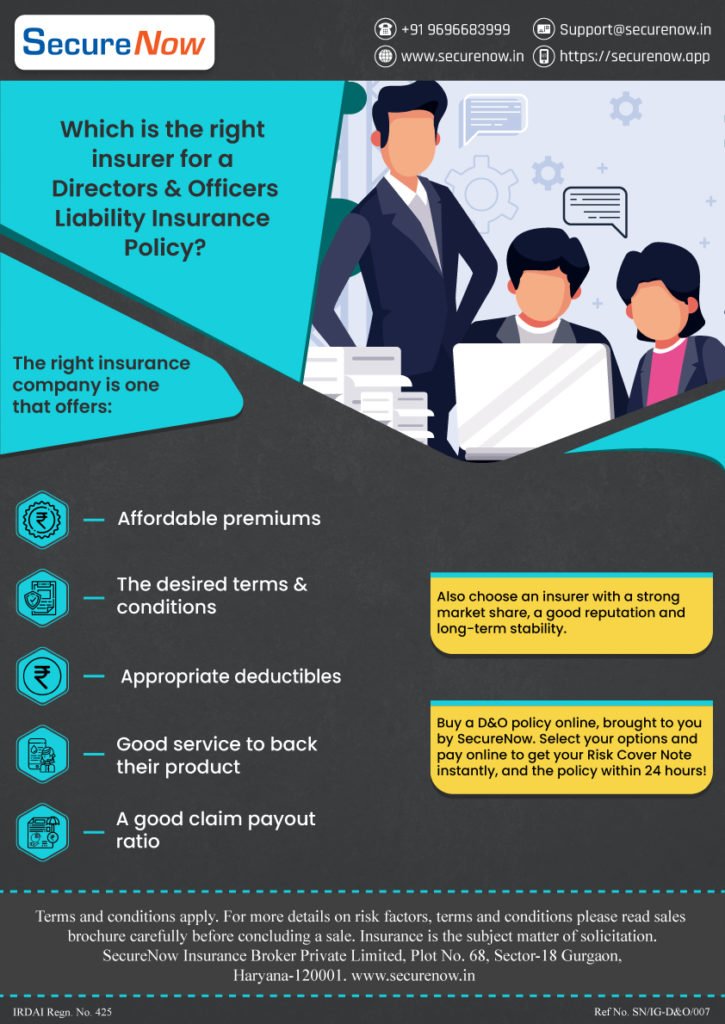
Infographic: Right insurer for directors and officers liability insurance
Similarly, this SecureNow infographic summarises the key factors to consider when choosing a D&O insurer. Use it as a quick visual reference alongside the checklist above.
Questions to Ask a D&O Insurer or Broker Before Buying
- What D&O coverage is provided under each insuring clause?
- What are the major exclusions, and are there any exceptions?
- Are defence costs covered, and how are they treated against the policy limit?
- Are defence costs advanced during a claim or reimbursed afterwards?
- What Side A protection is available?
- Is entity coverage included, and what does it cover?
- How are regulatory investigations treated?
- What is the policy retention, and which clauses does it apply to?
- What is the policy limit, and is there a separate per-claim limit?
- Are there important sublimits?
- How are claims notified, and to whom?
- What is the insurer’s experience handling D&O claims?
- What information is required during underwriting?
- What are the policy’s claims-made provisions and retroactive date?
- What are the key differences between the quotations being compared?
Do not assume the answers. Instead, ask for them in writing, and then check them against the policy wording.
Common Mistakes When Choosing a D&O Insurer
- Choosing only on premium. A cheaper quote may simply buy less cover. The saving can vanish when a claim falls outside it.
- Choosing on brand recognition alone. A well-known insurer may not have the most suitable D&O wording or team for your needs.
- Ignoring the actual wording. Brochures summarise, whereas wordings decide claims.
- Ignoring exclusions. Indeed, one broad exclusion can remove cover for your most likely claim.
- Not comparing limits. A lower limit makes quotes look cheaper but may leave you underinsured.
- Not checking defence-cost treatment. If costs erode the limit, a long defence can exhaust it.
- Ignoring Side A. Individuals may be personally exposed when the company cannot indemnify them.
- Ignoring claims-made provisions. Gaps in continuity or an unsuitable retroactive date can leave past decisions uncovered.
- Not checking D&O experience. Specialist knowledge affects both underwriting and claims.
- Not asking about claims service. You need to know who will help when a claim arrives.
- Comparing policies with materially different coverage. Price comparisons only work when the cover is comparable.
- Assuming every insurer uses the same wording. D&O wordings are not standard; therefore, small differences matter.
Practical Comparison Example
The following is a hypothetical example using anonymous policies. It does not describe any real insurer or product.
A mid-sized private company with investor-nominated directors receives two quotations:
| Feature | Policy A | Policy B | What to Review |
|---|---|---|---|
| Premium | Lower | Higher | Whether the difference reflects cover or pricing |
| Limit of liability | Lower aggregate limit | Higher aggregate limit | Whether the lower limit is adequate for likely claims |
| Retention | Higher retention on Side B and C | Lower retention | How much the company would bear before cover applies |
| Entity cover | Securities claims only | Broader entity cover | Whether the company is likely to be a defendant |
| Regulatory investigations | Covered under a small sublimit | Covered under a larger sublimit | Regulatory exposure of the business |
| Entity EPLI | Not included | Available as an extension | Size of workforce and employment claim risk |
| Defence costs | Inside the limit; prior consent required | Inside the limit; advancement clause included | Cash-flow impact of a long defence |
| Outside directorship cover | Not included | Included | Whether directors sit on other boards |
Neither policy is automatically better. For example, Policy A may suit a company with low regulatory exposure and a small workforce that is comfortable with a higher retention. Conversely, Policy B may suit a company with investor directors, a larger workforce, and active regulatory oversight. Therefore, the buyer needs to compare the differences against the company’s actual risk profile and requirements.
Conclusion
Overall, finding the right insurer for directors and officers liability insurance means looking beyond the headline premium. In particular, compare coverage and wording clause by clause, understand the limit, retention and defence-cost terms, and assess each insurer’s D&O experience, claims capability and financial strength.
Then use the scorecard and checklist in this guide to make a like-for-like comparison. The right choice is the one that fits your organisation’s risk profile – not necessarily the cheapest or the most expensive.
To compare quotations, visit SecureNow’s Directors & Officers Liability Insurance page, or read our guide on how to buy a D&O policy.
This article is general information and does not rank or recommend any insurer. Coverage depends on the specific policy wording. Insurance is the subject matter of solicitation.
5. D&O Insurer Buyer’s Checklist (standalone)
Print this worksheet and then complete one column per quotation.
| Checkpoint | Quote A | Quote B | Quote C |
|---|---|---|---|
| Basics | |||
| Insurer name and IRDAI registration confirmed | |||
| Full policy wording received (rather than only the quotation) | |||
| Premium (including taxes and extension premiums) | |||
| Limits and Retention | |||
| Aggregate limit | |||
| Any one claim limit | |||
| Key sublimits (investigations, extensions) | |||
| Retention – Side A / Side B / Side C | |||
| Defence costs inside or outside the limit | |||
| Coverage | |||
| Side A included | |||
| Side B included | |||
| Entity cover (Side C) – scope | |||
| Regulatory investigation cover | |||
| Entity EPLI available | |||
| Outside directorship cover | |||
| Run-off / extended reporting period | |||
| Territory and jurisdiction | |||
| Wording | |||
| Definition of “claim” includes investigations | |||
| Conduct exclusions need a final judgment before applying | |||
| Severability for innocent insureds | |||
| Allocation clause | |||
| Retroactive date | |||
| Prior/pending litigation date | |||
| Notice requirements understood | |||
| Insurer and Service | |||
| D&O experience and specialist team | |||
| Named claims contact and escalation route | |||
| Defence-cost advancement terms | |||
| Solvency ratio (latest public disclosure) | |||
| Decision Notes | |||
Frequently Asked Questions
Q) How do I choose the right D&O insurer?
A) Compare insurers on coverage, policy wording, exclusions, limits, retention, defence-cost treatment, D&O experience, claims-handling capability, service and financial-strength information. Then weigh the premium against all of these. Use a like-for-like comparison so price differences reflect real differences in cover.
Q) What should I look for in a D&O insurance company?
A) Look for suitable coverage for your risks, clear policy wording, specialist D&O experience, a responsive claims process, adequate limits, a manageable retention, reasonable exclusions and relevant financial-strength information. In short, the right D&O insurance company depends on your organisation’s risk profile.
Q) Should I choose the D&O insurer offering the lowest premium?
A) Not automatically. For example, a lower premium may reflect a lower limit, higher retention, narrower cover or more exclusions. Equally, a higher premium does not guarantee better cover. Instead, compare quotations like-for-like and assess total value.
Q) Is the claim settlement ratio a good way to choose a D&O insurer?
A) It is of limited use on its own. This is because published claim settlement figures are usually insurer-wide and mix many products. As a result, they do not directly measure D&O claim performance. Ask instead about the insurer’s D&O-specific claims experience and process.
Q) Why does D&O insurer experience matter?
A) D&O claims are complex, can involve several parties and may also run for years. Therefore, an insurer with management liability expertise is better placed to assess allegations, interpret wording and coordinate the defence.
Q) What should I check in a D&O policy wording?
A) Check the definitions, insuring clauses, exclusions, extensions, conditions, notice and claims-made provisions, retroactive date, prior litigation clause, defence-cost and consent provisions, severability, allocation and conduct exclusions.
Q) What should I check about D&O policy limits?
A) Check the aggregate limit, any per-claim limit, sublimits, whether defence costs erode the limit, and whether the limit is shared between insured persons and the company. There is no universal right limit; instead, it depends on your risk profile.
Q) What is the role of Side A coverage?
A) Side A protects individual directors and officers when the company does not indemnify them, for example because it is insolvent or legally prevented. Also check whether it is included, its limit and whether a retention applies.
Q) How should I compare two D&O insurance quotations?
A) Align the limit and retention first, then compare coverage, exclusions, extensions, defence-cost terms and claims service. Only then compare premiums. In addition, a blank scorecard can help you record each point side by side.
Q) How can I check a D&O insurer’s financial strength?
A) Review the insurer’s solvency ratio in its periodic public disclosures – IRDAI sets a control level of 150% – as well as its regulatory standing and any credit ratings. However, no single indicator guarantees that a particular claim will be paid.
Q) What questions should I ask a D&O insurer before buying?
A) Ask what each insuring clause covers, the main exclusions, how defence costs are treated, what Side A and entity cover apply, how investigations are treated, the limit, retention and sublimits, the claims-made provisions and retroactive date, as well as the insurer’s D&O claims experience.
Q) Does using a broker help when choosing a D&O insurer?
A) A broker can help by presenting your risk to several insurers, comparing quotations and wordings, negotiating terms, and supporting you during claims. The policy itself is issued by the insurer, so you should still review the final wording.