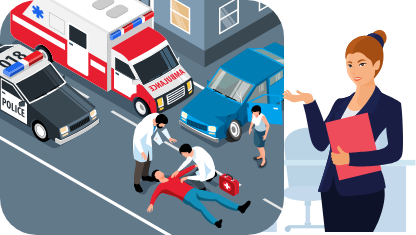


Employees are one of your biggest assets as your success depends on them. While, you have bought group term insurance and group health insurance to give financial security to their families after their death and also cover them against rising medical expenses, what if they don’t die but become disabled?
To combat such issues, it is imperative to buy a group personal accident insurance policy for your employees. The policy will offer cover in case your employee dies in an accident or becomes disabled.
Key Takeaways
-
The Disability Coverage Gap: Relying exclusively on life and medical insurance leaves families exposed; if a catastrophic highway crash results in survival with permanent total disability, a GPA cover is required to replace lost income.
-
Securing Academic Continuity: The integration of the children education allowance ensures that a parent’s sudden loss of earning power does not force a student to drop out of regular university or engineering courses due to lack of funds.
-
Strict Two-Child Limitation: Underwriting guidelines place a clear boundary on family scope, restricting the academic grant to a maximum of two dependent children per household.
-
Full-Time Enrollment Mandate: Educational compensation is not automatically released; the insurer mandates strict proof that the child is enrolled as a regular, full-time student in a recognized institutional course.
-
Dual-Track Benefit Design: Depending on the insurer’s portfolio structure, the grant can be issued either as a large flat lump sum (e.g., 50% of the sum insured) or mapped directly to actual institutional tuition invoices.
-
Completing the Security Net: From an enterprise risk perspective, combining group health, term life, and personal accident covers with high-utility riders creates a modern, resilient employee benefits package.
By paying an extra premium, you can offer children an education allowance under your group personal accident insurance policy as well.
As per this benefit, in the event of death or permanent total disability of the employee due to an accident, the group personal accident insurer will provide an education compensation fund for a maximum of two dependent children. For instance, some group personal accident insurers offer 50% of the sum insured as children education allowance subject to a maximum of Rs 15,000.
Some group personal accident insurers offer children education allowance in the form of tuition benefits. In the case of accidental death, 10% of the sum insured or the actual tuition fees charged by the educational institution, whichever is lower, is paid in the form of children’s education benefits.
However, the insurer offers children education allowance only if such a dependent child is pursuing an education course as a full-time student in the education institute.
It is an advantageous feature that ensures that the death or disability of the employee doesn’t affect the education of his/her child.
Case: children education allowance in GPA policy
Living in Delhi with his wife, Megha, and 15-year-old son Anvit, Raghav was a happy man. On a professional front, he was working in an IT company for the last ten years as a senior software engineer.
Considering the fact that his family was solely dependent on his earnings, Raghav bought a term insurance policy and health insurance policy as well. Completing the financial security net was the group personal accident insurance policy offered by his employer.
Armed with all these policies, he was confident that his family’s future was secure. However, life was not hunky-dory, and one day, when he was returning home in his car, he collided with a truck coming from the wrong side.
Read More: What is group personal accident insurance?
The impact of the collision was so severe that both the truck driver and Raghav suffered serious injuries. Raghav’s head was punctured through a hole in the car’s windshield and he suffered traumatic brain surgery. The accident occurred on a highway where traffic was less.
When after an hour, another truck passed by the spot, its driver spotted the accident, called the police, and took both victims to the hospital. Unfortunately, the injured truck driver was declared dead on arrival, while Raghav was immediately operated upon.
Doctors saved Raghav’s life, however, due to his brain injury, he became permanently disabled.
Being a breadwinner of the family, Raghav’s family’s future was in the dark. It was both emotional and financial losses for Megha who now had to make arrangements to deal with the medical expenses of Raghav and household expenses.
When Raghav’s employer came to know about his accident, the company came forward to help him. Due to the accident, Raghav was permanently disabled, and his employer’s personal accident insurance policy paid the compensation to him.
Read More: How the claim is processed under group personal accident insurance?
Summary Table: Mechanics of the Children Education Allowance Rider
| Policy Parameter | Standard Percentage-Based Grant | Fixed Tuition Benefit Framework | Mandatory Eligibility Criteria |
| Trigger Event |
• Accidental Death • Permanent Total Disability (PTD) |
• Accidental Death • Permanent Total Disability (PTD) |
Triggered strictly by catastrophic, life-altering trauma or fatalities. Minor or partial injuries do not activate this fund. |
| Payout Scaling | Up to 50% of the baseline Sum Insured, often capped at a predetermined regional maximum (e.g., ₹15,000 or ₹2,500,000 based on policy grade). | 10% of the baseline Sum Insured or the actual tuition fees charged, whichever is lower. | Payout structures depend entirely on the specific options selected by the employer during contract design. |
| Coverage Scope | Direct lump-sum or structured educational compensation fund. | Direct reimbursement of specialized academic institutional fees. | Restricted strictly to a maximum of two dependent children per insured employee. |
| Student Status Requirement | Must be a legal, financial dependent of the covered employee. | Must be a legal, financial dependent of the covered employee. | The child must be actively pursuing an educational course as a full-time student in a recognized institute. |
Further, his group personal accident insurance had an extra benefit in the form of children’s education allowance. As per the benefit, the insurer paid an education allowance to Raghav’s son, Anvit who just got admission in the regular course of engineering in a college. In this case, the insurer paid 50% of the sum insured as education allowance. As the sum insured was Rs 500,000, Anvit got Rs 2,50,000 (50% of 5,00,000)
Due to disability, Raghav lost his income power, but the education allowance paid by the group insurer helped in meeting education expenses of his child.
Without group personal accident insurance and children education allowance, Raghav and Megha would have a difficult time dealing with household and Anvit’s education expenses.
Frequently Asked Questions (FAQs)
1. What is the children education allowance in group personal accident insurance?
A) The children education allowance is a specialized add-on rider available under a corporate group personal accident insurance policy. In the tragic event of an insured employee’s accidental death or permanent total disability, this feature provides a dedicated compensation fund to cover the ongoing schooling or college expenses of the worker’s dependent children.
2. How much compensation is paid for a child’s education under a corporate GPA policy?
A) The exact payout depends on the plan structure chosen by the employer. Some group personal accident insurers offer a lump-sum grant equal to 50% of the total sum insured (such as a ₹2,50,000 payout on a ₹5,00,000 policy). Alternatively, other insurers structure it as a tuition benefit, paying 10% of the sum insured or the actual institutional fees, whichever is lower.
3. What are the eligibility criteria for a child to receive the GPA education benefit?
A) To qualify for the educational compensation fund, the child must be a verified legal dependent of the insured worker, with the benefit restricted to a maximum of two children per family. Additionally, the insurer strictly requires that the dependent child must be actively pursuing their studies as a full-time student in a regular course at a recognized educational institution.
4. Does group personal accident insurance pay the education allowance for partial injuries or fractures?
A) No, a standard group personal accident policy will not trigger the children education allowance for minor or partial injuries, such as temporary bone fractures or permanent partial impairments. This specific welfare extension is contractually reserved and activated only during catastrophic claims involving accidental death or permanent total disability.
5. Why is a personal accident cover necessary if an employee already has term and health insurance?
A) While term insurance covers death and health insurance pays for immediate hospital surgeries, neither protects a family if a worker survives a major crash but loses their livelihood due to a lifelong impairment. A group personal accident policy fills this gap, delivering vital lump-sum capital injections for disability alongside critical family allowances to secure everyday household stability.
6. What documents must be submitted to claim the child education allowance after an accident?
A) To successfully process the education allowance claim, the family or employer must submit a completed claim form, the primary death or permanent total disability certificate, and the local police FIR. This must be backed by institutional verification records, including the child’s birth certificate, official college admission receipts, and a formal certificate from the head of the institution confirming full-time student status.
Written By-
Gunjan Saxena
MBA Insurance Management
With a robust background in the insurance industry, Gunjan is a seasoned professional who brings 10 years of expertise to group personal accident insurance. Throughout her career, she has demonstrated a deep understanding of the intricacies and nuances of insurance products, particularly in personal accident coverage. Having worked closely with both individuals and businesses, she has gained valuable insights into the diverse needs and challenges faced by clients seeking insurance protection. Her experience encompasses designing tailored insurance solutions, providing expert advice, and guiding clients through the insurance process with confidence and clarity.
Through her articles, Gunjan aims to educate and inform readers about the importance of group personal accident insurance and the benefits it offers in safeguarding against unforeseen events.