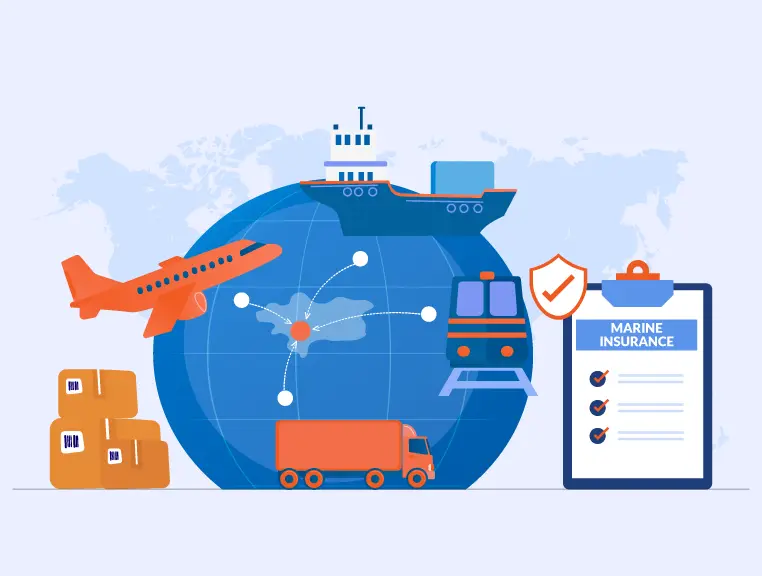



Goods rarely suffer damage sitting in a warehouse. They suffer damage in motion – on a truck that overturns, in a container that floods with water, on a vessel that rough weather catches, or during loading and unloading at a port. That is the exact gap marine insurance exists to close.
If you are preparing to buy marine insurance for the first time, or you already have a policy and want to buy a better one, this guide walks you through the entire journey: understanding what you need to insure, gathering the right information, comparing insurers, buying online, checking for coverage gaps, and knowing what to do once the policy is in hand.
What Is Marine Insurance?
A typical policy responds to perils such as fire, collision, overturning of the carrying vehicle, theft, non-delivery, and natural events like storms or flooding, subject to the specific policy wording, exclusions and conditions. Within the broader marine insurance category, you’ll come across a few related terms, and it helps to know how they differ before you buy:
- Marine cargo insurance – covers the value of the goods you ship, generally the most relevant type for a business insuring its stock or shipments.
- Marine transit insurance/transit insurance – often used interchangeably with cargo insurance to describe protection for goods moving from one point to another, whether within the country or across borders.
- Specific transit insurance – a policy taken for one identified shipment or journey.
- Open cover – an arrangement suited to businesses that ship regularly, where one arrangement covers multiple shipments over a period instead of requiring a fresh policy each time.
- Marine insurance broker – an intermediary who helps a buyer compare insurers, understand policy wording and complete the purchase.
- Marine insurance company – the insurer that underwrites the risk and is contractually liable to pay a valid claim.
These terms are related but not identical, and a policy document will usually make clear which category it falls under.
Who Needs Marine Insurance?
Anyone whose goods travel and hold value has an exposure worth insuring. That commonly includes importers and exporters, manufacturers dispatching finished goods, e-commerce sellers shipping inventory, wholesalers and distributors, and businesses that move raw material between plants or warehouses. The common thread isn’t the industry – it’s that the goods leave a controlled location and become exposed to transit risk.
When Should You Buy Marine Insurance?
There’s no single moment that applies to every shipment – timing depends on the specific policy, the type of shipment, and the transit terms agreed with the insurer. That said, a few principles hold across most situations.
- Arrange cover before the risk begins, not after. Once goods have left the point of origin, or once loading has started, the insurable event may already be underway, and an insurer will generally not accept a proposal for a risk that has already materialised. Buying insurance transfers a future, uncertain risk – not a loss that has already occurred or is already in progress.
- For importers, this usually means confirming coverage before the shipment leaves the supplier’s premises or port of origin, since the goods face risk from that point onward, subject to the specific transit terms of the policy.
- For exporters, you should typically arrange cover before the goods leave the factory or warehouse for the port, airport, or the buyer’s location, again depending on the applicable transit clause.
- For domestic transit (say, goods moving between two cities by road), the same logic applies: you need to have the policy in place before you load and dispatch the vehicle.
- For businesses shipping regularly, rather than treating each shipment as a fresh purchase decision, it is often more practical to review whether an open cover arrangement suits the frequency of dispatch, so that individual consignments don’t risk moving without cover due to a timing gap.
A practical example:
A furniture exporter in Jodhpur books a container for a shipment leaving in ten days. If you finalise the policy only after loading and moving the container to the port, any damage that occurred during loading may fall outside the insurer’s acceptance. Finalising the policy before loading begins avoids this gap entirely.
Always check the policy’s stated commencement point and transit clause – this is what actually determines when your cover starts, not a generic industry rule of thumb.
What Type of Marine Insurance Do You Need?
Before requesting a quote, it helps to know roughly which category fits your situation:
| Situation | Likely Fit |
|---|---|
| One-off shipment, occasional exporter/importer | Specific transit insurance |
| Regular, recurring shipments through the year | Open cover arrangement |
| Domestic movement of goods between cities | Marine transit insurance (inland) |
| Cross-border import/export shipment | Marine cargo insurance with export/import terms |
This is a general starting point, not a substitute for confirming the right fit with the insurer or your broker based on your actual shipping pattern.
How to Determine What You Need to Insure?
Start by writing down three things: what is moving, how it’s moving, and what it’s worth. That sounds simple, but it’s where most buyers either overinsure (and pay more than necessary) or underinsure (and get a smaller payout than the actual loss).
Consider the nature of the goods (fragile, perishable, high-value, hazardous), how you’ve packed them, which route they’ll travel, how many hands they’ll pass through (own transport, a third-party carrier, a freight forwarder, a customs warehouse), and where the greatest risk realistically lies – a long road journey through variable weather carries different risk than a short, direct rail movement.
What Information Do You Need to Buy Marine Insurance?
Insurers assess a proposal based on details about the goods and the journey. What insurers ask can vary by cargo type, but you’ll commonly need to provide the following:
| Information | Why It Matters |
|---|---|
| Type and description of goods | Determines the applicable rate and any special conditions |
| Cargo value/invoice value | Forms the basis for the sum insured |
| Origin and destination | Defines the transit exposure being covered |
| Transit route | Helps assess route-specific risk |
| Mode of transport | Road, rail, air, sea, or multimodal – each carries different risk |
| Shipment date | Confirms the period the cover needs to align with |
| Packaging details | Relevant where packaging affects damage risk |
| Nature/hazard classification of goods | Relevant for restricted or special-condition cargo |
| Sum insured required | The amount the buyer wants covered |
Some of this is mandatory for every proposal; the insurer, cargo, and policy type determine what other details you’ll need to provide. Don’t assume every insurer asks for an identical list – check the specific proposal form.
What Documents Do You Need to Buy Marine Insurance?
Documentation requirements also vary by insurer and by the nature of the shipment, but a buyer preparing to purchase should generally have the following ready or accessible:
| Document / Information | Why It May Be Needed |
|---|---|
| Commercial invoice | Establishes the value of goods being insured |
| Packing list | Confirms quantity, packaging and cargo composition |
| Transport document (e.g. bill of lading, LR, airway bill) | Confirms the mode and route of transit |
| Shipment/dispatch details | Confirms origin, destination and dispatch date |
| Purchase or sales order, where applicable | Supports the declared value and transaction |
| Cargo description | Used for underwriting and rate determination |
| Value documentation | Supports the sum insured requested |
| Details of any existing policy, where relevant | Relevant if replacing or renewing cover |
Not every document applies to every purchase – a domestic road shipment will need a different document set than an international sea shipment. Confirm the exact list with the insurer or broker before you begin.
How to Buy Marine Insurance Step by Step
Step 1 – Identify the shipment and risk
Establish what you’re transporting, where it’s going, how it will travel, and what could realistically go wrong along the way. This shapes every decision that follows.
Step 2 – Determine the cargo value
Build the sum insured around an accurate valuation – usually based on invoice value plus any relevant costs. Undervaluing the cargo can leave you short at claim time; overvaluing it means paying premium for cover you don’t need.
Step 3 – Determine the appropriate coverage
Look beyond the headline premium and evaluate what the policy actually covers: the named risks, the exclusions, policy limits, deductibles, the transit scope (door-to-door versus port-to-port, for example), and any conditions attached to the cover.
Step 4 – Decide whether single transit or broader coverage fits
If this is a one-off shipment, specific/single transit cover usually fits best. If shipments are frequent and recurring, it’s worth evaluating whether an open cover arrangement suits the business better than buying a fresh policy every time.
Step 5 – Compare insurers and policies
Compare more than price. Look at coverage scope, exclusions, claims process, service quality, and how well the insurer’s product matches the type of cargo and transit involved.
Step 6 – Obtain a quote
Provide accurate shipment and cargo details – the more precise the information, the more reliable the quote will be, and the fewer surprises at claim time.
Step 7 – Review the policy terms
Before accepting, go through the coverage, exclusions, conditions, deductible, and transit clause carefully. This is the point to raise questions, not after a loss has occurred.
Step 8 – Purchase the policy
Complete the purchase – online or through a broker/agent – once the terms match what you actually need.
Step 9 – Save policy documents
Keep the policy document, certificate, and any endorsements safely and accessibly. These are exactly what you’ll need if a claim arises later.
Can You Buy Marine Insurance Online?
Yes. Buying marine insurance online generally means submitting shipment and cargo details through an insurer’s or broker’s website, receiving a quote, selecting coverage, and completing payment digitally – with the policy document and certificate issued electronically, subject to the insurer’s underwriting process and any additional information they may request.
Benefits of Buying Transit Insurance Online
Buying transit insurance online carries several practical advantages over the traditional route of meeting an agent in person, though it isn’t automatically the better option in every situation – it depends on how comfortable the buyer is with self-service and how standard the shipment is.
Cost. Because the online channel reduces the insurer’s distribution overheads – agent commissions, physical infrastructure, and paperwork handling – insurers can reflect some of that saving in the premium they quote online, subject to their own pricing.
Time. Instead of visiting multiple agents, filling separate proposal forms, and waiting for each quote, a buyer can compare available options, upload documents and pay – all from one place, at a time that suits them.
Less paperwork. Digital uploads and e-signatures replace much of the manual documentation, physical copies and in-person form-filling that traditional purchase involves, where supported.
Faster issuance. Because you often need transit insurance in place close to a shipment’s dispatch date, an online purchase can help the risk cover note or policy document reach the buyer quickly, subject to the insurer’s own turnaround process – this isn’t a guarantee of instant issuance for every proposal, particularly when the insurer needs additional underwriting information.
Easier record-keeping. Digital policy documents are simpler to store, retrieve, and share internally when you need to file a claim later.
A limitation worth noting: online purchase suits straightforward, well-understood shipments well. For unusual cargo, non-standard routes, or situations with genuine ambiguity about the right coverage, discussing the requirement with an insurer or broker before finalising the purchase – online or not – is usually the safer approach.
What Is Umbrella Coverage in Online Marine Insurance?
“Umbrella coverage” doesn’t have one single, universal technical meaning across every marine insurance product – its exact scope depends on the specific policy wording. In the context most relevant to buyers of online marine insurance, the term refers to additional liability protection that insurers layer on top of the base cargo cover, meant to respond once the primary policy’s limit runs out, or to address certain liability exposures the base cargo policy may not otherwise pick up.
Where a standard cargo policy largely builds around physical loss or damage to the goods themselves, umbrella coverage typically extends into liability-related exposure connected with the cargo while it remains in the custody of third parties in the transit chain – carriers, warehouses, cargo handlers, or container terminals. Depending on the policy, this can include protection related to third-party injury, property damage claims, and certain liability exposures such as defamation-type claims connected with the shipping operation, though you must confirm the exact scope against the specific policy wording rather than assume it.
Why Buyers May Need Broader Protection?
A single shipment can pass through several custodians before it reaches its destination – the exporter’s own transport, a freight forwarder, a shipping line, a port authority, and the importer’s receiving warehouse. Each handover is a point where liability questions can arise, and a base cargo policy may not automatically extend to every one of these exposures. Umbrella coverage aims to reduce the gap between what a standard cargo policy responds to and what a business actually faces across the full chain of custody.
Gaps Between Policies
Because different parties in the transit chain may carry their own liability cover – the carrier, the terminal operator, the warehouse – there can be uncertainty about which policy responds first, and whether any exposure falls into a gap between them. This is precisely why checking umbrella coverage before finalising an online purchase matters: it’s the step where you confirm whether your own policy closes that gap, or whether you’re relying on someone else’s cover doing so.
Reviewing Umbrella Coverage Before You Buy Online
Because online purchase moves quickly, it’s worth deliberately slowing down at this one step. Read the policy wording (not just the marketing summary) for the umbrella or extended liability section, check the applicable limits and any sub-limits, and confirm the exclusions before accepting the quote.
Marine Insurance Umbrella Coverage Checklist
Use this list to question and verify – not every policy will contain every feature described below, so treat this as a set of questions to ask rather than a guarantee of what you’ll find.
- What goods does the policy insure, and is the description accurate?
- Which transit legs does the policy actually insure – origin to port, port to port, or full door-to-door?
- Which modes of transportation does the policy include (road, rail, air, sea)?
- What geographic areas does the policy cover?
- Does the policy cover multiple shipments, or only the one you’re declaring?
- Are transshipment or connecting points covered, where applicable?
- Are storage periods (pre-transit or post-transit) covered, and for how long?
- What are the overall policy limits and any sub-limits?
- What exclusions apply?
- Is a deductible applicable, and how much?
- Do special goods (hazardous, fragile, high-value) attract additional conditions?
- Do customs-related exposures apply to this shipment?
- Does this policy overlap with any other policy held by a party in the transit chain?
- What happens if the cargo composition or route changes mid-transit?
- What documentation do you need to support a claim?
- What are the claim notification timelines and conditions?
How to Evaluate a Marine Insurance Company
Rather than chasing a “top insurer” list, it’s more useful to evaluate a marine insurance company against your own shipment profile. Consider:
- Experience in marine insurance – how established the insurer is in this specific line of business.
- Financial strength and reputation – relevant to the insurer’s ability to pay claims.
- Product suitability – whether their policy wording actually matches your cargo and transit pattern.
- Coverage and exclusions – read past the headline coverage to the fine print.
- Claims process – how straightforward the notification and documentation process is.
- Customer support – accessibility when you need help understanding or amending the policy.
- Digital capabilities – relevant if you plan to buy and manage the policy online.
- Premium – one factor among several, not the only one.
- Risk appetite – whether the insurer is comfortable underwriting your specific type of cargo or transit.
The cheapest marine insurance policy is not necessarily the most suitable one. A lower premium attached to narrower coverage, tighter exclusions, or a higher deductible can end up costing more at claim time than a slightly higher premium with coverage that actually matches your risk.
What Should You Compare Before Buying?
| Factor | What to Check |
|---|---|
| Coverage | What risks are covered? |
| Exclusions | What is explicitly not covered? |
| Sum insured | Is the cargo adequately insured for its actual value? |
| Deductible | What amount remains with the insured in a claim? |
| Transit | What exact journey/legs does the cover apply to? |
| Geography | Which locations and routes are included? |
| Cargo conditions | Are there special conditions for this type of cargo? |
| Claims | What is the notification and documentation process? |
| Premium | What does the policy actually cost, including any add-ons? |
| Service | What support is available if something goes wrong? |
This comparison framework matters more than any single factor in isolation – a policy that looks attractive on premium alone can look very different once you line it up against coverage and claims process.
How Much Does Marine Insurance Cost?
Several factors generally influence marine insurance premiums: the value of the goods, the nature and packaging of the cargo, the mode and route of transport, the coverage scope you select, and the insurer’s own underwriting and pricing approach. Because these factors vary shipment to shipment, you can only get an accurate premium figure once you request a quote with your specific shipment details – generic published rates rarely reflect what insurers will actually quote you.
How to Decide the Sum Insured
The sum insured should reflect the actual value of the goods at risk – typically based on invoice value, and in some cases increased to reflect freight, duty or a margin, depending on the terms agreed with the insurer. Declaring a sum insured that’s too low can leave a genuine gap at claim time; declaring one that’s inflated adds unnecessary premium cost without adding real protection. When in doubt, work through the valuation with the insurer or broker rather than estimating it yourself.
How SecureNow Can Help With Marine Insurance
Buying the right marine insurance policy involves more decisions than most buyers expect – coverage scope, sum insured, exclusions, and insurer selection all need to align with the actual shipment. This is where a broker’s role can add value.
Understanding your requirements. Rather than starting from a generic policy, the process typically begins with understanding the nature of your shipments, cargo, and risk profile.
Comparing suitable options. SecureNow can help filter and compare available marine insurance policies against your stated requirements, so you’re looking at options relevant to your situation rather than a generic list.
Assisting with documentation. Filling in a proposal form accurately matters – incomplete or inaccurate information can affect a claim later. Support with understanding the terminology and completing the form correctly reduces this risk.
Supporting the purchase process. From requesting quotes to completing the purchase, a broker can help make the process more straightforward, particularly for buyers unfamiliar with marine insurance terminology.
Helping you understand policy terms. Insurance wording is dense. Getting a plain-language explanation of what a specific policy does and doesn’t cover helps you make a more informed choice before you buy.
Supporting the claims process. Where you need to file a claim, assistance with notification and documentation can help the process move more smoothly.
Helping identify potential coverage gaps. This includes flagging where umbrella coverage or additional protection may be relevant to your specific shipping pattern.
SecureNow operates as an insurance broker and intermediary – it does not underwrite risk itself, and coverage, claim outcomes and premiums remain subject to the terms of the insurer and policy you choose.
What to Check Before Finalising the Policy
Marine Insurance Pre-Purchase Checklist
- Cargo correctly and completely described
- Cargo value verified against actual invoice/purchase value
- Sum insured reviewed and appropriate
- Origin and destination checked
- Transit route confirmed
- Mode of transport confirmed
- Coverage scope reviewed
- Exclusions reviewed
- Deductible reviewed
- Policy period reviewed
- Claims process understood
- Documentation requirements understood
- Umbrella coverage reviewed
- Insurer evaluated against your requirements
- Policy wording reviewed, not just the summary
- Policy document saved once issued
Common Mistakes When Buying Marine Insurance
- Buying only on price, without weighing coverage and exclusions.
- Underinsuring cargo by declaring a value lower than what’s actually at risk.
- Buying after risk has already attached – once the shipment has started moving, it may be too late to arrange fresh cover for that transit.
- Incorrect cargo description, which can complicate a claim later.
- Not checking exclusions, and assuming “marine insurance” automatically covers every possible risk.
- Overlooking the deductible, then facing a surprise at claim time.
- Assuming the policy automatically covers all transit risks, when it may only cover specific named perils or specific legs of the journey.
- Not checking geographic limits on international or multi-country shipments.
- Overlooking transshipment or storage conditions, especially for longer or more complex routes.
- Ignoring umbrella coverage, and assuming the base policy handles every liability exposure in the chain of custody.
- Not reading the actual policy conditions, relying only on a summary or brochure.
- Failing to retain documentation, which can slow down or complicate a claim.
- Assuming carrier liability is the same as cargo insurance – carriers usually cap their liability, and it’s not a substitute for your own cargo cover.
- Not understanding the claims notification process until a loss has already occurred.
What to Do After Buying Marine Insurance
- Check the policy document for accuracy as soon as the insurer issues it.
- Verify that cargo details match what you declared.
- Verify the policy correctly reflects the sum insured.
- Confirm the policy correctly states the origin, destination and transit route.
- Confirm the coverage matches what you agreed at purchase.
- Save the policy and certificate in an accessible, secure location.
- Share relevant documents internally with whoever handles logistics or claims.
- Understand the claim notification requirements and timelines before you need them.
- Keep shipment records (invoices, transport documents, packing lists) that you may need to support a future claim.
Marine Insurance Buying Decision Framework
This is a general decision framework meant to guide your thinking – it is not personalised insurance advice, and you should confirm your actual requirement with an insurer or broker.
- Do you have a shipment to insure?
- Is it a single or occasional transit? → Consider whether specific transit cover is appropriate.
- Are shipments recurring? → Evaluate whether an open cover arrangement may suit your business better.
- Have you determined the cargo value?
- Have you reviewed the risks and exclusions relevant to your shipment?
- Have you compared suitable policies, not just premiums?
- Have you checked umbrella coverage and potential gaps?
- Have you reviewed the insurer’s suitability and the actual policy terms?
- Proceed with purchase once the policy genuinely meets your requirements.
Conclusion
Buying marine insurance is less about finding the cheapest quote and more about matching the right coverage to your actual shipment – the goods, the route, the mode of transport, and the points of custody along the way. Getting the timing right, gathering accurate information, comparing insurers on more than price, and checking for coverage gaps like umbrella liability protection are what separate a policy that pays out cleanly from one that leaves you exposed at the worst possible moment.
Frequently Asked Questions
Q) How do I buy marine insurance?
A) You buy marine insurance by identifying the shipment and its value, gathering shipment and cargo details, requesting quotes from one or more insurers, comparing coverage and exclusions (not just premium), and completing the purchase online or through a broker. The insurer usually issues the policy once payment clears, subject to their own underwriting.
Q) When should I buy marine insurance?
A) Ideally before the shipment’s risk begins – generally before the goods leave the point of origin or before loading starts, depending on the policy’s transit clause. Buying after the goods are already in transit or already exposed to a risk can mean the loss falls outside what the insurer will accept.
Q) Can I buy marine insurance online?
A) Yes, most insurers and brokers allow you to submit shipment details, get a quote, choose coverage and complete payment online, with the policy document issued electronically, subject to the insurer’s usual underwriting process.
Q) What information do you need to buy a marine insurance policy?
A) Commonly required information includes the type and description of goods, cargo value, origin and destination, transit route, mode of transport, shipment date, and the sum insured requested. Some insurers may ask for additional underwriting details depending on the cargo.
Q) What documents do you need to buy marine insurance?
A) Typical documents include the commercial invoice, packing list, transport document (such as a bill of lading or airway bill), and shipment details. Exact requirements vary by insurer, cargo type, and whether the shipment is domestic or international.
Q) What are the benefits of buying transit insurance online?
A) Buying transit insurance online typically offers convenience, faster comparison of policies, reduced paperwork, and quicker issuance of the policy document, since much of the process is digital rather than requiring in-person meetings with an agent.
Q) What is umbrella coverage in online marine insurance?
A) Umbrella coverage in online marine insurance generally refers to additional liability protection layered on top of a base cargo policy, meant to respond once the primary cover’s limit runs out or to address liability exposures across the chain of custody that a standard cargo policy may not fully cover. Its exact scope depends on the specific policy wording.
Q) How can I check umbrella coverage in a marine insurance policy?
A) Review the policy wording for the umbrella or extended liability section, check the applicable limits and sub-limits, confirm the exclusions, and verify whether the policy includes multiple shipments, transshipment points and storage periods before you finalise the purchase.
Q) How do I choose the right marine insurance company?
A) Evaluate insurers on their marine insurance experience, financial strength, product suitability for your cargo, coverage and exclusions, claims process, customer support, and digital capabilities – not on premium alone.
Q) What should I compare when buying a marine insurance policy?
A) Compare coverage, exclusions, sum insured, deductible, transit scope, geographic coverage, cargo-specific conditions, the claims notification process, premium, and the level of service support available.
Q) How do insurers determine the marine insurance premium?
A) The value of the goods, the nature and packaging of the cargo, the mode and route of transport, and the coverage scope you select generally influence the premium. Because these vary by shipment, an accurate premium is only available after requesting a quote with your specific details.
Q) What should I check before buying a marine insurance policy?
A) Before buying, verify the cargo description, cargo value and sum insured, the transit route and mode of transport, the coverage and exclusions, the deductible, the claims process, and whether umbrella coverage is relevant to your shipment.
Q) Can a marine insurance broker help me buy a policy?
A) Yes. A broker can help you compare suitable policies, understand policy wording, complete documentation accurately, and support the claims process if a loss occurs, though the broker does not underwrite the risk itself.
Q) Can SecureNow help with marine insurance policies?
A) SecureNow, as an insurance broker, can help buyers compare suitable marine insurance options, assist with completing proposal forms accurately, support the purchase process, and help identify potential coverage gaps such as the need for umbrella coverage.
Q) What is the difference between marine cargo insurance and transit insurance?
A) The terms are closely related and often used interchangeably. Marine cargo insurance generally refers to coverage for the value of goods in transit, while transit insurance is a broader term covering the movement of goods by road, rail, air or sea – the exact scope in each case depends on the specific policy.
Q) What happens after buying a marine insurance policy?
A) After purchase, check the policy document for accuracy, verify the cargo details and sum insured, save the policy and certificate securely, and make sure you understand the claim notification process and required documentation before you need them.
Q) Can one marine insurance policy cover multiple transit risks?
A) Depending on the policy type, yes – an open cover arrangement suits businesses with recurring shipments and can cover multiple transits over a defined period, subject to the terms you agree with the insurer. A specific transit policy, by contrast, generally covers a single identified shipment.
Q) What mistakes should I avoid when buying marine insurance?
A) Avoid buying only on price, underinsuring the cargo, arranging cover after the risk has already begun, ignoring exclusions and deductibles, overlooking umbrella coverage, and failing to retain documentation needed for a future claim.