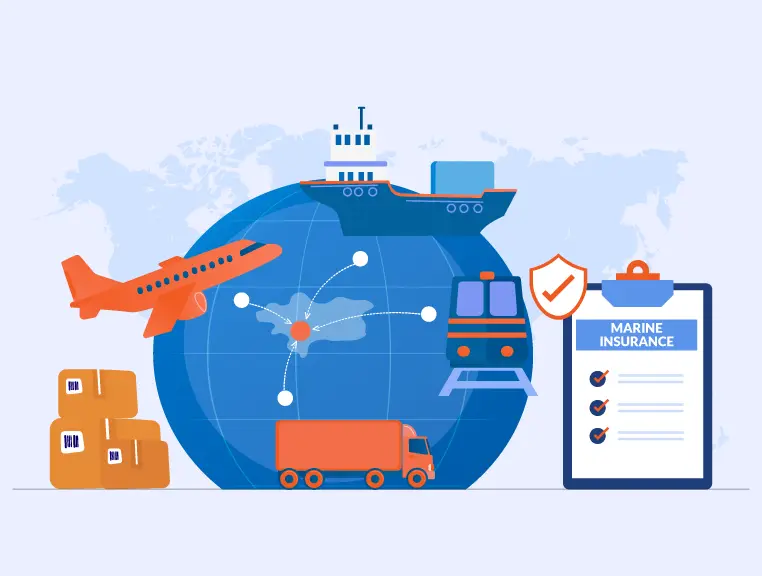



Every consignment that leaves an Indian port, airport, or land border faces risks that a domestic shipment never encounters – longer transit times, multiple handlers, and exposure to sea, air, and road hazards in one journey. Export & Import Insurance is the mechanism businesses use to protect the financial value of goods against these risks. This guide explains what the cover involves, how an Open Cover policy works for recurring shipments, when customs duty cover applies, and where carrier liability falls short. That way, you can make an informed decision about International Cargo Insurance for your business.
What Is Export & Import Cargo Insurance?
Export & Import Cargo Insurance is a form of marine insurance that protects the financial interest of an exporter, importer, or consignee in goods while they move between countries. It compensates the policyholder if the insured cargo suffers loss, damage, or destruction during transit, subject to the policy’s terms, conditions, exclusions, and limits.
The cover applies regardless of the mode of transport – sea, air, road, rail, or a multimodal combination. It differs from the carrier’s own liability, which separate transport contracts and international conventions usually limit and govern.
Who buys this cover? Exporters, importers, trading houses, manufacturers who ship raw materials or finished goods internationally, and sometimes freight forwarders or logistics companies acting on behalf of cargo owners. Depending on the trade contract and the agreed Incoterm, either the buyer or the seller may be responsible for arranging insurance for a given leg of the journey.
When does coverage typically begin and end? Insurers typically write most cargo policies on a “warehouse-to-warehouse” basis. This means cover can start when goods leave the point of origin (such as a factory or warehouse) and end when they reach the final destination named in the policy. This is subject to the specific transit clause, any time limits, and the conditions the policy wording states.
Export Cargo Insurance vs Import Cargo Insurance
The core protection is similar, but the practical starting point differs based on which side of the transaction you’re on.
| Aspect | Export Cargo Insurance | Import Cargo Insurance |
|---|---|---|
| Who typically buys it | Indian seller/exporter, depending on Incoterm | Indian buyer/importer, depending on Incoterm |
| Point of insurable interest | Often begins at the exporter’s warehouse in India | Often begins once goods are loaded overseas or as defined in the policy |
| Common concern | Damage before goods leave Indian jurisdiction, until risk transfers per contract | Damage in transit and, where customs duty cover is added, duty already paid on damaged goods |
| Currency/valuation | Usually based on invoice value in the agreed currency | Usually based on invoice value plus, where relevant, duty and freight |
A simple example: a Delhi-based garment exporter ships finished apparel to a buyer in Germany under a CIF (Cost, Insurance, Freight) contract. As the seller, the exporter is contractually responsible for insurance up to the destination port, so they buy export cargo cover for that leg. If the same exporter also imports fabric from Bangladesh, they would separately consider import cargo cover for that inbound shipment, since the risk profile, timing, and party bearing the insurable interest are different.
How Does Export & Import Cargo Insurance Work?
The basic process runs in a few steps, though the exact requirements depend on the policy and insurer:
- Assess the shipment – cargo type, value, route, and mode of transport.
- Select a policy structure – a single-transit policy for a one-off shipment, or an Open Cover policy for repeated shipments over a year.
- Declare the shipment details – invoice value, description of goods, and transit information, as required under the policy.
- Pay the applicable premium, calculated based on the declared value and risk factors.
- Cargo moves under cover, subject to the transit clause and any conditions in the policy.
- In the event of loss or damage, the policyholder notifies the insurer, arranges a survey where required, and submits a claim with supporting documentation.
Why Is International Cargo Insurance Important?
International shipments face a wider and more concentrated set of risks than domestic movements, simply because of distance, handling, and the number of parties involved.
- Long-distance transportation increases the time cargo spends exposed to weather, vibration, and handling stress.
- Multiple handling points – ports, terminals, container freight stations, and warehouses – each introduce a chance of mishandling, theft, or misplacement.
- Mode-specific risks vary: sea transit carries weather and vessel-related hazards; air transit carries technical and handling risks; road and rail transit carry accident, theft, and delay risks, and multimodal shipments combine several of these across a single journey.
- Theft and pilferage become more likely wherever cargo moves between vehicles, vessels, or storage facilities.
- Weather-related perils, where covered under the policy, can affect any mode of transport, particularly sea and road transit during monsoon conditions in parts of India.
- Carrier liability limitations mean that even when a carrier is at fault, the compensation available may fall well short of the cargo’s actual value.
- Working capital protection – a lost or damaged shipment ties up capital in goods that generate no revenue; insurance helps recover that value so the business doesn’t have to absorb the loss directly.
- Business continuity – repeated uninsured losses can disrupt supply chains, delivery commitments, and customer relationships.
- Contractual requirements – many trade contracts and Incoterms specify who must arrange insurance and to what level, making cover a practical necessity rather than an optional extra.
Because these risks vary by cargo type, route, and mode, exporters and importers should evaluate cover against their actual shipment profile rather than assume a standard policy addresses every scenario.
What Does Export & Import Cargo Insurance Cover?
Coverage depends entirely on the policy wording and the Institute Cargo Clauses (or equivalent clauses) selected. Broadly, insurers structure cargo policies around three common tiers of protection – commonly called ICC (A), ICC (B), and ICC (C) – offering progressively narrower coverage from an “all risks” basis down to named perils only.
Subject to the terms selected, cover may extend to:
- Physical loss or damage from accidents in transit, such as vessel sinking, capsizing, derailment, or overturning of the carrying vehicle
- Fire, lightning, and explosion
- General average sacrifice and salvage charges
- Theft and non-delivery of an entire package, depending on the clause selected
- Water damage, where the relevant clause covers the cause
- War and strikes risks, where the policyholder specifically purchases these extensions
Cargo insurance generally covers a wide range of goods, from raw materials to finished manufactured products. Most standard policies exclude high-risk categories such as arms and ammunition, though, and may require special terms for items like precious stones, fine art, or high-value electronics.
What Is Not Covered by Cargo Insurance?
Exclusions vary by policy and insurer, so it is important to check the specific wording rather than assume standard exclusions apply uniformly. That said, cargo policies commonly exclude, subject to the exact terms:
- Loss caused by inherent vice or the nature of the goods themselves (such as natural deterioration)
- Loss arising from inadequate or unsuitable packaging
- Delay, even where an insured peril causes the delay, unless the policy specifically covers it
- Wilful misconduct of the insured
- Ordinary wear and tear
- Loss from insolvency or financial default of parties involved in the shipment, unless separately covered
- War, strikes, riots, and civil commotion, unless the policyholder specifically purchases these extensions
Because exclusions differ across insurers and policy types, exporters and importers should review the exclusion clause of their specific policy rather than relying on generic assumptions.
What Is an Open Cover Policy?
How Open Cover Works
- The policy period generally runs for one year, and policyholders can typically renew it annually.
- The insurer and the insured agree on rate, terms, and conditions upfront, at the start of the period.
- Each time a shipment goes out, the insured declares the relevant details – value, description of goods, and shipment/transit information – to the insurer.
- The insurer applies the declared value for each consignment against the overall sum insured under the policy, in the manner the policy terms specify.
- The insured typically pays premium on a regular basis, often tied to the volume or value of declared shipments, as agreed with the insurer.
Who Benefits from an Open Cover Policy
Businesses that ship or receive cargo frequently – exporters and importers with recurring international consignments – generally find Open Cover more practical than buying a new policy for each shipment. It reduces administrative repetition and can offer more predictable annual costs.
Advantages and Limitations
Open Cover offers continuity and administrative convenience, but it comes with conditions. The insured must declare shipments accurately and on time, must track the sum insured against cumulative shipments, and follow the specific terms agreed at inception, which govern what is and isn’t covered. An Open Cover policy does not automatically cover every shipment without limit – coverage remains subject to the agreed sum insured, declaration requirements, and policy conditions.
Example: An electronics trading company in Pune ships components to buyers across Southeast Asia roughly twice a month. Instead of arranging a new policy for each shipment, the company takes an Open Cover policy for the year. Before each shipment, it declares the invoice value and shipment details to the insurer, and the insurer sets off the declared amount against the policy’s overall sum insured, as per the agreed terms.
Can Customs Duty Cover Be Added to an Open Cover Policy?
Yes, an importer can generally purchase a customs duty cover alongside an Open Cover policy under export and import insurance, subject to the insurer’s terms and the specific policy conditions.
What Is Customs Duty Cover?
Customs duty cover protects an importer against the financial loss of customs duty already paid on goods that arrive damaged or go missing in transit. When imported cargo arrives damaged, the importer has often already paid the applicable duty – and insuring the goods under the cargo policy doesn’t automatically make that duty recoverable. Customs duty cover addresses this specific gap.
Why This Matters
Import duties can represent a meaningful share of the landed cost of goods. If cargo arrives damaged and the importer rejects the goods or accepts them at reduced value, they may still have paid duty calculated on the original, undamaged value. The cargo cover alone may not reimburse that cost. Importers generally take out customs duty cover before the goods arrive, and it works alongside – not instead of – the underlying cargo policy.
How It Works with Open Cover
Where a business has recurring import shipments, a customs duty cover can typically run alongside the Open Cover policy. Together they address both the physical cargo and the associated duty exposure for the declared consignments, subject to the specific conditions, declaration requirements, and limits agreed with the insurer.
Practical example: A textile company in Hyderabad imports denim fabric regularly from an overseas supplier. It holds an Open Cover policy for its shipments and has also purchased customs duty cover. On one occasion, imported denim arrives damaged after the company has already paid the applicable customs duty. Because both covers are in place, the Open Cover policy addresses the loss on the fabric itself, while the customs duty cover addresses the duty already paid on the damaged consignment. Each responds according to its own terms and limits.
What Is Limited Carrier Liability Cover?
When a carrier – a shipping line, airline, trucking company, or rail operator – transports goods, contracts or law usually limit its liability for loss or damage, and that liability often falls short of the cargo’s full commercial value. This limitation may arise from the transport contract, applicable international conventions, national law, or the carrier’s own terms and conditions, and it varies by mode of transport and jurisdiction.
Why Carrier Liability Is Often Limited
- Carriers are frequently not liable for losses that are unforeseeable or outside their control, such as certain weather events, depending on the applicable law and contract.
- Where a carrier is liable, contracts often cap compensation per package, per kilogram, or by a similar formula – a limit that can fall far below the actual value of high-value or lightweight-but-costly goods.
- Carriers generally aren’t responsible for loss that inherent characteristics of the goods or inadequate packaging cause.
- Under general average principles applicable to sea transit, cargo owners may have to contribute proportionately toward losses incurred to save the vessel and the remaining cargo – even when their own goods remain undamaged.
Because liability rules differ by mode of transport, governing law, and the specific transport contract, exporters and importers should not assume a fixed liability figure applies universally; this depends on the applicable conventions and contract terms.
Example
Consider an exporter shipping electronic goods worth ₹20 lakh by sea. Suppose the applicable terms cap the carrier’s liability at a fixed amount per package – which may be a fraction of the shipment’s actual value – and the cargo suffers damage in transit. In that case, the exporter could recover only a small portion of the loss from the carrier. Cargo insurance exists specifically to bridge this gap between the carrier’s limited liability and the actual value of the goods.
Carrier Liability vs Cargo Insurance
| Aspect | Carrier Liability | Cargo Insurance |
|---|---|---|
| Basis of compensation | Limited liability, often capped per package/weight, governed by transport contract or applicable law | Based on the insured value declared in the policy, subject to policy terms |
| Fault required | Often requires proving carrier negligence or fault, subject to the contract and applicable law | Generally responds to insured perils regardless of fault, subject to policy exclusions |
| Coverage scope | Narrow, and may exclude many common transit risks | Broader, depending on the clause (ICC A/B/C or equivalent) selected |
| Claim process | Governed by carriage contracts, bills of lading, or airway bills, and applicable transport law | Governed by the insurance policy wording and claims procedure |
| Reliability for full value recovery | Often insufficient to cover full cargo value | Designed to more closely reflect the insured value, subject to policy limits |
Relying only on carrier liability leaves a business financially exposed to the gap between what the carrier must pay and the actual value of the goods. Cargo insurance is generally the more reliable route to recovering the real financial loss, subject to the coverage purchased.
What Risks Can Affect International Cargo?
Depending on the mode of transport and route, international cargo can face:
- Theft and pilferage during handling or storage
- Accidental physical damage from mishandling, dropping, or collision
- Fire and explosion at ports, warehouses, or aboard the carrying vessel or vehicle
- Water-related damage, where the policy covers the specific cause
- Vessel or vehicle accidents, such as sinking, capsizing, derailment, or overturning
- Weather and natural perils, where covered under the policy terms
- Handling damage at ports, terminals, and transhipment points
- Transportation-related incidents during road, rail, sea, or air movement
Every policy doesn’t automatically cover every listed risk – coverage depends on the specific clause and terms selected, and businesses should confirm exactly which perils their policy insures against.
How Is the Value of Cargo Insurance Determined?
The insured value is typically based on the invoice value of the goods. Depending on the valuation basis specified in the policy, it may also include an agreed uplift to cover freight, insurance costs, and sometimes an anticipated profit margin. The declared value should reflect the actual value of the shipment; underinsuring can leave a genuine gap between the claim payout and the real financial loss. The policy wording sets out the specific valuation method and any conditions attached to it.
What Factors Affect Export & Import Cargo Insurance Premiums?
Several factors influence how insurers calculate a cargo insurance premium:
- Policy structure – a single-transit policy versus an Open Cover policy covering repeated shipments
- Type and nature of goods – perishable, flammable, corrosive, or high-value goods generally carry higher premiums due to greater risk
- Cargo value – higher declared values generally result in higher premiums, in proportion to the risk insured
- Shipping route – routes through politically unstable regions, piracy-prone waters, or areas with poor infrastructure may attract higher premiums
- Mode of transportation – sea, air, road, and rail carry different risk profiles, and multimodal shipments involving several changes in transport mode may cost more to insure
- Packaging – insurers often view goods packed in standard containers or crates more favourably than those that are not
- Transit duration – longer transit times generally increase exposure to risk
- Loss history – a business with a history of frequent claims may see higher premiums
- Coverage selected – broader “all risks” cover generally costs more than a named-perils basis
- Deductible or excess – a higher deductible can reduce the premium, and vice versa
Actual premium rates vary by insurer, who calculates them based on individual risk assessment; this guide does not quote specific percentages, since these depend on the insurer’s underwriting and the shipment’s risk profile.
What Is the Difference Between Single Transit and Open Cover?
| Aspect | Single Transit Policy | Open Cover Policy |
|---|---|---|
| Best suited for | One-off or infrequent shipments | Businesses with frequent, recurring shipments |
| Policy period | Covers one specific shipment/voyage | Typically one year, renewable |
| Administrative effort | A new policy for every shipment | One policy; ongoing declarations for each shipment |
| Cost predictability | Premium assessed per shipment | Terms and rates agreed upfront for the period |
| Declaration requirement | Not applicable – cover is shipment-specific | Required for each shipment under the policy |
Exporter Clause Checklist
Before finalising an Export & Import Insurance policy, it’s worth reviewing the following items. This is a practical checklist of things to verify – not a list of clauses that are universally mandatory, since requirements vary by insurer and policy.
- Insured value – does the declared value reflect the true value of the goods, including any agreed uplift?
- Description of goods – is the cargo accurately and specifically described?
- Origin and destination – does the policy or declaration clearly state both points?
- Mode of transportation – sea, air, road, rail, or multimodal, and whether the policy covers the actual mode used
- Transit route – does the route match what you declared, especially for high-risk regions?
- Packaging requirements – does the policy specify packaging standards to meet?
- Policy period – start and end dates, and renewal terms for Open Cover
- Open Cover requirements – sum insured limits and how the insurer tracks them against declarations
- Declaration requirements – what the insured must declare, and by when, for each shipment
- Coverage scope – which Institute Cargo Clause or equivalent basis applies
- Exclusions – what the policy specifically excludes
- Deductibles/excess – the amount payable by the insured before the insurer’s liability begins
- Customs duty cover – whether this is needed and available alongside the main policy
- Documentation requirements – invoices, packing lists, bills of lading, and other paperwork the insurer may require
- Claim notification requirements – the timeframe and method for notifying the insurer of a loss
- Survey requirements – whether a surveyor must inspect damaged goods before a claim proceeds
- Contractual responsibilities – who is responsible for insurance under the trade contract
- Incoterms – how the agreed Incoterm affects where insurable interest and responsibility for cover lies
How to Choose the Right Export & Import Insurance Policy?
Selecting the right cover starts with an honest assessment of your shipment profile rather than picking the cheapest available option. Consider:
- Shipment frequency – an Open Cover policy usually suits frequent shippers better; occasional shippers may find single-transit policies more practical.
- Cargo type and value – higher-value or higher-risk cargo generally warrants broader coverage (closer to an “all risks” basis).
- Route and mode – routes through higher-risk regions or involving multiple transport modes may need additional consideration, such as war and strikes extensions where relevant.
- Contractual obligations – check what your trade contract and the agreed Incoterm require of you regarding insurance.
- Customs duty exposure – importers should evaluate whether customs duty cover is worth adding alongside the main cargo policy.
- Insurer’s claims track record – a policy is only as useful as the claims experience behind it, so ask about typical claim-handling timelines and documentation requirements.
How to File a Cargo Insurance Claim?
While the exact steps and documentation vary by insurer and by policy, the general process for a cargo insurance claim typically involves:
- Notify the insurer promptly as soon as you discover loss or damage, since most policies specify a notification timeframe.
- Preserve evidence – take photographs of the damage and retain damaged packaging where possible.
- Arrange a survey, where required by the policy, so an independent surveyor can assess and document the loss.
- Notify the carrier as well, particularly where a carrier liability claim may also apply.
- Gather documentation, which commonly includes the invoice, packing list, bill of lading or airway bill, insurance policy or declaration, survey report, and any correspondence with the carrier.
- Submit the claim to the insurer with the required documents within the specified timeframe.
- Cooperate with the insurer’s assessment, providing any additional information requested during processing.
Because documentation and timelines differ across insurers, it’s advisable to confirm the specific claims process at the time of policy purchase.
Common Mistakes Exporters and Importers Should Avoid
- Underinsuring cargo – declaring a value lower than the actual worth of the goods, which can leave a shortfall at claim time
- Ignoring exclusions – assuming a policy covers a risk without checking the exclusion clause
- Relying entirely on carrier liability – and discovering only after a loss that a contract caps the carrier’s liability well below the cargo’s value
- Missing declaration requirements – under an Open Cover policy, failing to declare a shipment correctly or on time
- Not checking Incoterms – being unclear on who is contractually responsible for arranging insurance
- Poor documentation – incomplete invoices, packing lists, or transport documents that slow down claims
- Delayed claim notification – reporting a loss after the policy’s notification window has passed
- Not understanding Open Cover conditions – assuming the policy automatically covers every shipment without limit, regardless of the sum insured or declaration process
Frequently Asked Questions
Q) What is Export & Import Cargo Insurance?
A) Export & Import Cargo Insurance is marine insurance that protects the financial value of goods moving between countries against loss or damage during transit, subject to the policy’s terms, conditions, and exclusions. It applies across sea, air, road, and rail transport and is separate from the limited liability that carriers themselves may hold.
Q) Why is International Cargo Insurance important?
A) International shipments face extended transit times, multiple handling points, and mode-specific risks like weather, theft, and accidents. Carrier liability is usually limited and may not reflect the true value of the cargo, so International Cargo Insurance helps protect working capital and business continuity when goods suffer loss or damage in transit.
Q) What does Export & Import Insurance cover?
A) Coverage depends on the clause selected (commonly ICC A, B, or C or equivalent) and can include physical loss or damage from accidents, fire, certain water damage, and theft, subject to the policy wording. War and strikes risks are usually available only as separate extensions. Exact coverage always depends on the specific policy purchased.
Q) What is an Open Cover policy?
A) An Open Cover policy is a marine cargo insurance arrangement that provides continuous coverage for multiple shipments over an agreed period, typically one year, without requiring a new policy for each consignment. The insured declares each shipment’s value and details, and the insurer applies them against the overall sum insured, subject to policy terms.
Q) Can customs duty cover be added to an Open Cover policy?
A) Yes, an importer can generally purchase a customs duty cover alongside an Open Cover policy, subject to the insurer’s terms. It protects an importer against the loss of customs duty already paid when imported goods arrive damaged, and importers usually take it out before the goods arrive.
Q) What is limited carrier liability in export-import insurance?
A) Limited carrier liability refers to the fact that carriers – shipping lines, airlines, or road/rail operators – are typically liable for only a capped amount per package or weight, governed by the transport contract or applicable law, rather than the full commercial value of the cargo. This gap is a key reason businesses purchase separate cargo insurance.
Q) Is carrier liability the same as cargo insurance?
A) No. Carrier liability is a limited, contract- or law-based obligation that often requires proving the carrier’s fault, and contracts typically cap it well below actual cargo value. Cargo insurance is a separate policy that responds to insured perils based on the declared value, subject to its own terms and exclusions, and generally offers broader financial protection.
Q) What is the difference between export cargo insurance and import cargo insurance?
A) Both protect the financial value of goods in international transit, but the party responsible for buying cover, and the point at which insurable interest begins, typically differ based on the trade contract and Incoterm. Exporters usually insure outbound shipments from the point they bear risk; importers usually insure inbound shipments from the point their risk begins.
Q) What factors affect Export & Import Insurance premiums?
A) Premiums depend on factors such as cargo type and value, shipping route, mode of transport, packaging, transit duration, loss history, the coverage level selected, and the deductible chosen. Insurers price Open Cover policies differently from single-transit policies since Open Cover covers a year’s worth of declared shipments.
Q) Does an Open Cover policy cover multiple shipments?
A) Yes, that is its core purpose – an Open Cover policy exists to cover multiple shipments made during the policy period, subject to correct declarations and the sum insured under the policy.
Q) What documents are generally needed for a cargo insurance claim?
A) Commonly required documents include the commercial invoice, packing list, bill of lading or airway bill, the insurance policy or declaration, a survey report where applicable, and correspondence with the carrier. Exact requirements vary by insurer.
Q) What risks are commonly excluded from cargo insurance?
A) Common exclusions, subject to the specific policy, include inherent vice or natural deterioration of goods, inadequate packaging, delay (unless separately covered), wilful misconduct, ordinary wear and tear, and war or strikes risks unless specifically added as an extension.
Q) Who should consider International Cargo Insurance?
A) Any business that exports or imports goods – manufacturers, trading companies, e-commerce exporters, and logistics intermediaries – should evaluate International Cargo Insurance based on their shipment value, frequency, route, and the terms of their trade contracts.
Q) How does cargo insurance protect exporters and importers?
A) It provides a mechanism to recover the financial value of goods lost or damaged in transit, independent of whether the carrier is liable or able to pay compensation. This helps protect working capital and reduces the financial disruption caused by transit losses.
Q) How should an exporter choose an Export & Import Insurance policy?
A) An exporter should assess shipment frequency (to decide between single-transit and Open Cover), cargo value and risk profile, the shipping route and mode, contractual insurance obligations under the applicable Incoterm, and whether add-ons like customs duty cover or war and strikes extensions are relevant to their trade.
Conclusion
Export & Import Insurance exists to close the gap between what a carrier must pay and what a shipment is actually worth. An Open Cover policy makes this practical for businesses with recurring shipments. Customs duty cover addresses a specific and often-overlooked exposure for importers, and understanding the real limits of carrier liability helps prevent unpleasant surprises after a loss. As with any insurance decision, the right choice comes down to your actual shipment profile – cargo type, value, route, and frequency. Match that profile against a policy’s specific terms, conditions, and exclusions rather than assuming what “cargo insurance” automatically covers.