Directors and officers of any company hold responsible and powerful positions and the decisions of these key personnel can impact every aspect of their firm or business. These key decision-makers are often personally held liable for any alleged breach of duty or negligence. Over the last years, many IT companies have grown to achieve large scales of operation and turnover in India. IT company key decision-makers face a variety of challenges related to cybercrimes, shareholders, regulatory litigations, investors, talent management, cost management, competition, and customers. There can also be potential litigation against the entity itself. With challenges continuing to broaden, having an adequate amount of directors’ and officers’ liability insurance coverage can be the correct way to manage risk.
Key Takeaways
-
High Exposure in the Tech Ecosystem: Fast-paced innovation, fierce market competition, and valuation volatility make IT company leadership uniquely vulnerable to shareholder, competitor, and regulatory litigation.
-
Cybersecurity as a Board-Level Governance Risk: Data breaches are no longer viewed purely as technical failures; shareholders and regulators hold board directors personally liable for improper cyber risk management and oversight.
-
Vital Tool for Executive Talent Recruitment: To attract top-tier C-suite talent, tech founders, and independent board members, IT firms must provide robust D&O insurance to protect personal financial assets.
-
Mitigation for Insolvency and Market Distresses: Economic slowdowns, shifting tech demand, and corporate insolvencies expose IT executives to aggressive creditor claims, making Side A protection critical.
-
Shield Against Restructuring & Employment Litigation: Crisis management decisions-such as workforce reductions, travel restrictions, and altered employment arrangements-frequently trigger costly employment practices claims.
What is directors’ and officers’ insurance?
Directors’ & officers’ liability insurance offers liability cover for key decision-makers of the company to protect themselves against litigations that may result from their managerial decisions. D&O policy also provides coverage to the company for its liabilities towards reimbursing claims against directors and officers. The coverage is also offered to the entity itself in case of securities claims. Basically, directors’ and officers’ insurance is a complex policy with many layers. The policy can be customized based on the industry and the company-specific requirements.
Additional Read: Who are covered under directors & officers (D&O) liability insurance policy?
D&O insurance for IT companies
In today’s increasingly competitive environment, directors and officers of IT companies face some unique industry-specific risks and challenges. For a Tech company to evolve and cope with the competition, it is important to have a capable management team that can provide strong insights for business growth, capital investment, customer and employee management, etc., without having to worry about personal financial threats. Companies alone may not be able to reimburse the directors and officers when they face lawsuits due to some of their bold decisions. Hence, it is important to have D&O liability insurance coverage as a second line of defense to attract the best industry talents to take the company’s key decisions.
Additional Read: How D&O policy help you attract new talent?
Directors and officers claims in IT companies
Directors’ and officers’ claims may arise from various sources. As the technology industry is steadily growing and evolving to keep up with the competition, fresh challenges constantly emerge for key decision-makers. Here are some of the challenges faced by information technology companies’ key decision-makers that may lead to directors’ and officers’ claims.
- Changing regulatory landscape: As innovation is a constant thing for tech companies, the sector experiences many changes in the regulatory landscape which provide business opportunities but also result in new threats. IT companies’ key decision-makers are required to make constant decisions to offer innovative products and find ways to meet customer needs in new ways each time. This requires the management to have strategic engagement with the regulators to work towards their goals. As regulations and policies can impact the performance and growth prospects of the company, key decision-makers need to take business decisions keeping in mind the regulatory changes and emerging policies. However, the decisions can have adverse impacts which can put directors and officers at great risk of regulatory claims. Having directors’ and officers’ insurance policies can be the ideal solution to protect the decision-makers and encourage them to take fearless business decisions.
- Cutting-edge competition: As the IT sector is experiencing a fast-paced growth environment, competition is on the rise. Every IT company needs to remain competitive to survive and grow. This prompts the key decision-makers of the IT company to strategize newer ways to compete each time. This definitely exposes them to a greater risk of directors’ and officers’ claims from competitors.
- Cybersecurity risk: Cybercrimes are constantly rising in the technology space. Cybersecurity risks faced by IT companies are no longer treated as purely technical risks. Cybersecurity breaches involving large companies that make headlines every now and then are considered to be the result of improper cyber risk management plans laid by the key personnel of the company. Hence, increasing cybersecurity risk can put IT companies’ key decision-makers at legal risk.
- Securities class action: The rising trend of securities litigation in the IT sector has made it imperative for the key decision-makers of the company to have directors’ and officers’ insurance coverage. Securities class action lawsuits can come from investors against the directors and officers for not acting in their fiduciary responsibilities on grounds of breach of trust.
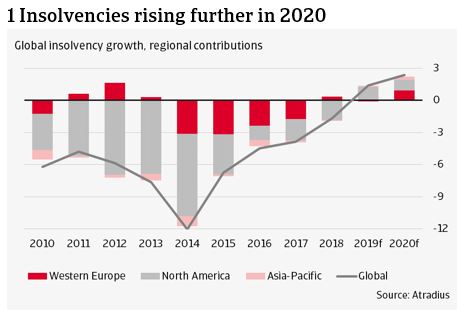
- Insolvencies: Elevated competition and the inability to produce newer products and offerings have triggered many insolvencies in the technology sector. With deteriorating profit margins and reduced demand, i.e., sales, the sector has been experiencing an increasing trend of insolvencies as well. This puts the key decision-makers of the company at greater exposure to litigation risks. As per a recent economic research report by Atradius Group, the insolvency rate is expected to accelerate throughout 2020 as a result of the COVID-19 outbreak.
Summary Table: D&O Liability Drivers & Coverage Mandates in Information Technology (IT)
Here is their projection chart
- Employment practices: Temporary business disruptions, restricted travel and the new ways of working needed in businesses during 2020 amid the COVID-19 crisis may lead to more serious problems in the near future. With the international market hard hit, IT companies need to prepare themselves for financial risks and other impacts due to the current situation. Some of these decisions can end up attracting employment practices claims such as wrongful termination and discrimination, etc.
Managing and mitigating risk is the biggest challenge for the management of any company. With the global pandemic crisis, more specifically, IT companies’ key decision makers are prompted to take some tough decisions in the year 2020, which will potentially expose them to a greater risk of litigation that can be highly expensive and long-running. Having adequate directors and officers’ insurance policy coverage can be a practical way to safeguard themselves.
Frequently Asked Questions (FAQs)
1. Why is Directors and Officers (D&O) liability insurance uniquely critical for Information Technology (IT) companies?
A) IT companies operate in a hyper-competitive, highly volatile environment governed by shifting regulations, investor expectations, and rapid technological disruption. D&O insurance protects tech founders, executives, and board members from personal financial losses caused by lawsuits alleging mismanagement, breach of fiduciary duty, regulatory non-compliance, or failed strategic decisions.
2. How does a D&O insurance policy protect IT company executives against cybersecurity breaches?
A) While Cyber Liability insurance covers data recovery, customer notification, and ransomware costs, D&O insurance protects board members if shareholders or regulators sue leadership for failing to implement proper cybersecurity governance, oversight, or risk management protocols prior to a breach.
3. What is the difference between Tech Errors & Omissions (Tech E&O) and D&O insurance for software and IT firms?
A) Tech Errors & Omissions (Tech E&O) covers financial losses suffered by clients due to software bugs, system downtime, or failed service deliverables (how the product works). D&O insurance covers lawsuits arising from managerial, financial, and governance decisions made by company leaders (how the company is run).
4. Why do venture capital (VC) firms mandate D&O insurance before investing in tech startups?
A) Venture capital and institutional investors require D&O insurance as a closing condition to safeguard their invested capital from being spent on corporate litigation. Additionally, VC representatives sitting on the startup’s board require D&O coverage to ensure their personal financial assets are protected from shareholder or employee lawsuits.
5. How does D&O insurance cover employment practice claims during corporate restructuring or layoffs in the IT sector?
A) When IT companies undergo downsizings, layoffs, or policy changes, executives face elevated risks of claims alleging wrongful termination, constructive dismissal, or workplace discrimination. D&O policies-when integrated with Employment Practices Liability Insurance (EPLI)-cover legal representation fees and financial settlements resulting from these employment disputes.
About The Author
Rajesh
MBA Finance
With a wealth of expertise in the insurance realm, Rajesh is a distinguished writer specializing in articles focusing on directors and officers insurance for SecureNow. Boasting 9 years of experience in the industry, he profoundly understands the complexities surrounding directors and officers liability coverage. Their articles delve into the intricacies of D&O insurance, providing readers with invaluable insights into risk mitigation strategies and policy considerations. Renowned for their comprehensive knowledge and attention to detail, Rajesh is dedicated to delivering informative and engaging content that empowers individuals and businesses to navigate the complexities of insurance with confidence.