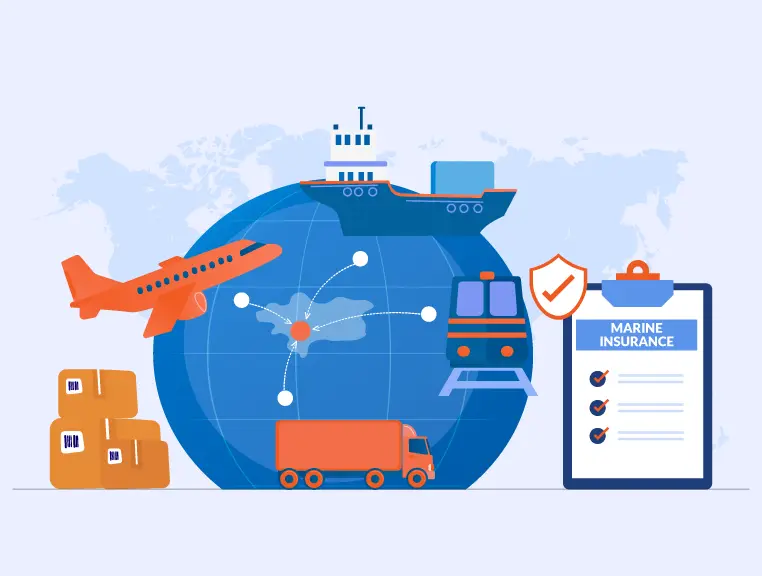



Every exporter, importer, or logistics manager who has ever compared two Marine Insurance quotes has asked the same question: why does one policy cost more than another for what looks like the same shipment? The honest answer is that Marine Insurance pricing is never a single number pulled from a rate card. It is the outcome of a structured risk assessment that weighs cargo type, route, transport mode, packaging, claims history, and market conditions together.
This guide breaks down exactly how Marine Insurance premiums are calculated in India, what factors underwriters actually look at, and how businesses can genuinely lower their cargo insurance costs without cutting corners on protection. Whether you ship by sea, air, road, or rail, understanding this pricing logic puts you in a far stronger position at renewal time.
Quick Answer:
Key Takeaways
- Marine Insurance premiums are based on sum insured, base rate, and risk adjustments – not a fixed tariff.
- Cargo type, value, route, transport mode, packaging, and claims history are the core pricing factors.
- Ratemaking follows a structured flow: Risk Assessment → Underwriting → Premium Calculation → Policy Issuance.
- Multimodal shipments often carry higher premiums due to cumulative handling risk.
- The most effective way to reduce premiums is to reduce actual risk – through better packaging, security, route planning, and claims prevention – not by choosing the cheapest policy.
- Annual policy reviews and experienced broker guidance help ensure pricing stays aligned with current risk.
What Is a Marine Insurance Premium?
A Marine Insurance premium is the amount a policyholder pays an insurer in exchange for financial protection against loss or damage to cargo, ships, or other insurable interests while goods are in transit or storage. It reflects the insurer’s assessment of how likely a claim is, and how large that claim could be, over the policy period.
Definition Box
Marine Insurance Premium = the price of transferring cargo transit risk from a business to an insurer, expressed as a percentage of the sum insured or as a fixed amount per shipment or per policy period.
The premium is not a penalty or a fixed government tariff. It is a commercial calculation, and in India, insurers price Marine Cargo Insurance under IRDAI-approved frameworks while retaining flexibility to price individual risks based on their own underwriting judgment.
How Marine Insurance Premiums Are Calculated
At a broad level, every Marine Insurance premium calculation follows a similar logic, regardless of insurer.
- Sum Insured – the declared value of the cargo, typically invoice value plus a markup (commonly 10–15%) to cover freight, insurance, and anticipated profit.
- Base Rate – a starting rate determined by cargo category, historical loss data for that category, and the chosen Institute Cargo Clause (ICC A, B, or C).
- Risk Loading or Discount – adjustments applied for route, transport mode, packaging, claims history, and security measures.
- Policy Type and Duration – whether the cover is a single transit policy, an annual open policy, or a specific voyage policy.
- Deductible Level – higher voluntary deductibles typically reduce the premium since the insurer’s exposure on smaller claims drops.
In simple terms:
Premium = Sum Insured × Base Rate × Risk Adjustment Factor
This is not an exact formula insurers publish, since actual pricing involves proprietary underwriting models, but it captures the mechanics reasonably well for business planning purposes.
Why Premiums Vary Between Insurers
Two insurers assessing the same shipment can arrive at different premiums because each maintains its own loss experience, reinsurance arrangements, risk appetite, and administrative cost structure. This is why comparing quotes on price alone, without checking the underlying coverage (ICC clause, exclusions, deductible), often misleads businesses into a false sense of savings.
Factors That Affect Marine Insurance Premiums
Marine Insurance pricing factors generally fall into five broad groups: what is being shipped, how it is packed, how it travels, where it travels, and who is shipping it (based on claims history). Each of these is explored below.
Risk Assessment Process
Before quoting a premium, an underwriter typically works through a structured risk assessment:
- Reviewing the nature and value of the cargo
- Checking the route and any known geopolitical, weather, or piracy risks
- Evaluating the transport mode and carrier reliability
- Assessing packaging and handling standards
- Reviewing the applicant’s claims history and shipping frequency
- Confirming the desired Institute Cargo Clause and deductible
This process determines both the probability of a loss occurring and the likely severity if it does – the two pillars of insurance pricing.
Cargo Type and Value
High-value, fragile, hazardous, or easily pilferable cargo attracts higher premiums because the potential claim size or claim frequency is greater. Bulk commodities like steel or grain, by contrast, are often lower risk per unit value because they are less prone to theft or breakage.
Claims History
A business with a clean claims record is viewed as a better risk than one with repeated losses, even if the cargo type and route are identical. Frequent claims signal weaker packaging, handling, or route selection, and insurers price this in through higher premiums or tighter terms at renewal.
Transport Mode
Sea, air, road, rail, and multimodal shipments each carry a different risk profile. Air cargo, for instance, faces less transit time and handling exposure but higher cargo values per shipment; road transport faces higher theft and accident risk over long inland stretches.
Shipping Route
Routes through high-risk maritime zones, conflict-affected regions, or areas with poor port infrastructure and inland connectivity increase premiums. Well-established, low-incident trade corridors typically carry standard or discounted rates.
Packaging and Storage
Poor packaging is one of the most common – and most controllable – causes of cargo damage claims. Insurers reward businesses that use export-standard, cargo-appropriate packaging with better pricing, since it directly reduces the probability of a claim.
Risk-Factor Table: What Drives Your Marine Insurance Premium
| Risk Factor | Low Risk | Medium Risk | High Risk | Premium Impact |
|---|---|---|---|---|
| Cargo Type | Bulk commodities, steel, textiles | Machinery, furniture | Electronics, pharmaceuticals, chemicals | Higher value/fragility = higher premium |
| Cargo Value | Low declared value | Moderate declared value | High declared value | Premium rises with sum insured |
| Shipping Route | Established low-incident corridors | Routes with moderate congestion or delays | Conflict zones, high-piracy or high-theft regions | Higher premium for elevated geopolitical/theft risk |
| Destination Country | Stable regulatory and port environment | Developing infrastructure, moderate delays | Politically unstable or high-claim jurisdictions | Country risk directly loads the rate |
| Mode of Transport | Sea (bulk, established carriers) | Rail, inland waterways | Road (long-haul), complex multimodal | Handling transitions increase exposure |
| Packaging Quality | Export-grade, reinforced, cargo-specific | Standard commercial packaging | Inadequate or generic packaging | Weak packaging raises claim probability |
| Claims History | No claims in 3+ years | One or two minor claims | Frequent or high-value claims | Repeated claims raise renewal premium |
| Frequency of Shipments | Occasional shipper (single transit) | Regular shipper (quarterly) | High-frequency shipper without annual cover | Annual open policies can reduce per-shipment cost |
| Nature of Goods | Non-perishable, non-hazardous | Semi-fragile or temperature-sensitive | Hazardous, perishable, or highly fragile | Special handling needs increase rate |
| Security Measures | GPS tracking, sealed containers, verified carriers | Partial tracking or standard locks | No tracking, unverified handlers | Weak security raises theft-related loading |
Why these factors matter: each row above changes either the probability of a loss happening or the size of the claim if it does – and Marine Insurance pricing is fundamentally an exercise in quantifying both.
Marine Insurance Ratemaking Principles
Ratemaking is the technical process insurers use to convert risk data into a priced premium. It is far more structured than “guessing” a number, and understanding it helps businesses see why premiums move the way they do.
Core Elements of Ratemaking
- Risk Assessment – identifying and measuring every relevant exposure tied to the shipment.
- Probability of Loss – how likely a claim is, based on cargo type, route, and handling.
- Severity of Loss – how large a claim is likely to be if a loss occurs.
- Historical Claims Data – the insurer’s own book of business, and industry-wide loss ratios for similar cargo and routes.
- Cargo Characteristics – fragility, perishability, hazard classification, and susceptibility to theft.
- Underwriting Principles – consistent rules the insurer applies to price similar risks similarly, ensuring fairness and portfolio balance.
- Market Conditions – broader insurance market cycles; premiums can harden or soften depending on global claims trends and capacity.
- Reinsurance Costs – insurers pass on a portion of large risks to reinsurers, and reinsurance pricing feeds directly into the premium charged.
- Administrative Expenses – policy issuance, claims processing, and compliance costs are built into the rate.
- Profit Margin – a reasonable margin that allows the insurer to remain solvent and competitive.
The Ratemaking Flow
Risk Assessment → Underwriting → Premium Calculation → Policy Issuance
- Risk Assessment: The insurer gathers information on cargo, route, mode, and applicant history.
- Underwriting: An underwriter applies internal guidelines to decide whether to accept the risk, and on what terms.
- Premium Calculation: The base rate is adjusted using the risk factors identified above to arrive at a final premium.
- Policy Issuance: Once terms are agreed, the policy is issued with the applicable Institute Cargo Clause, deductible, and conditions.
This four-step flow is consistent across Marine Cargo Insurance, Inland Cargo Insurance, and specialised marine covers, even though the specific rating factors used at each stage differ by product.
Multi-Mode Transportation Premium Impact
The mode of transport materially changes a Marine Insurance premium because each mode carries a distinct handling, duration, and exposure profile.
| Transport Mode | Risk Level | Typical Premium Impact | Common Risks |
|---|---|---|---|
| Road Transport | Medium–High | Often higher for long-haul inland routes | Accidents, theft, pilferage, poor road infrastructure |
| Rail Transport | Low–Medium | Generally moderate | Handling damage at loading/unloading points, delays |
| Sea Freight | Medium | Varies widely by route and vessel type | Weather, rough handling, wetting damage, piracy on certain routes |
| Air Freight | Low–Medium | Often lower due to shorter transit time, but high cargo value per shipment can offset this | Handling damage, tight connection risk, high-value cargo concentration |
| Inland Waterways | Medium | Route- and vessel-dependent | Water damage, limited tracking infrastructure |
| Multimodal Transportation | Medium–High | Can attract a combined or slightly elevated rate | Multiple handling and transfer points increase cumulative exposure |
Why multimodal shipments may cost more to insure: every time cargo changes hands – from truck to rail, rail to port, port to vessel – there is an added opportunity for mishandling, delay, or damage. Insurers account for this cumulative “touchpoint risk” when pricing multimodal cover, even though each individual leg might otherwise be low risk.
Inland Cargo Insurance vs Marine Cargo Insurance: Inland Cargo Insurance, which covers domestic road and rail movement within India, is typically priced lower than international Marine Cargo Insurance because it usually involves shorter transit distances and does not carry ocean-specific risks. However, poor road conditions, long inland hauls, and high-value domestic cargo can still push Inland Cargo Insurance premiums upward.
How to Reduce Marine Insurance Premiums?
Lowering your Marine Insurance premium sustainably is about reducing actual risk, not just negotiating harder or choosing the cheapest policy on offer. A cheap policy with poor coverage can cost far more at claim time than a slightly higher premium with solid protection.
Practical Cost-Reduction Checklist
| Action | Expected Benefit |
|---|---|
| Improve packaging to export standards | Fewer damage claims, lower loss probability |
| Maintain a strong claims-prevention record | Better renewal pricing over time |
| Opt for a higher deductible where cash flow allows | Lower premium since insurer’s small-claim exposure drops |
| Choose the right Institute Cargo Clause (avoid over- or under-insuring) | Right-sized cover at an appropriate rate |
| Implement cargo risk management practices | Insurer views the business as lower risk |
| Ensure accurate and complete cargo declaration | Avoids disputes, penalties, and rate loading from misdeclaration |
| Consolidate shipments where feasible | Reduces per-shipment administrative cost and handling exposure |
| Improve security (tracking, sealed containers, verified carriers) | Reduces theft-related risk loading |
| Plan routes to avoid high-risk zones where possible | Lower geopolitical and weather-related risk loading |
| Review the policy annually rather than auto-renewing | Ensures pricing reflects current risk profile, not outdated assumptions |
| Work with an experienced insurance broker | Access to better risk placement and clause selection guidance |
The underlying goal of every item on this checklist is the same: make the shipment genuinely less likely to result in a claim, and let that lower risk translate into a lower premium – rather than simply shopping for the lowest quoted number.
Common Pricing Mistakes
- Choosing cover based on price alone, without checking whether the Institute Cargo Clause actually protects against the risks the cargo faces.
- Under-declaring cargo value to save on premium, which can lead to under-insurance and a reduced claim payout.
- Ignoring packaging standards, assuming insurance alone will cover any damage regardless of how goods were packed.
- Not reviewing the policy annually, so pricing and cover no longer reflect current shipment volumes or routes.
- Overlooking deductible flexibility, missing an opportunity to lower premiums for businesses with strong risk management.
- Failing to disclose claims history accurately, which can create disputes at claim stage even if it temporarily lowers a quoted premium.
Practical Examples
A textile exporter shipping monthly by sea. Because the shipments are regular and low-value-per-unit, an annual open Marine Cargo Insurance policy usually works out cheaper than insuring each shipment individually, and a clean claims history over successive renewals can further improve pricing.
A pharmaceutical company transporting temperature-sensitive products. Perishability and strict handling requirements push this cargo into a higher-risk category, so premiums reflect both the value at risk and the need for temperature-controlled logistics; investing in verified cold-chain partners can help moderate the rate over time.
An electronics importer using multimodal transport. High cargo value combined with multiple handling points (port, rail, road) increases touchpoint risk, so premiums are generally higher unless the importer can show strong security measures and a reliable logistics partner network.
A business with multiple claims over the past three years. Frequent claims signal elevated risk to underwriters, typically resulting in higher premiums, tighter terms, or higher deductibles at renewal until the claims trend improves.
A manufacturer improving packaging to lower insurance costs. By moving from generic to export-grade, cargo-specific packaging, the manufacturer reduces the probability of transit damage, which insurers can reflect in more favourable renewal pricing.
A company increasing deductibles to reduce premium. By absorbing smaller, more predictable losses itself, the business lowers the insurer’s expected payout, which is typically rewarded with a reduced premium – a sensible trade-off for businesses with stable cash flow.
A logistics company expanding into international shipments. Moving from domestic Inland Cargo Insurance to international Marine Cargo Insurance introduces new route, currency, and jurisdictional risks, so premiums typically rise to reflect the broader risk exposure, even before route-specific factors are considered.
Myth vs Fact: Marine Insurance Pricing
| Myth | Fact |
|---|---|
| The cheapest Marine Insurance policy is always the best. | The cheapest policy may offer weaker coverage; value depends on the clause, exclusions, and claim-servicing quality, not price alone. |
| Past claims never affect future premiums. | Claims history is one of the strongest factors insurers use to price renewals. |
| Air cargo always costs more to insure. | Air freight often has shorter transit and lower handling exposure, which can offset its high per-shipment value. |
| Premiums depend only on cargo value. | Route, transport mode, packaging, and claims history all influence pricing alongside cargo value. |
| Inland Cargo Insurance is always cheaper than Marine Cargo Insurance. | It is often lower-cost due to shorter transit, but high-value domestic cargo or poor road conditions can raise it significantly. |
| A higher deductible always makes cover worse. | A higher deductible mainly lowers the premium; it does not reduce protection against major losses. |
| Multimodal transport is always cheaper because it uses multiple efficient legs. | Multiple handling points can increase cumulative risk, sometimes raising the premium. |
| Once a policy is bought, there is no need to review it again. | Annual review ensures pricing and cover reflect current shipment volumes, routes, and risk profile. |
| Insurers charge the same rate regardless of the insurer chosen. | Rates vary by insurer based on their own claims experience, reinsurance costs, and risk appetite. |
| Marine Insurance premiums are fixed by regulation across India. | IRDAI provides a regulatory framework, but individual pricing reflects each insurer’s underwriting assessment of the specific risk. |
| Good packaging has little effect on premium. | Packaging quality directly affects loss probability and is one of the most controllable pricing levers available to a business. |
| Claims-free businesses get no pricing benefit. | A clean claims record is typically rewarded with more favourable premiums at renewal. |
Decision Tree: How Can You Reduce Your Marine Insurance Premium?
Start: What type of business are you?
- Exporter → Focus on export-grade packaging, accurate invoicing for correct sum insured, and an annual open policy if shipping regularly.
- Importer → Verify supplier packaging standards, confirm correct Institute Cargo Clause for the cargo type, and review destination-country risk with your broker.
- Manufacturer → Invest in cargo-specific packaging and handling protocols, since this is the highest-leverage lever for reducing claims and premiums.
- Logistics Company → Strengthen carrier verification, tracking, and route planning across all client shipments to build a favourable claims record.
- SME → Consider a higher deductible if cash flow allows, and consolidate shipments to reduce per-transit costs.
- Large Enterprise → Negotiate annual open policies with volume-based terms and conduct annual risk audits with your insurer or broker.
- Frequent Shipper → An annual open policy generally offers better value and pricing consistency than repeated single-transit policies.
- Occasional Shipper → A single transit policy tailored to the specific route and cargo may be more cost-effective than an annual cover.
At every branch, the underlying strategy is the same: reduce the actual probability and severity of loss, choose the right clause and deductible for your risk appetite, and review pricing at least annually.
Conclusion
Marine Insurance premium calculation is not arbitrary – it is a disciplined process built on risk assessment, historical claims data, and underwriting judgment. Cargo type, value, route, transport mode, packaging, and claims history all combine to determine what an insurer charges. Understanding these levers gives exporters, importers, manufacturers, and logistics companies real control over their insurance costs, provided the goal remains reducing genuine risk rather than simply chasing the lowest quote.
A well-structured Marine Insurance policy, priced fairly and reviewed annually, protects cargo value while keeping costs proportionate to actual exposure – which is exactly what good risk management should achieve.
Frequently Asked Questions
Q) How is Marine Insurance premium calculated?
A) Marine Insurance premium is calculated by applying a base rate to the sum insured, then adjusting it based on risk factors such as cargo type, route, transport mode, packaging quality, and claims history. Insurers also factor in reinsurance costs and administrative expenses before arriving at the final premium.
Q) What factors affect Marine Insurance premiums?
A) Key factors include cargo type and value, shipping route, destination country, mode of transport, packaging quality, claims history, shipment frequency, and security measures. Each factor influences either the probability or the severity of a potential loss.
Q) Does claims history increase Marine Insurance premium?
A) Yes. A history of frequent or high-value claims signals elevated risk to underwriters and typically results in higher premiums or tighter terms at renewal, while a clean claims record is generally rewarded with more favourable pricing.
Q) How does cargo type affect insurance cost?
A) Fragile, hazardous, perishable, or high-value cargo like electronics and pharmaceuticals typically carries a higher premium than bulk, low-risk commodities such as steel or textiles, because the probability or severity of a claim is greater.
Q) How is Marine Cargo Insurance priced?
A) Marine Cargo Insurance is priced using the sum insured, a base rate specific to the cargo category, and adjustments for route, mode of transport, packaging, and the applicant’s claims history, within the insurer’s underwriting guidelines.
Q) Does destination country affect premium?
A) Yes. Destinations with unstable political conditions, weaker port infrastructure, or a history of high claims frequency generally attract higher premiums than destinations with stable, well-established trade routes.
Q) Why does packaging influence Marine Insurance premium?
A) Packaging quality directly affects how likely cargo is to be damaged in transit. Export-grade, cargo-specific packaging reduces claim probability, which insurers reflect through more favourable pricing.
Q) Which transport mode has the highest insurance premium?
A) There is no single mode that is always highest; it depends on cargo value, route, and handling exposure. Long-haul road transport and complex multimodal shipments often carry higher risk loading due to accident, theft, and multiple handling points.
Q) Does multimodal transportation cost more to insure?
A) Multimodal transportation can attract a higher premium because each transfer between transport modes adds an additional handling and damage risk point, increasing cumulative exposure compared to a single-mode shipment.
Q) Can businesses reduce Marine Insurance premiums?
A) Yes. Businesses can reduce premiums by improving packaging, maintaining a strong claims record, choosing appropriate deductibles, using accurate cargo declarations, improving security, and reviewing their policy annually with a broker.
Q) How can exporters lower Marine Insurance costs?
A) Exporters can lower costs by using export-standard packaging, declaring accurate cargo values, choosing the right Institute Cargo Clause, and consolidating regular shipments under an annual open policy rather than insuring each transit separately.
Q) Does choosing ICC A instead of ICC C increase premium?
A) Yes, generally. Institute Cargo Clause A offers the broadest “all risks” cover, so it typically carries a higher premium than the more restricted Clause C, which covers only named major perils.
Q) How does cargo value affect insurance pricing?
A) Higher cargo value increases the sum insured, which directly raises the premium since the insurer’s potential payout in the event of a total loss is larger.
Q) How often should Marine Insurance premiums be reviewed?
A) Marine Insurance premiums should ideally be reviewed annually, or whenever there is a significant change in shipment volume, routes, cargo type, or claims history, to ensure pricing still reflects the current risk profile.
Q) Are Marine Insurance premiums negotiable?
A) To an extent, yes. While base rates follow underwriting guidelines, businesses with strong risk management, low claims history, and higher shipment volumes can often negotiate better terms, especially through an experienced broker.
Q) Does Inland Cargo Insurance cost less than Marine Cargo Insurance?
A) Inland Cargo Insurance is often priced lower than international Marine Cargo Insurance because domestic transit distances are typically shorter and ocean-specific risks do not apply, though high-value cargo or poor road conditions can still raise the rate.
Q) What is the role of deductibles in Marine Insurance pricing?
A) A deductible is the amount the policyholder absorbs before the insurer pays a claim. Choosing a higher deductible generally lowers the premium because it reduces the insurer’s exposure to smaller, more frequent claims.
Q) How do underwriters assess Marine Insurance risk?
A) Underwriters assess risk by reviewing cargo type and value, route, transport mode, packaging standards, claims history, and shipment frequency, then apply the insurer’s underwriting guidelines to price the policy accordingly.
Q) What documents influence Marine Insurance pricing?
A) Commercial invoices, packing lists, past claims records, shipment history, and route or transport documentation all help underwriters accurately assess risk and price the policy correctly.
Q) How can businesses improve their insurability?
A) Businesses can improve their insurability by maintaining a clean claims record, using strong packaging and security measures, providing accurate cargo declarations, and demonstrating consistent, well-managed shipping practices over time.
Q) Why do insurers charge different premiums for the same cargo?
A) Different insurers maintain different claims experience, reinsurance arrangements, and risk appetite, which means the same shipment can be priced differently depending on which insurer is underwriting it.
Q) Does shipment frequency affect Marine Insurance premium?
A) Yes. Frequent shippers often benefit from annual open policies that offer more consistent, and sometimes lower, per-shipment pricing compared to insuring each transit individually.
Q) What is the difference between a single transit policy and an annual open policy?
A) A single transit policy covers one specific shipment, while an annual open policy covers all qualifying shipments over a policy year, typically offering better value and administrative simplicity for frequent shippers.
Q) Does hazardous cargo always attract a higher premium?
A) Generally yes, because hazardous cargo carries a higher probability of causing significant loss or damage, which underwriters price in through a higher base rate or additional conditions.
Q) Can improving security measures lower Marine Insurance premiums?
A) Yes. Measures such as GPS tracking, sealed containers, and verified carriers reduce theft-related risk, which insurers can reflect through reduced risk loading on the premium.
Q) Is Marine Insurance premium the same as Marine Insurance cost?
A) The premium is the price paid for the policy itself, while overall Marine Insurance cost can also include deductibles borne at claim time and any administrative charges, so the two are related but not identical.
Q) Does route planning affect Marine Insurance premium?
A) Yes. Choosing established, lower-risk trade corridors over routes through conflict zones or high-piracy areas can help keep premiums lower.
Q) Why is accurate cargo declaration important for pricing?
A) Accurate declaration ensures the correct sum insured and risk category are used, avoiding both under-insurance and pricing disputes or penalties that can arise from misdeclaration.
Q) Should businesses buy Marine Insurance based on price alone?
A) No. Businesses should evaluate coverage scope, exclusions, deductible, and insurer claims service alongside price, since the cheapest policy can sometimes offer materially weaker protection.
Q) How does working with a broker help with Marine Insurance pricing?
A) An experienced broker can help identify the right Institute Cargo Clause, negotiate terms based on risk management practices, and ensure the policy is priced fairly relative to the actual risk profile of the business.