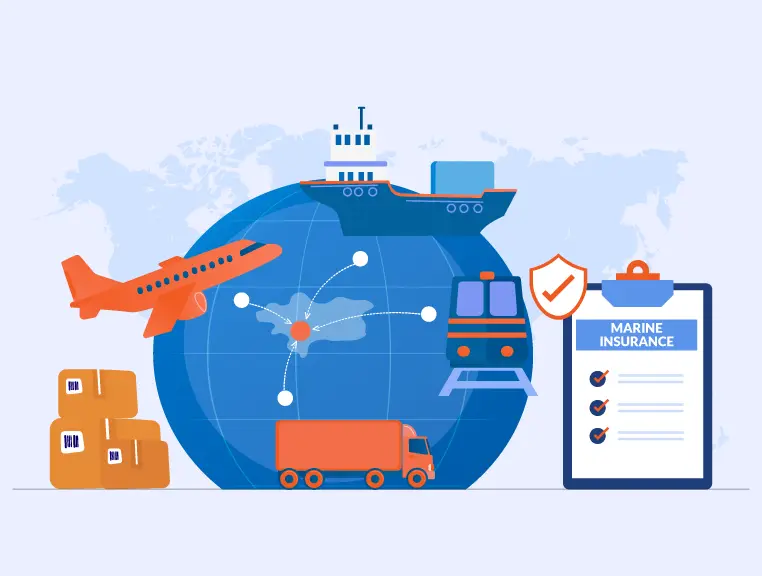



Every time cargo leaves a warehouse, it enters a stretch of the supply chain that the shipper does not fully control. During loading, a container can fall; a truck can meet with an accident; or water can damage a consignment on a vessel deck. For a business that ships goods only occasionally – a one-off export order, a single machinery shipment, a first-time import – buying a full annual marine policy rarely makes sense. This is where a Specific Transit Marine Insurance Policy, also called a single transit or specific marine policy, fits in.
In short, this guide brings together everything a business needs to know about this policy: what it is, why it matters, who buys it, what it covers, how to work out premiums and the sum insured, how to choose an insurer, how to buy it online, and how insurers settle a claim – all in one place, and all subject to the terms, conditions and exclusions of the policy actually issued.
What Is Specific Transit Marine Insurance?
A Specific Transit Marine Insurance Policy insures one defined shipment of goods, from a stated origin to a stated destination, for a single journey, subject to the policy’s terms, conditions, exclusions and limits.
In practice, the word “specific” refers to the fact that the cover applies to one particular consignment and one particular movement, not to every shipment a business makes over a year. Once the goods reach the destination named in the policy, the cover for that transit ends.
By contrast, an open or annual marine policy automatically covers every shipment a business makes during the policy period, without requiring a fresh policy each time. An open policy therefore suits businesses that ship frequently, because it removes the need to arrange insurance for every consignment. A specific transit policy, on the other hand, suits businesses that ship rarely, or that want to insure a particular high-value or unusual consignment on its own terms.
Example: A furniture exporter in Jaipur receives a one-time order to ship a container of handcrafted items to a buyer in Germany. Because this is not a recurring export line, the exporter buys a specific transit policy that covers only this container, on this route, for this journey, rather than committing to an annual cargo policy.
Why Is Specific Transit Insurance Important?
Goods in transit face financial exposure that is separate from, and often larger than, the risks a business insures at its own premises. A single incident during loading, transportation, or unloading can wipe out the entire value of a consignment, along with the freight, duties, and other costs already sunk into it.
Several factors make this exposure real for businesses that move goods:
- Physical handling risk. Cargo typically passes through multiple hands – loading at origin, transfer between vehicles or vessels, storage at ports, and unloading at destination. Each handling point adds a chance of damage.
- Transport-related accidents. Vehicles carrying cargo can meet with accidents; vessels can run into rough weather, collisions, or mechanical issues.
- Theft and pilferage. Thieves can target cargo waiting at ports, warehouses, or transshipment points.
- Weather and natural perils. Depending on the cover a business chooses, the policy may insure certain weather-related and natural perils.
- Limited carrier liability. Law or the terms of the bill of lading or consignment note usually cap what a shipping line, airline, or transporter accepts for lost or damaged cargo, and that cap is often far lower than the actual value of the goods. Relying on the carrier alone can therefore leave a significant gap.
The Carrier Liability Gap
For a business shipping high-value or occasional consignments, this gap between potential loss and what a carrier must pay can be large enough to disrupt cash flow and delay fulfilment of the next order. A specific transit policy aims to close that gap for the duration of a defined shipment.
Example: A pharmaceutical distributor sends a consignment of equipment worth ₹40 lakh by road and sea to a client in Sri Lanka. Should the consignment suffer damage in transit, the carrier’s liability under the transport contract may cover only a fraction of the loss. A specific transit policy, sized to the value of the shipment, aims to make up that difference, subject to the policy’s terms.
Who Can Buy Specific Transit Marine Insurance?
In other words, anyone with an insurable interest in a shipment – meaning they stand to suffer a financial loss if the goods suffer damage or loss – can generally consider a specific transit policy. In practice, this typically includes:
- Importers and exporters
- Manufacturers dispatching finished goods
- Traders and distributors moving stock between locations
- E-commerce and retail businesses shipping bulk consignments
- Freight forwarders and logistics companies handling client cargo
- Individuals or businesses making a one-time, high-value shipment
Eligibility, the specific terms offered, and the documentation required will vary from insurer to insurer, and depend on the nature of the goods, the transit route and the mode of transport. It is therefore worth checking with the insurer or broker what proof of insurable interest and shipment details they will need before issuing a policy.
What Are the Important Features of Specific Transit Insurance?
Indeed, a specific transit policy has a few defining characteristics that set it apart from other forms of marine cover.
Key Features at a Glance
| Feature | What It Means | Why It Matters |
|---|---|---|
| Single-transit basis | Cover applies to one shipment, one journey, from a named origin to a named destination | You only pay for the transit you actually need covered |
| Defined transit period | Cover starts and ends as defined in the policy, typically tied to the movement of the specific consignment | There is no ambiguity about when protection begins and ends |
| Customisable coverage | Businesses can tailor cover using Institute Cargo Clauses (ICC-A, ICC-B, or ICC-C) or named-peril wording | Businesses can match the cover to the value and risk profile of the goods |
| Defined sum insured | Insurer and insured agree the sum insured, based on the value of the specific consignment | Claim settlement is linked to a value that both parties have agreed upon in advance |
| Applicable exclusions | The policy excludes certain causes of loss, as set out in its wording | Understanding exclusions in advance avoids surprises at claim time |
| Deductible/excess | Some policies apply a deductible, where applicable | Deductibles can affect both the premium and the amount recovered on a claim |
| Flexibility for occasional shippers | No requirement to commit to an annual policy | Suits businesses that ship only occasionally or unpredictably |
Coverage Levels Under the Institute Cargo Clauses
Insurers generally structure cover under a specific transit policy around the Institute Cargo Clauses (ICC), an internationally used set of standard wordings:
- ICC-A offers the widest cover, insuring against loss or damage from a broad range of named and unnamed perils, subject to specific exclusions.
- ICC-B covers a defined, narrower list of specified perils.
- ICC-C is the most restrictive of the three, covering only certain major perils such as fire, explosion, and vessel-related events.
Which clause applies – and therefore how wide the cover is – depends entirely on which clause the buyer selects and the policy schedule states.
What Does Specific Transit Insurance Cover?
In short, coverage under a specific transit policy depends on the Institute Cargo Clause the buyer selects, any endorsements added, and the exclusions and conditions the policy wording sets out. As a general guide, the perils a policy commonly covers – subject to the policy wording – include:
Potentially covered perils
- Fire or explosion
- Vessel or vehicle overturning, derailment, or sinking
- Collision of the carrying conveyance with any external object
- Cargo washed overboard
- General average sacrifice and salvage charges
- Loss of an entire package during loading or unloading
- Earthquake, lightning, or volcanic eruption
- Entry of sea, lake or river water into the vessel or container
- Theft and non-delivery of an entire package, where insured
- Total loss of a package lost overboard
Common exclusions and limitations
- Loss caused by the wilful misconduct of the insured
- Loss caused by delay, even where the delay results from an insured peril
- Ordinary wear and tear, ordinary leakage, or inherent vice of the goods
- Inadequate or improper packaging
- War and related perils, unless specifically bought back as an add-on
- Strikes, riots, and terrorism, unless specifically bought back as an add-on
Insurers can often add war, strike, riot and terrorism risks back into the policy for an additional premium, depending on the insurer and the route involved. Because exclusions and add-ons vary between insurers, it is essential to read the actual policy wording rather than relying on a general description of cover.
What Risks Can Affect Goods During Sea Transit?
In fact, sea shipment hazards are a major reason marine transit insurance exists in the first place. Cargo moving by sea passes through conditions and handling steps that are largely outside the shipper’s control.
Weather and Geographical Hazards
For instance, storms, cyclones, rough seas, and geographical hazards such as sandbars can threaten both the vessel and the cargo it carries. Modern container ships and navigation technology reduce – but do not eliminate – this risk.
Man-Made and Handling Hazards
Indeed, a large share of cargo damage happens not at sea but during loading and unloading, when handlers lift, stack, or move goods between vehicles and vessels. Even experienced handling teams can cause damage through a moment’s error.
Packaging-Related Hazards
Goods packed inadequately for the rigours of a sea voyage are more likely to suffer damage, and the policy typically excludes losses linked to improper packaging from cover.
Port and Transshipment Risks
Cargo that waits at ports or moves between carriers faces theft, weather, and further handling damage.
Container and Vessel-Related Risks
Similarly, water ingress into a container, a vessel running aground, or a collision between vessels can all result in cargo loss, depending on how the policy defines the perils it covers.
Overall, a marine transit insurance policy aims to give financial protection against many of these hazards, subject to the perils actually insured under the chosen Institute Cargo Clause.
Is Specific Transit Cargo Insurance Worth Buying?
In short, whether a specific transit policy is worth buying depends on the shipment, not on a blanket rule. It tends to be particularly useful in situations such as:
- A one-off or occasional shipment, where an annual policy would not be cost-effective
- High-value cargo, where a loss could materially affect the business
- International shipments involving multiple handling points and longer transit times
- Long-distance transit where the consignment is out of the shipper’s direct control for an extended period
- A first-time export or import, where the buyer wants certainty around a new trade relationship
That said, for businesses that ship goods regularly throughout the year, an open or annual marine policy may prove more convenient and, over time, more cost-efficient than buying a fresh specific transit policy for every consignment. The right choice depends on shipment frequency, cargo value, and the level of risk the business is willing to carry without cover.
How Is the Sum Insured Decided?
To begin with, the sum insured under a specific transit policy is not a fixed, standard figure – it is the value that the insurer and the insured agree represents the maximum value at risk for that consignment. Because a specific transit policy covers only one shipment, getting this valuation right matters more than it might for an ongoing annual policy, since there is no later opportunity to adjust it for that same consignment.
How the Sum Insured Is Built Up
The sum insured is generally built up from three components:
- Invoice value of the goods – the actual worth of the cargo being shipped, which forms the base of the calculation.
- Freight cost – the cost of transporting the goods, including packaging, loading and carriage charges.
- Incidental expenses – a margin added to cover costs such as insurance premiums, duties, or other charges connected with the shipment.
As a general guide, insurers often calculate the sum insured as follows:
- For inland transit: invoice value plus 10%-15%
- For overseas transit: invoice value plus insurance cost plus freight cost, plus a further 10%-15%
These percentages are illustrative of common market practice, and regulation does not fix them – so the business should always agree the final figure with the insurer based on the actual shipment.
What Happens If You Underinsure
Consequently, if a business sets the sum insured lower than the true value at risk, a claim settlement may not be enough to replace the loss, since the sum insured and the extent of damage generally determine the payout, rather than the goods’ full replacement cost.
Example: A manufacturing company exports an electronic components consignment worth ₹50 lakh to a buyer overseas. Because it was a single, sizeable shipment, the company insured the full invoice value, added the freight and insurance costs, and included an additional 10% for incidental expenses, arriving at a sum insured that reflected the complete value at risk, not just the invoice price of the goods.
Keeping the Right Documentation Ready
Finally, businesses should keep invoices, shipping documents, and cost breakdowns ready, since insurers typically rely on this documentation to verify and support the declared sum insured.
How Much Does Specific Transit Marine Insurance Cost?
Indeed, there is no single “correct” premium for a specific transit policy – the cost depends on the risk profile of the shipment and the coverage selected. Insurers commonly assess several factors when pricing a policy:
| Pricing Factor | Potential Impact on Premium |
|---|---|
| Nature and value of cargo | Higher-value or more fragile/perishable goods generally attract a higher premium |
| Inherent risk of the goods | Goods prone to spoilage, breakage, or theft carry higher perceived risk |
| Type of coverage (ICC-A/B/C) | Wider cover under ICC-A typically costs more than the narrower ICC-B or ICC-C |
| Transit route and destination | Longer or higher-risk routes can increase the premium |
| Mode of transport | Sea, air, road, or multimodal transport each carry a different risk profile |
| Type and condition of vessel/vehicle | Vessel age, construction, and fitness affect the underwriting assessment |
| Packaging standard | Adequate, transit-worthy packaging can support more favourable pricing |
| Deductible/excess chosen | A higher deductible generally reduces the premium |
| Add-on covers (war, SRCC) | Additional perils bought back increase the premium |
In turn, insurers assess these factors together rather than in isolation, which is why two shipments of similar value can carry different premiums. Because there is no universal percentage rate that applies across all cargo types, buyers should not assume that a figure quoted for one shipment will apply to another.
What Is the Right Premium for Specific Marine Insurance?
In short, the “right” premium is not simply the lowest quote available – it is the premium that buys coverage genuinely suited to the shipment’s risk. A cheaper policy that excludes key perils, carries a high deductible, or offers a narrow Institute Cargo Clause may end up costing more at claim time than a slightly higher-priced policy with broader, better-matched cover.
When comparing quotes, it helps to look beyond the headline premium at:
- The scope of coverage (which ICC clause, and which perils are named)
- Exclusions and any conditions attached to the cover
- The sum insured basis and whether it has been calculated correctly
- Deductibles or excess amounts
- The insurer’s claim-handling process and documentation requirements
- Overall value for the specific shipment, not just price
To manage cost without compromising on essential cover, a few practical steps can help: choosing the coverage category that actually matches the shipment rather than over-insuring, opting for a higher deductible where the business can absorb small losses, and comparing quotes from multiple insurers side by side before finalising a policy.
How to Choose the Right Marine Insurance Company
Insurers to Consider in India
To begin with, several general insurance companies in India offer marine and transit insurance, including large public-sector insurers as well as private insurers. Names commonly seen offering marine cargo cover in the Indian market include The New India Assurance, Oriental Insurance, National Insurance Company, United India Insurance, ICICI Lombard, HDFC ERGO, Bajaj Allianz, Tata AIG, Cholamandalam MS, and Reliance General Insurance, among others.
How to Evaluate an Insurer
Instead, rather than treating any list as a fixed ranking, it is more useful to evaluate insurers against a set of practical criteria, since the right insurer for one business may not be the right one for another:
- Experience with marine and cargo insurance – insurers with a strong track record in this line tend to understand shipment-specific risks better.
- Policy wording and coverage options – check which Institute Cargo Clause options, exclusions, and add-ons are available.
- Claim handling process – how claims are surveyed, documented, and settled matters as much as the premium quoted.
- Financial standing – an insurer’s ability to pay claims reliably is a basic requirement.
- Customer service and responsiveness – particularly important when a claim needs to be reported quickly.
- Digital and online capabilities – the ease of getting quotes, buying online, and tracking a policy or claim.
- Premium competitiveness – considered alongside coverage, not in isolation.
Ultimately, no single insurer is objectively “best” for every shipment; the right fit depends on the cargo type, route, budget, and the buyer’s own priorities. For this reason, comparing quotes and policy wordings from more than one insurer – for example, through a broking platform that shows multiple insurers side by side – is generally a more reliable approach than picking a name at random.
How to Buy a Specific Transit Marine Insurance Policy Online
In general, buying a specific transit policy online follows a similar sequence across most Indian insurers and broking platforms:
- Identify the shipment. Note the cargo type, origin, and destination clearly before requesting a quote.
- Provide cargo details. Share the description, quantity, and nature of the goods being shipped.
- Provide origin and destination. Give the exact pickup and delivery points, including any transshipment stops.
- Select the transportation mode. Indicate whether the shipment moves by sea, air, road, rail, or a combination of these.
- Determine the required sum insured. Work out the invoice value, freight, and incidental expenses to arrive at an appropriate sum insured.
- Select the appropriate coverage. Choose the Institute Cargo Clause (ICC-A, B, or C) or named-peril cover that matches the shipment’s risk.
- Compare policy terms and premium. Review quotes from more than one insurer, focusing on coverage as well as price.
- Submit required information and documents. This typically includes a proposal form and a marine declaration with details such as the policyholder’s name, goods being shipped, value of goods, and vessel or vehicle details.
- Make the payment. Pay the premium through the insurer’s or broker’s online payment option.
- Receive and check the policy document. Review the cover note and policy document carefully before the shipment begins, to confirm the sum insured, coverage, and exclusions match what was agreed.
What Information or Documents Are Needed to Buy the Policy?
In general, the exact document list can vary by insurer, but commonly requested information for a specific transit policy includes:
Commonly requested information
- Name of the policyholder
- Description of the items being shipped
- Value of the goods (invoice value)
- Origin and destination of the shipment
- Mode of transport
- Name of the vessel or transport details, where applicable
- Nature of the risk involved in the shipment
Documents that may be required depending on the insurer
- Commercial invoice
- Packing list
- Marine declaration form
- Proposal form
- Bill of lading or transport document, where already available
Because requirements differ between insurers, it is worth confirming the exact document checklist with the chosen insurer or broker before the shipment date, so that the insurer can issue the policy without delay.
Claim Filing Process Under a Specific Transit Insurance Policy
For instance, when cargo insured under a specific transit policy suffers loss or damage, a structured claim process helps ensure fair assessment and timely settlement. The general steps are:
- Identify the loss or damage as soon as it is discovered, whether at the point of delivery or during transit.
- Notify the carrier and other relevant parties promptly, in line with the terms of the transport contract.
- Inform the insurer without delay, since late notification can complicate a claim.
- Preserve evidence of the damaged goods, including photographs, and avoid disposing of damaged cargo before it has been inspected.
- Collect the required documentation, including the policy, invoice, and transport documents.
- Arrange a survey or inspection, where the insurer appoints a surveyor to assess the extent and cause of the loss.
- Submit the claim form along with supporting documents to the insurer.
- Cooperate with the insurer and surveyor during the assessment process, providing any further information requested.
- Claim assessment, where the insurer reviews the survey report and documentation against the policy terms.
- Settlement or decision, where the insurer communicates the outcome and, where the claim is admitted, processes payment.
Claim settlement timelines vary by insurer, the complexity of the loss, and how quickly the claimant provides documentation – there is no single fixed timeframe that applies across the industry.
What Documents Are Required for a Marine Insurance Claim?
Similarly, while the exact list depends on the specific claim and the insurer’s requirements, documents commonly requested for a marine cargo claim include:
- The insurance policy or certificate
- Commercial invoice for the goods
- Transport document (bill of lading, airway bill, or lorry receipt, as applicable)
- Packing list
- Delivery or proof-of-damage records at the point of receipt
- Survey report, where a surveyor has been appointed
- Correspondence with the carrier regarding the loss or damage
- Completed claim form
In short, keeping these documents organised from the start of the shipment – rather than trying to assemble them after a loss occurs – is one of the simplest ways to avoid delays at claim time.
Specific Transit vs Specific Voyage Insurance
In fact, “specific transit” and “specific voyage” insurance are closely related terms, and in everyday use they often refer to essentially the same kind of single-shipment cover. When a distinction exists, it is usually about emphasis rather than a fundamentally different product: a specific voyage policy typically centres on one particular sea (or air) voyage from a named port or airport to another, while the term “specific transit” sometimes applies more broadly to the full inland-to-inland movement of goods, including any onward road or rail legs before and after the main voyage.
Comparing the Two at a Glance
| Factor | Specific Transit | Specific Voyage |
|---|---|---|
| Scope | Can cover the full transit, including inland legs before/after the main journey | Typically centres on one defined voyage/route |
| Duration | Cover ends when the specific consignment reaches its destination | Cover ends once the vessel or aircraft completes the named voyage and cargo reaches its recipient |
| Best suited for | Occasional shippers needing end-to-end cover for one consignment | Businesses making a single import/export voyage, where frequency of shipping is low |
| Add-on options | Often available as an add-on for war, strike, riot and civil commotion cover | Similarly extendable for perils like strike, riot, and civil commotion |
| Sum insured basis | Invoice value plus freight and incidental costs (typically +10%-15%) | Contract value plus an incidental cost margin (commonly +10%-15%) |
Specific Transit Insurance vs Open Cover
| Factor | Specific Transit | Open Cover (Annual Policy) |
|---|---|---|
| Scope | One named shipment | All shipments made during the policy period, as declared |
| Best suited for | Occasional or one-off shippers | Businesses shipping frequently throughout the year |
| Administrative effort | A fresh policy for each shipment | One policy covering multiple shipments, reducing repeat paperwork |
| Cost structure | Premium calculated per shipment | Premium typically based on overall declared turnover or shipment volume |
| Flexibility | Coverage can be closely tailored to that one consignment | Standard terms generally apply across all declared shipments |
In general, businesses that ship only occasionally usually find a specific transit policy simpler and more cost-effective, while frequent shippers tend to benefit from the convenience of an open cover arrangement.
Common Mistakes to Avoid
However, even experienced buyers can trip up on a few recurring issues. In particular, watch out for the following:
- Choosing a policy solely on price, without checking what coverage and exclusions come with it.
- Underinsuring cargo by setting the sum insured too low, which can reduce the claim payout.
- Not checking exclusions before the shipment begins, leading to unpleasant surprises at claim time.
- Providing an incorrect or vague cargo description, which can complicate claim assessment.
- Ignoring packaging requirements, since insurers commonly exclude damage linked to inadequate packaging.
- Not verifying transit details such as route, mode of transport, and transshipment points before buying the policy.
- Delaying claim notification after a loss is discovered.
- Poor documentation, including missing invoices or transport documents needed to support a claim.
- Assuming carrier liability is equivalent to cargo insurance, when in practice law or contract usually caps carrier liability, and it may fall well short of the goods’ actual value.
- Not reviewing the policy document after purchase to confirm the sum insured, coverage, and exclusions match what was agreed.
Advantages and Limitations
Overall, like any insurance product, a specific transit policy carries clear strengths alongside a few trade-offs worth weighing before purchase.
Advantages
- Useful for insuring individual, occasional shipments without committing to an annual policy
- Coverage can be closely tailored to the specific consignment
- Flexibility to select the level of cover (ICC-A, B, or C) that matches the value and risk of the goods
- Potential protection against significant financial loss from a single high-value shipment
Limitations and considerations
- The terms, conditions, and exclusions in that one policy strictly limit coverage
- Every new shipment needs a fresh policy and fresh underwriting
- Accurate valuation is essential, since there is no later opportunity to correct the sum insured for that consignment
- Documentation requirements apply for both buying the policy and filing a claim
- For businesses shipping frequently, arranging a separate policy for every consignment may be less convenient than an open cover arrangement
Complete Guide to Marine Insurance
Broadly speaking, specific transit insurance sits within a wider family of marine insurance products. At the top level, marine insurance is the broad category covering vessels, cargo, and related liabilities connected with the transport of goods by sea, air, or land. Within that, marine transit insurance (also called cargo insurance) focuses specifically on goods in transit, as distinct from hull insurance (which covers the vessel itself) or marine liability insurance (which covers third-party claims). Specific transit insurance is one way of buying that cargo cover – insuring a single defined shipment – as opposed to an open or annual cargo policy that automatically covers all shipments during a policy period.
In short, understanding where specific transit insurance sits in this hierarchy helps in choosing the right product: a business should think about how often it ships goods, the value of typical consignments, and whether it needs vessel or liability cover in addition to cargo cover, before deciding which type of marine policy fits best.
Conclusion
A Specific Transit Marine Insurance Policy exists to solve a specific problem: protecting the value of a single shipment, for the duration of one journey, without requiring a business to commit to an annual marine insurance arrangement. It suits importers, exporters, manufacturers, and traders who ship occasionally, ship high-value consignments, or are moving goods on a route for the first time.
In the end, getting it right comes down to a few essentials: accurately valuing the sum insured, choosing coverage that matches the actual risk of the shipment, understanding the exclusions before the goods move, and keeping documentation ready in case the business needs to file a claim. Every one of these decisions ultimately depends on the specific policy wording the insurer issues, so reviewing the actual policy document remains the final and most important step before any shipment begins.
Frequently Asked Questions
Q) What is Specific Transit Marine Insurance?
A) Specific Transit Marine Insurance is a policy that covers one defined shipment of goods, from a stated origin to a stated destination, for a single journey. Businesses typically use it for occasional or one-off shipments rather than ongoing, year-round cargo movement, and coverage remains subject to the policy’s terms, conditions, and exclusions.
Q) What is a Specific Transit Insurance Policy?
A) A Specific Transit Insurance Policy is another name for the same product: cover for a single, named consignment during one transit, as opposed to an open or annual marine policy that automatically covers every shipment a business makes during a policy year.
Q) What is the difference between Specific Transit and Specific Voyage Insurance?
A) People often use specific transit insurance to describe end-to-end cover for one shipment, including inland legs before and after the main journey, while specific voyage insurance typically centres on one particular sea or air voyage. In practice, both insure a single consignment for a single journey, and people frequently use the terms interchangeably.
Q) Who can buy Specific Marine Insurance?
A) In general, anyone with an insurable interest in a shipment can generally buy specific marine insurance, including importers, exporters, manufacturers, traders, distributors, and freight forwarders. Exact eligibility and documentation requirements depend on the insurer and the nature of the shipment.
Q) Why is Specific Transit Insurance important?
A) It matters because law or contract usually caps carrier liability for lost or damaged cargo, and that cap often falls short of the goods’ actual value. Specific transit insurance aims to bridge that gap, protecting the shipper’s cash flow and business continuity against loss during a single, defined journey.
Q) What does Specific Transit Insurance cover?
A) Coverage depends on the Institute Cargo Clause selected (ICC-A, B, or C) and can include perils such as fire, collision, vessel overturning, earthquake, and theft, subject to the policy’s exclusions and conditions. Common exclusions include wilful misconduct, delay, inherent vice, and improper packaging, unless specifically stated otherwise.
Q) What are the important features of Specific Transit Insurance?
A) In summary, key features include single-transit cover for one named shipment, a defined transit period, a customisable coverage level based on Institute Cargo Clauses, an agreed sum insured, and applicable exclusions and deductibles as set out in the policy.
Q) How much does a Specific Transit Marine Insurance Policy cost?
A) Overall, there is no fixed premium – cost depends on factors such as cargo value, nature of goods, coverage level (ICC-A/B/C), route, mode of transport, and any deductible chosen. Two similar shipments can attract different premiums based on their individual risk profile.
Q) What is the right premium for Specific Marine Insurance?
A) Indeed, the right premium is not necessarily the cheapest one; it is the premium that buys coverage genuinely suited to the shipment’s risk, factoring in the scope of cover, exclusions, deductibles, and the insurer’s claim-handling reputation, alongside the price quoted.
Q) How do I buy a Specific Transit Insurance Policy online?
A) Typically, the process generally involves sharing cargo, origin, destination and transport details, working out the sum insured, selecting the coverage level, comparing quotes from insurers, submitting a proposal and marine declaration form, paying the premium, and reviewing the policy document before the shipment begins.
Q) What information is required to buy Specific Marine Insurance?
A) Specifically, commonly requested details include the policyholder’s name, description and value of the goods, origin and destination, mode of transport, and vessel or vehicle information, typically submitted through a proposal form and marine declaration.
Q) How do I file a claim under a Specific Transit Insurance Policy?
A) Notify the carrier and insurer as soon as you discover loss or damage, preserve evidence, arrange a survey where required, and submit the claim form with supporting documents such as the invoice, transport document, and survey report for the insurer’s assessment.
Q) What documents are required for a Marine Insurance claim?
A) Overall, typical documents include the policy or certificate, invoice, transport document, packing list, delivery or damage records, survey report, and a completed claim form, though the exact list depends on the nature of the claim and the insurer’s requirements.
Q) How is the sum insured decided for Specific Transit Insurance?
A) Insurers generally base the sum insured on the invoice value of the goods, plus freight cost, plus an added margin (commonly 10%-15%) for incidental expenses, giving a figure that reflects the full value at risk rather than just the goods’ invoice price.
Q) What sea shipment hazards can Marine Transit Insurance cover?
A) For example, depending on the policy, marine transit insurance can address losses from perils such as storms, vessel collisions, water damage, fire, and cargo lost during loading or unloading – subject to the specific perils named in the chosen Institute Cargo Clause.
Q) Is Specific Transit Cargo Insurance worth buying?
A) It is often worth buying for occasional shipments, high-value cargo, international shipments, or a first-time export or import, where a full annual policy would not be cost-effective but the financial exposure of a single loss is significant.
Q) How should I choose the right Marine Insurance company?
A) Compare insurers on their marine insurance experience, policy wording and coverage options, claim-handling process, financial strength, customer service, and premium – rather than choosing based on price or name recognition alone.
Q) What is the difference between Specific Transit Insurance and Open Cover?
A) Specific transit insurance covers one named shipment under a fresh policy, while open cover (an annual policy) automatically covers all shipments made during the policy period as the business declares them, which suits businesses that ship frequently.